I see a form, I see a face
Behind the song
Beauty alone does not tell this lover that he has found his own lass. ‘I see a form, I see a face’ begins by admiring someone who could rank among the fairest, then asks for a more particular sign: the affectionate look that he recognises in Jean’s eyes. The song makes recognition depend on returned love.[1]
Read the fuller story
The chorus states the distinction plainly. A woman may be fair, yet she is not his own lassie; he knows his beloved by the kindness in her eye. Each stanza returns to that look. Even when he praises Jean’s figure and admits how long she has held his heart, her beauty matters through the feeling it expresses towards him.[1]
Jean is ‘pawkie’, sly or knowingly playful, when she tries to steal an unnoticed glance. The lover claims that lovers’ eyes are ‘gleg’, quick and keen enough to catch it. In the last stanza, fashionable young men and learned scholars may miss what he sees. The song grants the attentive lover his own expertise: affection makes a small sign legible that social polish and scholarship cannot guarantee.[1]
James C. Dick identifies the song in Thomson’s Scotish Airs of 1799 and reports that Burns sketched it in July and finished it in August 1795. His note says the rhythm puzzled Burns, who thought altering the first or chorus part would improve its effect. The making of the lyric thus involved a practical question about how its recurring declaration should fit the music.[2]
The tune heading is ‘This is no mine ain house’, and Dick marks the setting ‘Moderate time’. He gives the chorus first, with a return after the stanza indicated by D.C. and a close at Fine. His note traces the air, also called ‘Abbeyhills rant’, through earlier collections and says Thomson made considerable melodic changes. In this displayed setting, the repeated return brings the listener back to the same test of recognition: the kindness visible in the beloved’s eye.[1][2]
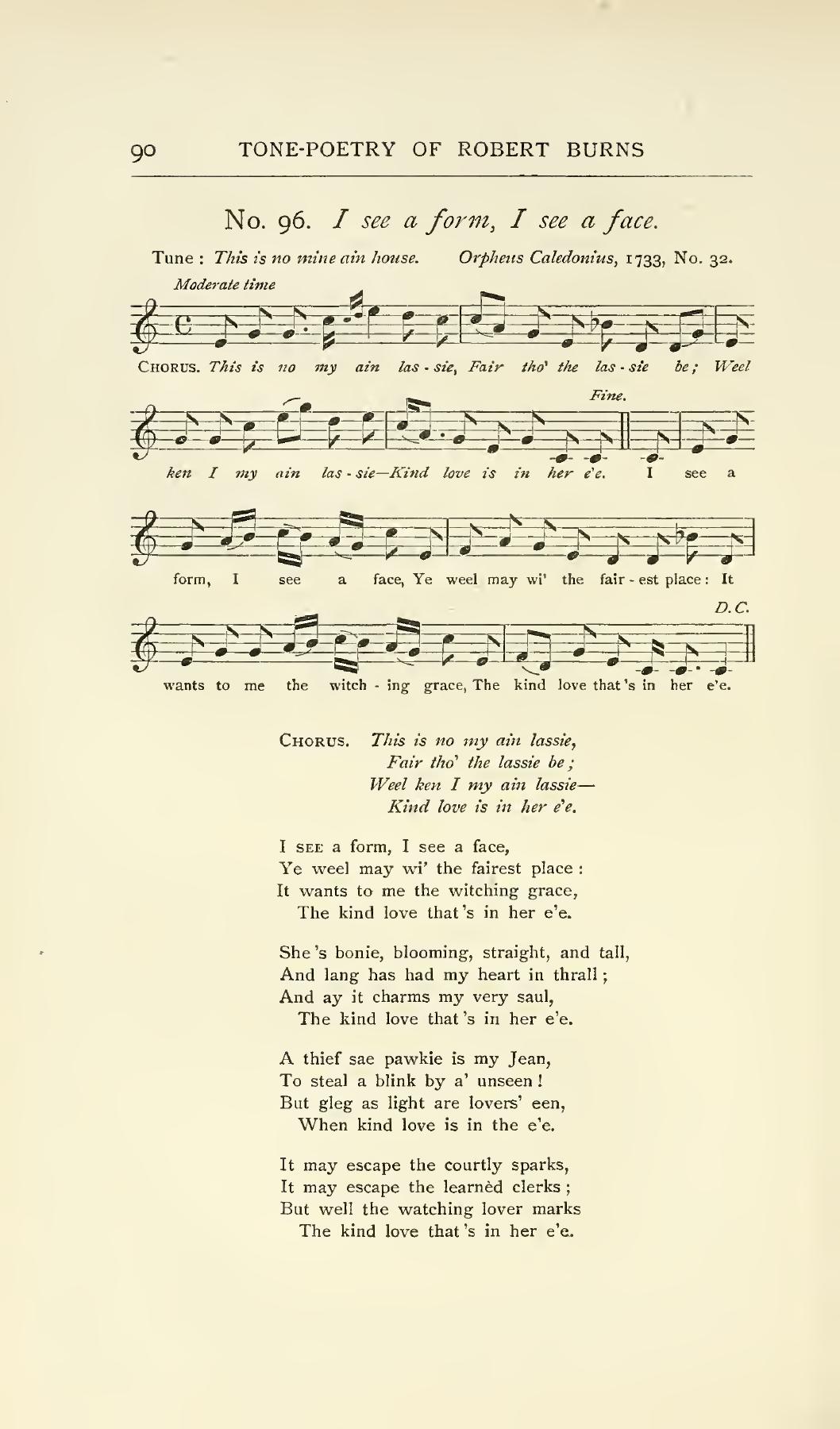 View score Dick’s Songs of Robert Burns (1903)
Lyrics
Dick (1903) · no. 96
CHORUS
This is no my ain lassie,
Fair tho' the lassie be;
Weel ken I my ain lassie—
Kind love is in her e'e.

I see a form, I see a face,
Ye weel may wi' the fairest place:
It wants to me the witching grace,
The kind love that's in her e'e.

She's bonie, blooming, straight, and tall,
And lang has had my heart in thrall;
And ay it charms my very saul,
The kind love that's in her e'e.

A thief sae pawkie is my Jean,
To steal a blink by a' unseen!
But gleg as light are lovers' een,
When kind love is in the e'e.

It may escape the courtly sparks,
It may escape the learnèd clerks;
But weel the watching lover marks
The kind love that's in her e'e.
View the source edition · Dick1903 no. 96; p. 90
About this edition
Syllables separated by the musical notation are joined into words in this reading.
Music
View historical scores
Dick’s Songs of Robert Burns (1903)
Dick1903 no. 96; p. 90