Their groves o' sweet myrtle
Behind the song
The fragrance of foreign myrtle loses its appeal when the singer thinks about a Scottish glen where Jean walks. Then he pictures a palace surrounded by servants and a Scot as free as the mountain wind. Cunningham identifies Jean as Jean Armour, Burns’s wife. [1]
Read the fuller story
The opening invites other lands to boast of their groves and perfume. The speaker’s chosen place is quieter and humbler: bracken, broom, a hidden burn and flowers growing close to the ground. Jean’s presence gives that landscape its decisive value, joining affection to the sights and sounds of home.[1]
The next stanza turns the comparison towards power. Richly scented woods near a palace become the imagined setting of tyranny and servitude, while the Caledonian moves as freely as mountain winds. These are the song’s charged opposing pictures, through which personal preference becomes a statement of independence.[1]
The closing qualification makes affection central again. Love alone can place willing fetters on the free wanderer, and those bonds belong to Jean. Cunningham prints “Humours of Glen” as the tune. His headnote’s association with Mrs Burns accompanies a lyric in which the value of home is measured through both freedom and attachment.[1]
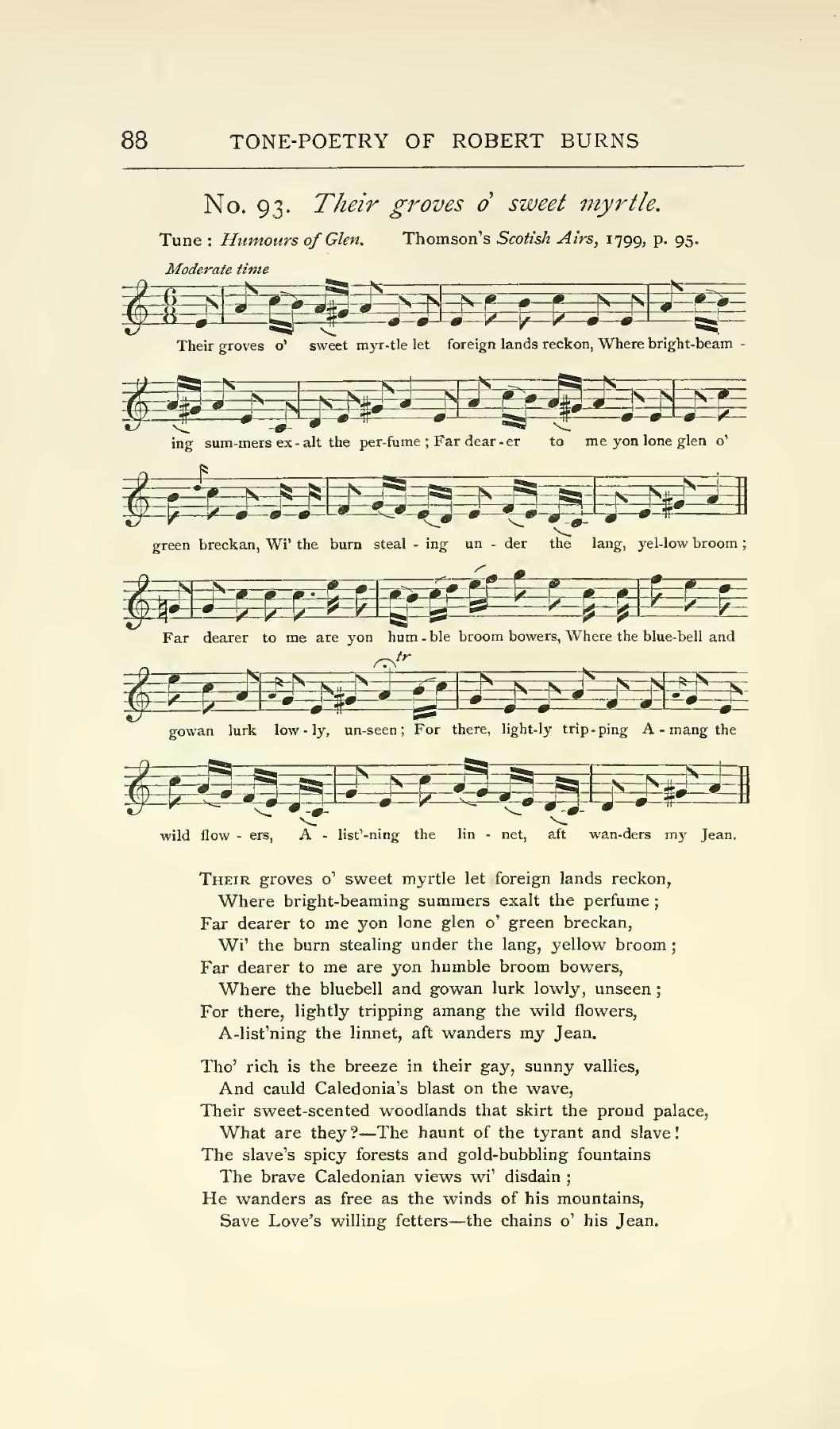 View score Dick’s Songs of Robert Burns (1903)
Lyrics
Choose an edition
Cunningham (1855)
Their groves o’ sweet myrtle let foreign lands reckon,
  Where bright-beaming summers exalt the perfume;
Far dearer to me yon lone glen o’ green brockan,
  Wi’ the burn stealing under the lang yellow broom:
Far dearer to me are yon humble broom bowers,
  Where the blue-bell and gowan lurk lowly unseen;
For there, lightly tripping amang the wild flowers,
  A listening the linnet, aft wanders my Jean.

Tho’ rich is the breeze in their gay sunny valleys,
  And cauld Caledonia’s
Their sweet-scented woodlands that skirt the proud palace,
  What are they?—The haunt of the tyrant and slave!
The slave’s spicy forests, and gold-bubbling fountains,
  The brave Caledonian views wi’ disdain;
He wanders as free as the winds of his mountains,
  Save love’s willing fetters, the chains o’ his Jean.
Digital text from Project Gutenberg.
View the source edition · p. 304
About this edition
Cunningham’s preface discusses several poems he left out of the collection.
Dick (1903) · no. 93
The words are on the score page.
View the source edition · no. 93; p. 88
Music
View historical scores
Dick’s Songs of Robert Burns (1903)
no. 93; p. 88