Can I cease to care
Behind the song
Chloris is ill. Her lover sleeps badly, wakes in dread and finally prays that he might give up anything else he has if only she is spared. Each chorus takes him back to the long night and the heavy morning. [1]
Read the fuller story
The chorus stretches distress across the daily cycle. Night drags, the next day arrives heavily, and the beloved lies on a ‘bed of sorrow’. The first verse answers that situation with questions rather than consolation. ‘Care’ means anxious concern here; to ‘languish’ is to weaken or suffer. Her physical anguish is matched by his inability to find rest.[1]
The next stanza closes down the usual refuges. Hope has fled, fear has become terror, and dreams bring horror. The final stanza turns outward in prayer. Addressing divine powers, the speaker offers anything else he possesses if Chloris can be spared. That attempted exchange gives the short song its emotional climax: love speaks through helplessness, trying to bargain when it cannot cure.[1]
James C. Dick’s note identifies the song in Currie’s Works of 1800 under the title ‘On Chloris being ill’. He also discusses Thomson’s Scotish Airs of 1801, objecting to its altered verses and a modern form of the air. His strong judgement records an editor’s preference for the text and musical character he presents here.[2]
The printed tune is ‘Ay, waukin, O’, and the setting is marked ‘Slow’. Its notation begins with the chorus, proceeds to the questioning verse and directs a return with D.C., ending at Fine. That design repeatedly brings the singer back to the long night and heavy morning. The short phrases and repeated questions give the anxiety an insistent form, while the last prayer seeks an answer the song cannot supply.[1]
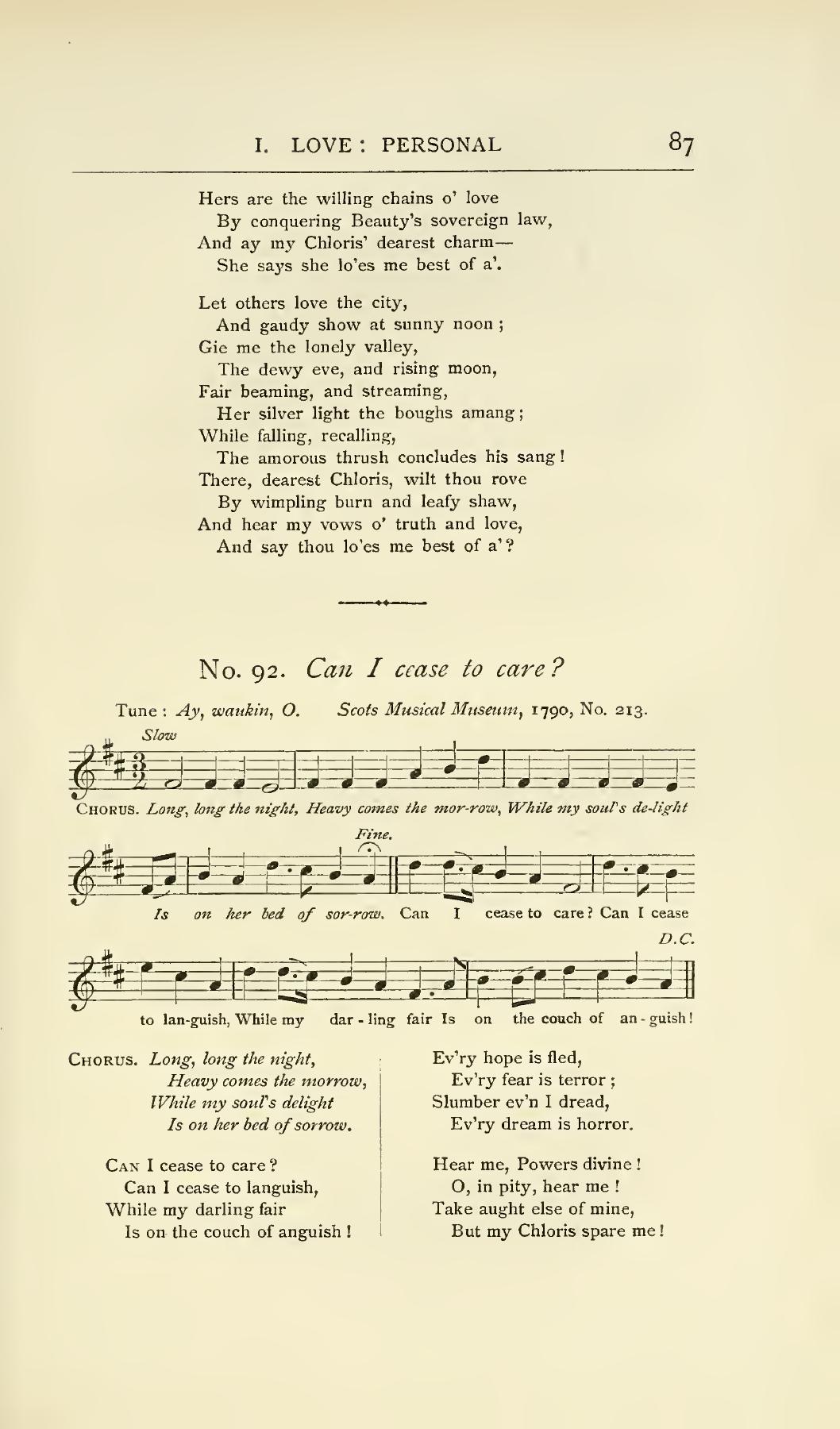 View score Dick’s Songs of Robert Burns (1903)
Lyrics
Dick (1903) · no. 92
CHORUS
Long, long the night,
Heavy comes the morrow,
While my soul's delight
Is on her bed of sorrow.

Can I cease to care?
Can I cease to languish,
While my darling fair
Is on the couch of anguish!

Ev'ry hope is fled,
Ev'ry fear is terror;
Slumber ev'n I dread,
Ev'ry dream is horror.

Hear me, Powers divine!
O, in pity, hear me!
Take aught else of mine,
But my Chloris spare me!
View the source edition · Dick1903 no. 92; p. 87
About this edition
Syllables separated by the musical notation are joined into words in this reading.
Music
View historical scores
Dick’s Songs of Robert Burns (1903)
Dick1903 no. 92; p. 87