Sleep'st Thou, or Wak'st Thou, Fairest Creature?
Behind the song
The opening question reaches towards someone who may still be asleep. Around her, morning is already active: buds glisten, birds sing and the sun rises. In this greeting, the beloved’s appearance completes the awakening world.
Read the fuller story
The first stanza moves among woods, rising vapour and singing birds before placing the woman beside the sun: both arise “to bless the day”. Its longer sweep of short lines gives the greeting room to gather motion, from the lintwhite in its bower to the lav’rock ascending into the sky.
In the second stanza, that public morning becomes an image of the lover’s private state. Absence brings care and starless gloom; the sight of the beloved restores life, light and joy. The repeated imagery makes her arrival feel like another sunrise.
Cunningham calls this a morning salutation to Chloris and reports that a letter by Burns partly suggested its occasion: a night at the punch-bowl followed by a walk past her window at dawn. His “partly intimated” leaves the connection tentative. The printed tune direction, “Deil tak the Wars”, accompanies the selected text.
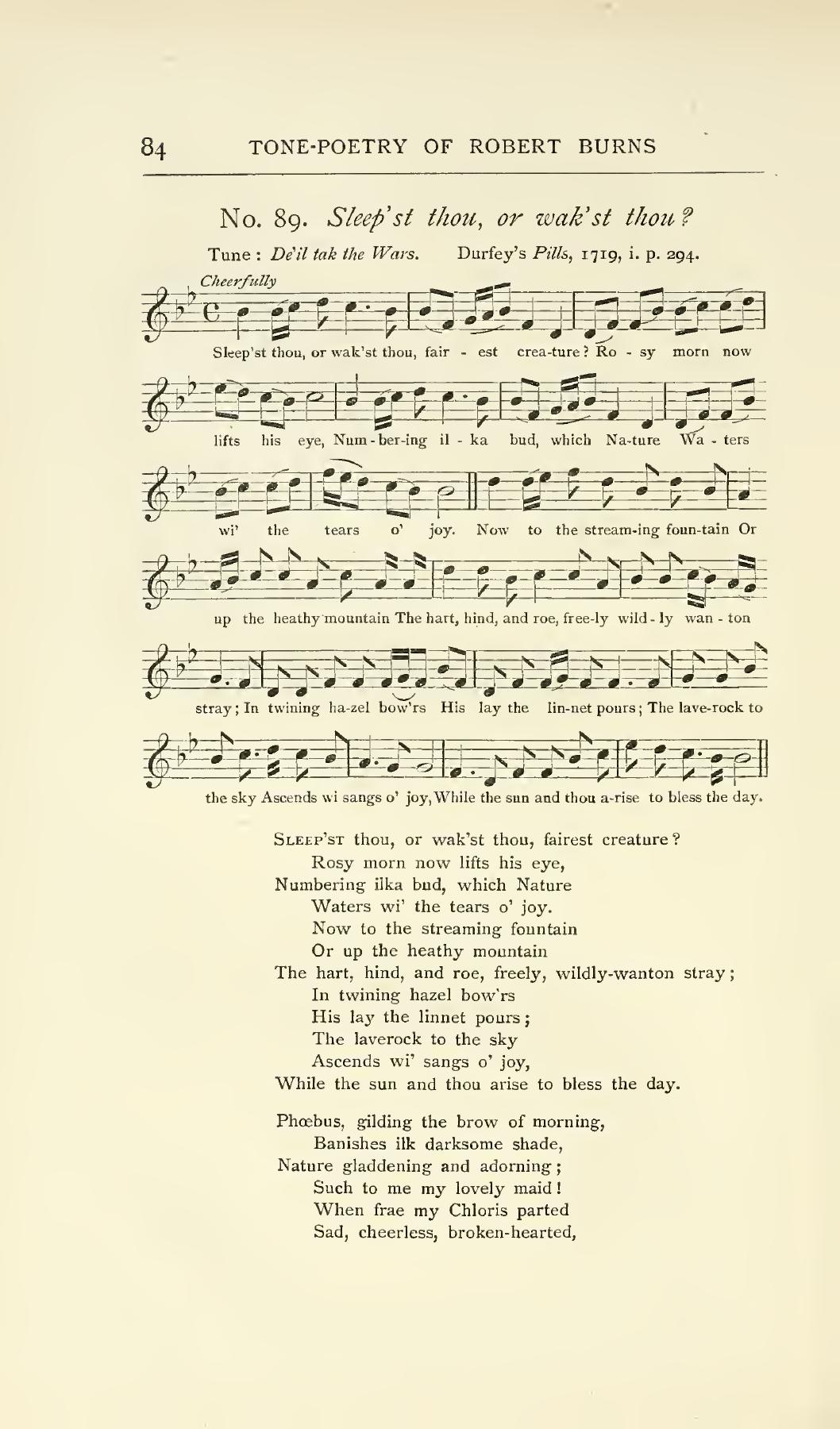 View score Dick’s Songs of Robert Burns (1903)
Lyrics
Choose an edition
Cunningham (1855)
Sleep’st thou, or wak’st thou, fairest creature?
  Rosy Morn now lifts his eye,
Numbering ilka bud which nature
  Waters wi’ the tears o’ joy:
  Now through the leafy woods,
  And by the reeking floods,
Wild nature’s tenants freely, gladly stray;
  The lintwhite in his bower
  Chants o’er the breathing flower;
  The lav’rock to the sky
  Ascends wi’ sangs o’ joy,
While the sun and thou arise to bless the day.

Phœbus gilding the brow o’ morning,
  Banishes ilk darksome shade,
Nature gladdening and adorning;
  Such to me my lovely maid.
  When absent frae my fair,
  The murky shades o’ care
With starless gloom o’ercast my sullen sky;
  But when, in beauty’s light,
  She meets my ravish’d sight,
  When thro’ my very heart
  Her beaming glories dart—
’Tis then I wake to life, to light, and joy.
Digital text from Project Gutenberg.
View the source edition · p. 295
About this edition
Cunningham’s preface discusses several poems he left out of the collection.
Dick (1903) · no. 89
The words are on the score page.
View the source edition · no. 89; pp. 84–85
Music
View historical scores
Dick’s Songs of Robert Burns (1903)
no. 89; pp. 84–85