Wilt thou be my dearie
Behind the song
First the singer asks whether he can cheer her when she is sad. Then he asks her to tell him that she loves him. The brave offer of care has become a plea: if she will never be his, he wants to die while he can still believe she loves him. [1]
Read the fuller story
Cunningham tentatively associates the verses with Janet Miller of Dalswinton; Dick states that identification directly. Dick quotes a letter to Alexander Cunningham dated 3 March 1794 in which Burns praises The sutor’s dochter and says that he has written one of his best songs for it. In that account Burns also recalls the air being sung by Major Robertson of Lude. [2][3]
Dick describes the song passing through Cunningham to Thomson and then being sent to Johnson for the Museum. He reports a manuscript instruction to use the first part of the tune and traces the designation The shoemaker’s daughter in earlier collections. His printed setting is marked Slow and headed The sutor’s dochter. The two nine-line stanzas give the melody repeated words of promise and supplication, with the emotional balance changing sharply between them. [3][1]
Story references
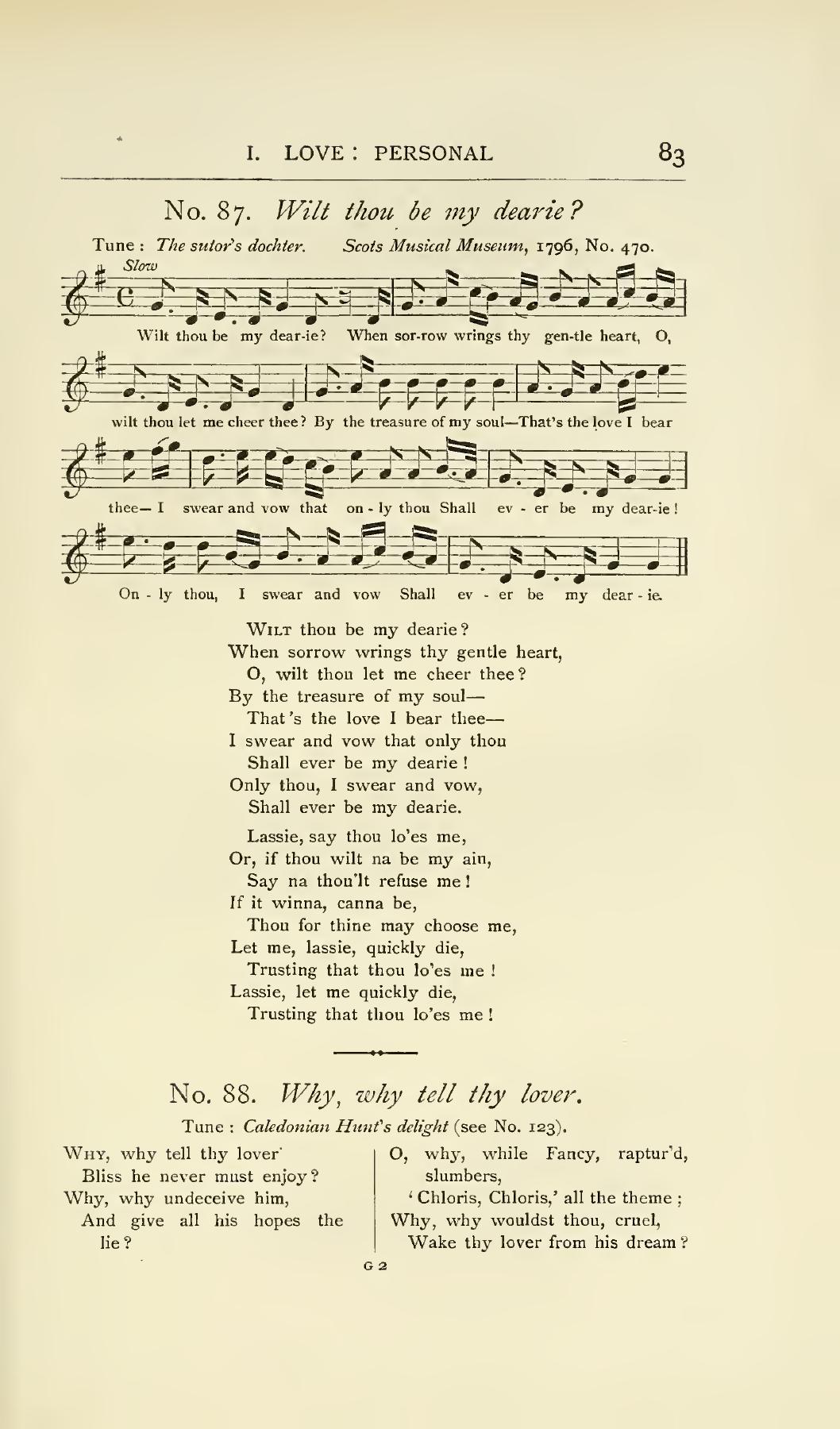 View score Dick’s Songs of Robert Burns (1903)
Lyrics
Choose an edition
Version notes
| Dick (1903) · no. 87 | Cunningham · 1855Ebook transcription |
|---|---|
| O, wilt thou let me cheer thee? | Wilt thou let me cheer thee? |
| wilt na | wilt no |
| soul— / thee— / dearie! | soul, / thee! / dearie. |
| Say na thou’lt refuse me! | Say na thou’lt refuse me: |
More differences between these editions
| Dick (1903) · no. 87 | Cunningham · 1855Ebook transcription |
|---|---|
| Lassie, say thou lo’es me, | Lassie, say thou lo’es me; |
Dick (1903) · no. 87
Wilt thou be my dearie?
When sorrow wrings thy gentle heart,
O, wilt thou let me cheer thee?
By the treasure of my soul—
That's the love I bear thee—
I swear and vow that only thou
Shall ever be my dearie!
Only thou, I swear and vow,
Shall ever be my dearie.

Lassie, say thou lo'es me,
Or, if thou wilt na be my ain,
Say na thou'lt refuse me!
If it winna, canna be,
Thou for thine may choose me,
Let me, lassie, quickly die,
Trusting that thou lo'es me!
Lassie, let me quickly die,
Trusting that thou lo'es me!
View the source edition · no. 87; p. 83
About this edition
Both readings have two nine-line stanzas. Dick includes O, before wilt thou let me cheer thee, reads wilt na against Cunningham’s wilt no, and sets the treasure-of-my-soul statement between dashes. Cunningham uses different stops at several appeals, including a colon after refuse me; Dick has an exclamation mark.
Cunningham (1855)
Wilt thou be my dearie?
When sorrow wrings thy gentle heart,
Wilt thou let me cheer thee?
By the treasure of my soul,
That’s the love I bear thee!
I swear and vow that only thou
Shall ever be my dearie.
Only thou, I swear and vow,
Shall ever be my dearie.

Lassie, say thou lo’es me;
Or if thou wilt no be my ain,
Say na thou’lt refuse me:
If it winna, canna be,
Thou, for thine may choose me,
Let me, lassie, quickly die,
Trusting that thou lo’es me.
Lassie, let me quickly die,
Trusting that thou lo’es me.
Digital text from Project Gutenberg.
View the source edition · p. 289
About this edition
Both readings have two nine-line stanzas. Dick includes O, before wilt thou let me cheer thee, reads wilt na against Cunningham’s wilt no, and sets the treasure-of-my-soul statement between dashes. Cunningham uses different stops at several appeals, including a colon after refuse me; Dick has an exclamation mark.
Scots Musical Museum, vol. V (catalogued 1796) · no. 470
View the source edition · Volume 5, no. 470; p. 484
Music
View historical scores
Dick’s Songs of Robert Burns (1903)
no. 87; p. 83