Sensibility how charming
Behind the song
A lily flattened by the wind and a woodlark exposed to birds of prey give “On Sensibility” its images of vulnerable beauty. Its opening addresses a friend who knows both the charm of sensibility and the horrors of distress. The power to feel deeply carries its own cost.
Read the fuller story
The four short stanzas move from a personal address through two natural examples to a musical image. The lily blooms in sunlight until a blast lays it on the ground; the woodlark’s small joys leave it open to the “pirate of the skies”. Each image joins something precious with the forces that can destroy it.
The closing stanza gathers those examples into the image of vibrating chords. The same strings that yield the sweetest pleasure can sound the deepest sorrow. Sympathy becomes a capacity shared by pleasure and pain, with the friend addressed in the opening serving as its experienced witness.
Cunningham heads the poem as an address to Mrs Dunlop and says, with the qualification “it is said”, that a communication from her occasioned it. He also reports a Museum alteration introducing “Dearest Nancy” and judges that change to have weakened the personal sympathy. His account preserves a tension between a poem addressed to a particular friend and words capable of finding another addressee.
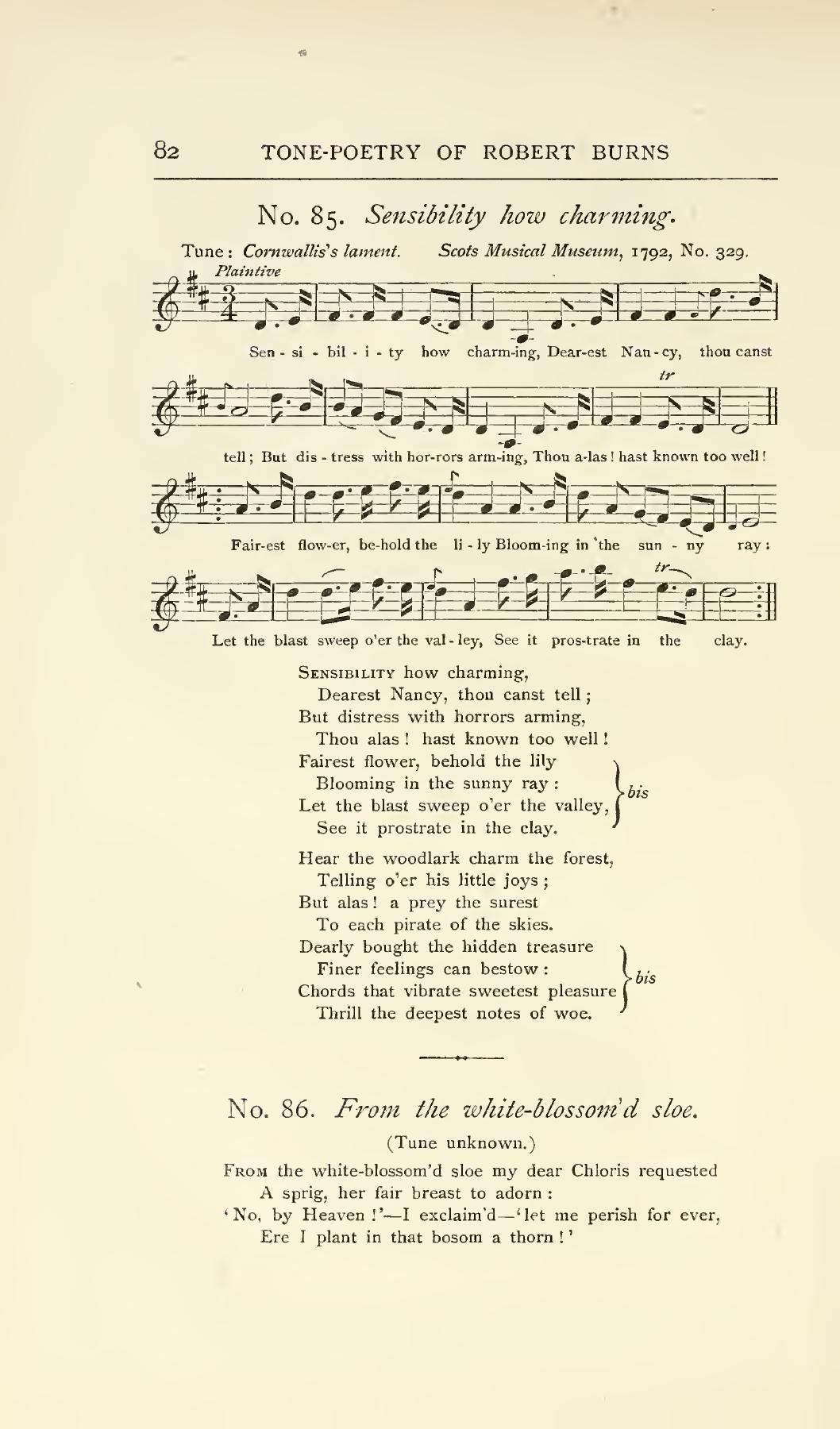 View score Dick’s Songs of Robert Burns (1903)
Lyrics
Choose an edition
Cunningham (1855)
Sensibility how charming,
  Thou, my friend, canst truly tell:
But distress with horrors arming,
  Thou host also known too well.

Fairest flower, behold the lily,
  Blooming in the sunny ray:
Let the blast sweep o’er the valley,
  See it prostrate on the clay.

Hear the woodlark charm the forest,
  Telling o’er his little joys:
Hapless bird! a prey the surest,
  To each pirate of the skies.

Dearly bought, the hidden treasure,
  Finer feeling can bestow;
Chords that vibrate sweetest pleasure,
  Thrill the deepest notes of woe.
Digital text from Project Gutenberg.
View the source edition · p. 188
About this edition
Cunningham’s preface discusses several poems he left out of the collection.
Dick (1903) · no. 85
The words are on the score page.
View the source edition · no. 85; p. 82
Scots Musical Museum, vol. IV (1792) · no. 329
View the source edition · Volume 4, no. 329; p. 339
Music
View historical scores
Dick’s Songs of Robert Burns (1903)
no. 85; p. 82