Ae Fond Kiss, and Then We Sever
Behind the song
In late 1791, Agnes McLehose was preparing to sail to the West Indies to rejoin her husband. She and Burns wrote to each other as “Clarinda” and “Sylvander”. James C. Dick and Allan Cunningham both connect “Ae Fond Kiss” with their parting. [2][3]
The singer calls her “Nancy”. In “Had we never lov’d sae kindly”, he imagines how they might have escaped their grief. Then he wishes her joy, peace and pleasure and takes leave of her once more. [1]
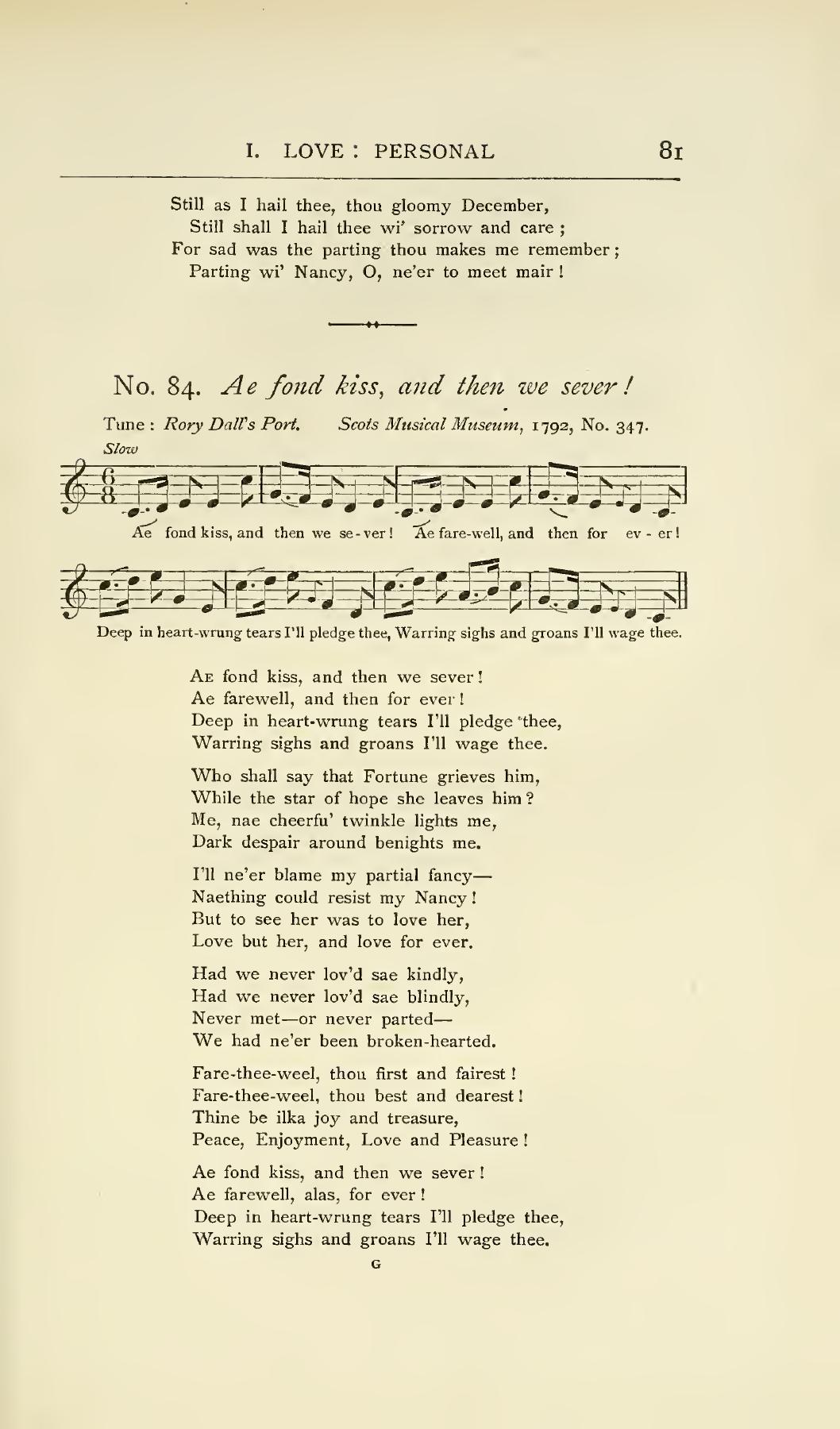
The song appeared in the Scots Musical Museum in 1792. Dick prints the tune, “Rory Dall’s Port”, with the first four lines under the melody. [1][2]
Read the fuller story
Dick dates the beginning of the correspondence to December 1787 and describes a rapid exchange of letters after their first meeting. [2]
In his note on “Ae Fond Kiss”, Dick quotes Burns writing that he had been composing songs to different tunes for James Johnson’s collection. Agnes already had three volumes, and Burns promised her the fourth. It included “Ae Fond Kiss” as song number 347. [2]
Dick marks “Rory Dall’s Port” “Slow” and prints it in 6/8. His historical note traces an air of that name to the Caledonian Pocket Companion, around 1756. The score shown here is his 1903 printing. Cunningham names the tune above the words. [1][2][3]
The two editions keep the same twenty-four lines in the same order. Dick arranges them in six four-line verses and Cunningham in three eight-line stanzas. Cunningham’s first stanza has “Ae fareweel”, where Dick has “Ae farewell”. Capitals, hyphens and punctuation also vary. [1][3]
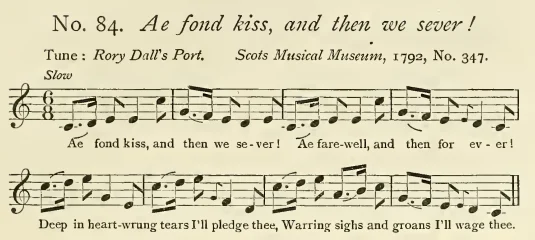 View score Dick’s Songs of Robert Burns (1903)
Lyrics
Choose an edition
Version notes
Dick prints six quatrains. The Cunningham transcription groups them into three stanzas. Dick has “farewell” in both the opening and closing verses. The Cunningham transcription opens with “fareweel” and closes with “farewell”. Dick (1903) · no. 84 · Cunningham · 1855
| Dick (1903) · no. 84 | Cunningham · 1855Ebook transcription |
|---|---|
| six quatrains | three eight-line stanzas |
| Ae fond kiss, and then we sever! | Ae fond kiss, and then we sever; |
| Ae farewell, and then for ever! | Ae fareweel, and then for ever! |
| Who shall say that Fortune grieves him, | Who shall say that fortune grieves him |
More differences between these editions
| Dick (1903) · no. 84 | Cunningham · 1855Ebook transcription |
|---|---|
| Me, nae cheerfu’ twinkle lights me, | Me, nae cheerfu’ twinkle lights me; |
| I’ll ne’er blame my partial fancy— | I’ll ne’er blame my partial fancy, |
| Naething could resist my Nancy! | Naething could resist my Nancy; |
| But to see her was to love her, | But to see her, was to love her; |
| Love but her, and love for ever. | Love but her, and love for ever.— |
| Never met—or never parted— | Never met—or never parted, |
| We had ne’er been broken-hearted. | We had ne’er been broken hearted. |
| Fare-thee-weel, thou first and fairest! | Fare thee weel, thou first and fairest! |
| Fare-thee-weel, thou best and dearest! | Fare thee weel, thou best and dearest! |
| Peace, Enjoyment, Love and Pleasure! | Peace, enjoyment, love, and pleasure! |
| Ae farewell, alas, for ever! | Ae farewell, alas! for ever! |
| Warring sighs and groans I’ll wage thee. | Warring sighs and groans I’ll wage thee! |
Dick (1903) · no. 84
Ae fond kiss, and then we sever!
Ae farewell, and then for ever!
Deep in heart-wrung tears I’ll pledge thee,
Warring sighs and groans I’ll wage thee.

Who shall say that Fortune grieves him,
While the star of hope she leaves him?
Me, nae cheerfu’ twinkle lights me,
Dark despair around benights me.

I’ll ne’er blame my partial fancy—
Naething could resist my Nancy!
But to see her was to love her,
Love but her, and love for ever.

Had we never lov’d sae kindly,
Had we never lov’d sae blindly,
Never met—or never parted—
We had ne’er been broken-hearted.

Fare-thee-weel, thou first and fairest!
Fare-thee-weel, thou best and dearest!
Thine be ilka joy and treasure,
Peace, Enjoyment, Love and Pleasure!

Ae fond kiss, and then we sever!
Ae farewell, alas, for ever!
Deep in heart-wrung tears I’ll pledge thee,
Warring sighs and groans I’ll wage thee.
Complete lyric checked against Dick’s printed p. 81. Original spelling, punctuation and stanza grouping retained; apostrophe shapes and spacing normalised.
View the source edition · no. 84; p. 81
About this edition
The reading follows the separate lyric beneath the notation. Dick prints six quatrains and uses “farewell” in both the opening and closing verses. His “Fare-thee-weel” is hyphenated; “Fortune”, “Enjoyment”, “Love” and “Pleasure” carry capitals. The lines above the no. 84 heading belong to the preceding song.
Cunningham (1855)
Ae fond kiss, and then we sever;
Ae fareweel, and then for ever!
Deep in heart-wrung tears I’ll pledge thee,
Warring sighs and groans I’ll wage thee.
Who shall say that fortune grieves him
While the star of hope she leaves him?
Me, nae cheerfu’ twinkle lights me;
Dark despair around benights me.

I’ll ne’er blame my partial fancy,
Naething could resist my Nancy;
But to see her, was to love her;
Love but her, and love for ever.—
Had we never lov’d sae kindly,
Had we never lov’d sae blindly,
Never met—or never parted,
We had ne’er been broken hearted.

Fare thee weel, thou first and fairest!
Fare thee weel, thou best and dearest!
Thine be ilka joy and treasure,
Peace, enjoyment, love, and pleasure!
Ae fond kiss, and then we sever;
Ae farewell, alas! for ever!
Deep in heart-wrung tears I’ll pledge thee,
Warring sighs and groans I’ll wage thee!
Digital text from Project Gutenberg.
View the source edition · p. 251
About this edition
Cunningham groups each pair of Dick’s quatrains into one stanza. The first farewell is “fareweel”, while the closing verse has “farewell”. He prints “broken hearted” as two words and “Fare thee weel” without hyphens. The reading retains the ebook’s spelling and punctuation.
Scots Musical Museum, vol. IV (1792) · no. 347
View the source edition · Volume 4, no. 347; p. 358
Music
View historical scores
Dick’s Songs of Robert Burns (1903)
no. 84; p. 81