O May, thy morn was ne'er sae sweet
Behind the song
The singer remembers a December night with wine, a room to themselves and a woman he keeps unnamed. He turns the memory into a toast. Cunningham passes on a tradition associating the song with Clarinda, Burns’s name for Agnes McLehose. [1]
Read the fuller story
Two stanzas circle back to the people who remain unnamed. The first promises lasting remembrance of the woman; the second drinks to companions, well-wishers and those whose names must stay private. The repeated endings make discretion part of the song’s convivial pleasure.[1]
Cunningham says that lyrical tradition assigns its inspiration to Clarinda and notes its omission from Chambers’s People’s Edition. He presents the identification as a received story, while the lyric itself keeps its beloved unnamed.[1]
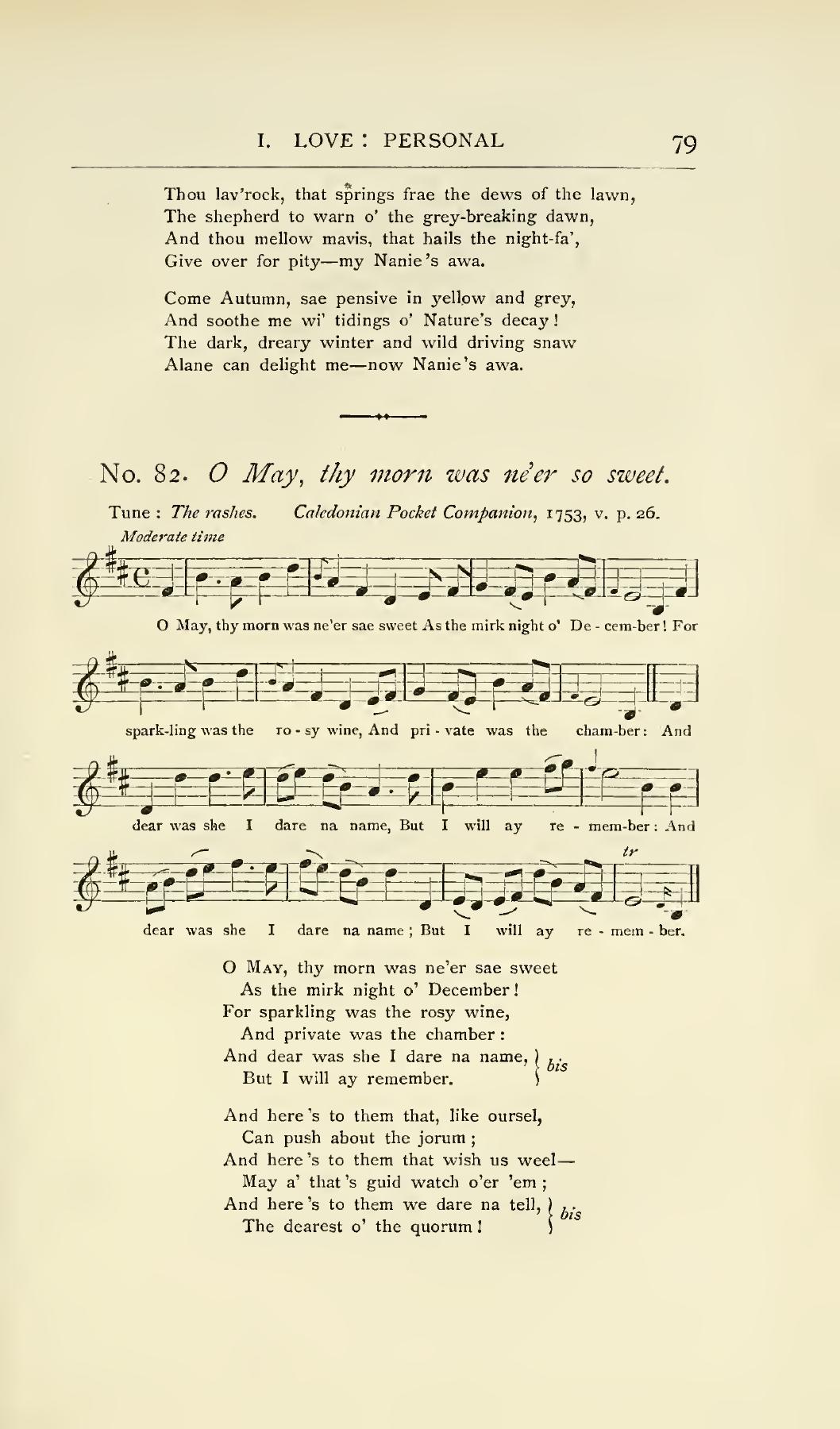 View score Dick’s Songs of Robert Burns (1903)
Lyrics
Choose an edition
Cunningham (1855)
O May, thy morn was ne’er sae sweet
  As the mirk night o’ December;
For sparkling was the rosy wine,
  And private was the chamber:
And dear was she I dare na name,
  But I will ay remember.
And dear was she I dare na name,
  But I will ay remember.

And here’s to them, that, like oursel,
  Can push about the jorum;
And here’s to them that wish us weel,
  May a’ that’s guid watch o’er them,
And here’s to them we dare na tell,
  The dearest o’ the quorum.
Ami here’s to them we dare na tell,
  The dearest o’ the quorum!
Digital text from Project Gutenberg.
View the source edition · p. 269
About this edition
Cunningham’s preface discusses several poems he left out of the collection.
Dick (1903) · no. 82
The words are on the score page.
View the source edition · no. 82; p. 79
Scots Musical Museum, vol. V (catalogued 1796) · no. 464
View the source edition · Volume 5, no. 464; p. 477
Music
View historical scores
Dick’s Songs of Robert Burns (1903)
no. 82; p. 79