Clarinda, mistress of my soul
Behind the song
Burns writes as Sylvander to Clarinda, the name Agnes McLehose used in their correspondence. The time they have together is up and his first question is where he can go when his sun has gone. By the final stanza he takes his vow from the same image: how could a glimmering planet command the devotion he gave to the sun? [1]
Read the fuller story
Dick dates the verses to early 1788 and places them in the Clarinda series. Cunningham introduces the recipient as the woman addressed in Burns’s Clarinda correspondence. The two editions preserve the same sixteen-line sequence, headed To Clarinda by Cunningham and Clarinda, mistress of my soul by Dick. [2][3][1]
Dick attributes the Museum melody to Schetky, citing Burns’s comment in the Interleaved Museum. He also reports that Thomson later printed altered lines with an original melody by Stephen Clarke. The music printed here carries the tune name Clarinda and the direction Slow. [2][1]
Story references
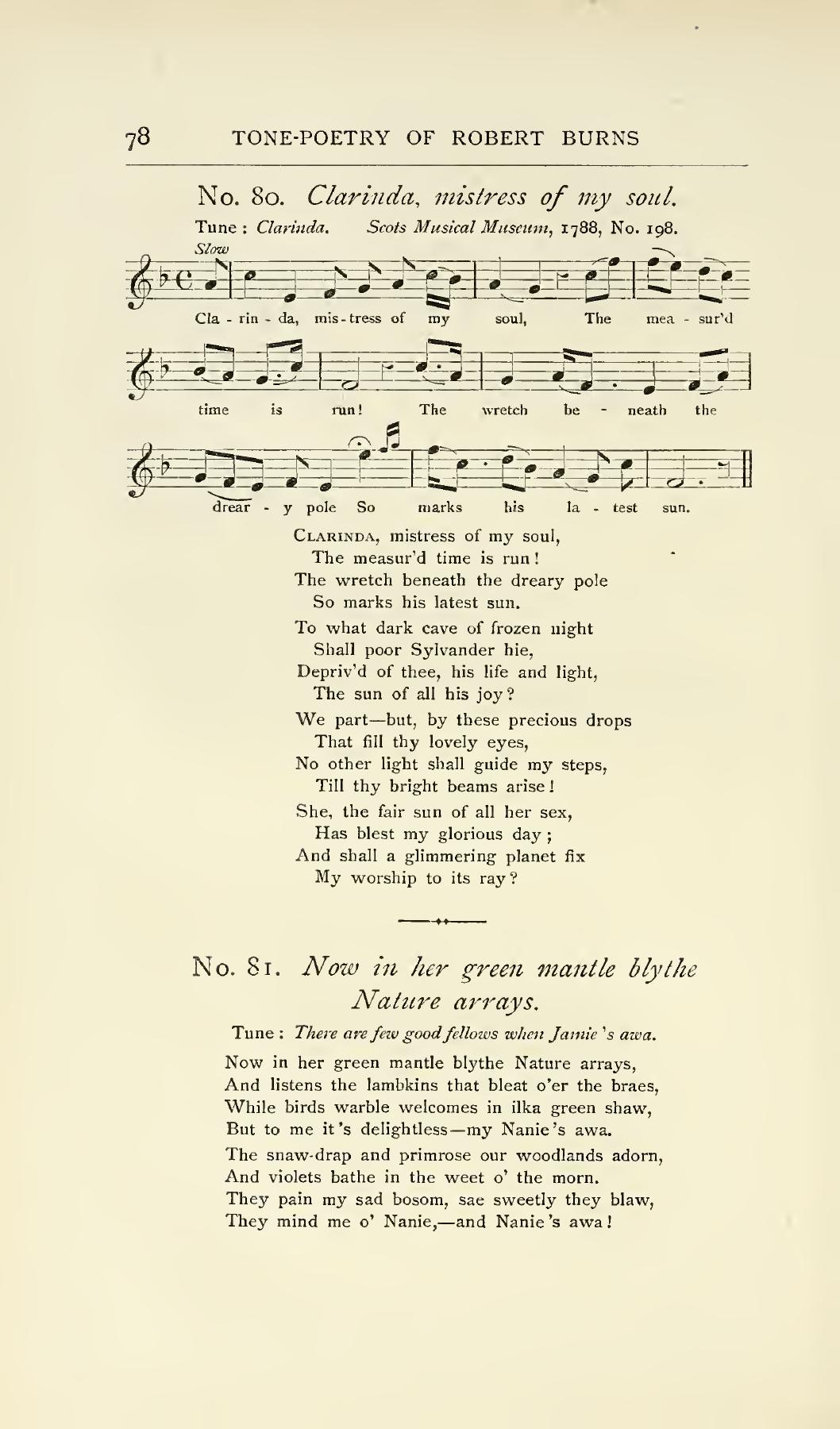 View score Dick’s Songs of Robert Burns (1903)
Lyrics
Choose an edition
Version notes
| Dick (1903) · no. 80 | Cunningham · 1855Ebook transcription |
|---|---|
| hie, / joy? | hie; / joy. |
Dick (1903) · no. 80
Clarinda, mistress of my soul,
The measur'd time is run!
The wretch beneath the dreary pole
So marks his latest sun.

To what dark cave of frozen night
Shall poor Sylvander hie,
Depriv'd of thee, his life and light,
The sun of all his joy?

We part—but, by these precious drops
That fill thy lovely eyes,
No other light shall guide my steps,
Till thy bright beams arise!

She, the fair sun of all her sex,
Has blest my glorious day;
And shall a glimmering planet fix
My worship to its ray?
View the source edition · no. 80; p. 78
About this edition
Both editions print the same sixteen lines as four quatrains. Dick ends joy with a question mark, eyes with a comma and arise with an exclamation mark; Cunningham has a full stop, an exclamation mark and a full stop respectively. Dick also places a comma after steps.
Cunningham (1855)
Clarinda, mistress of my soul,
  The measur’d time is run!
The wretch beneath the dreary pole
  So marks his latest sun.

To what dark cave of frozen night
  Shall poor Sylvander hie;
Depriv’d of thee, his life and light,
  The sun of all his joy.

We part—but, by these precious drops
  That fill thy lovely eyes!
No other light shall guide my steps
  Till thy bright beams arise.

She, the fair sun of all her sex,
  Has blest my glorious day;
And shall a glimmering planet fix
  My worship to its ray?
Digital text from Project Gutenberg.
View the source edition · p. 144
About this edition
Both editions print the same sixteen lines as four quatrains. Dick ends joy with a question mark, eyes with a comma and arise with an exclamation mark; Cunningham has a full stop, an exclamation mark and a full stop respectively. Dick also places a comma after steps.
Scots Musical Museum, vol. II (1788) · no. 198
View the source edition · Volume 2, no. 198; p. 206
Music
View historical scores
Dick’s Songs of Robert Burns (1903)
no. 80; p. 78