Your friendship much can make me blest
Behind the song
“Your friendship much can make me blest” is both a reassurance and a firm answer. The speaker wants to keep the friend, who risks losing that happiness by asking for love. [1]
Read the fuller story
The opening is generous before it becomes defensive. Friendship can make the speaker blessed; the difficulty lies in the other person’s insistence on asking for more. The questions turn that insistence back upon its source. If the friend knows what the answer must be, why make the request? The lyric gives refusal an emotional cost without making it uncertain.[1]
The second half moves from spoken demands to private thought. If love must remain in the friend’s mind, the speaker asks that it stay concealed there. The final image is painful: preserving the boundary may require tearing from the heart the very friend who was sought. The eight lines have no answering voice or resolution. Their force comes from holding warmth and refusal within the same address.[1]
James C. Dick identifies these lines as Burns’s addition to verses written by Mrs M’Lehose, his correspondent Clarinda. He says that she wrote twelve lines, four of which were omitted in the Scots Musical Museum, and that Burns supplied the eight printed here. Dick describes their appearance as the second stanza of “Talk not of love, it gives me pain”, published in the Museum in 1788. This selected entry is therefore Burns’s contribution to a shared song, with the other writer’s preceding stanza outside its scope.[2]
The setting is headed “Banks of Spey” and marked “Very slow”. Dick traces the air to McGibbon’s Scots Tunes and distinguishes another melody of the same name in McGlashan’s Reels. The restrained pace suits a speaker asking to preserve a valued attachment while setting its terms. Knowing the contribution history also changes how the eight lines are heard: Burns is writing within a song whose starting point belonged to Mrs M’Lehose.[1][2]
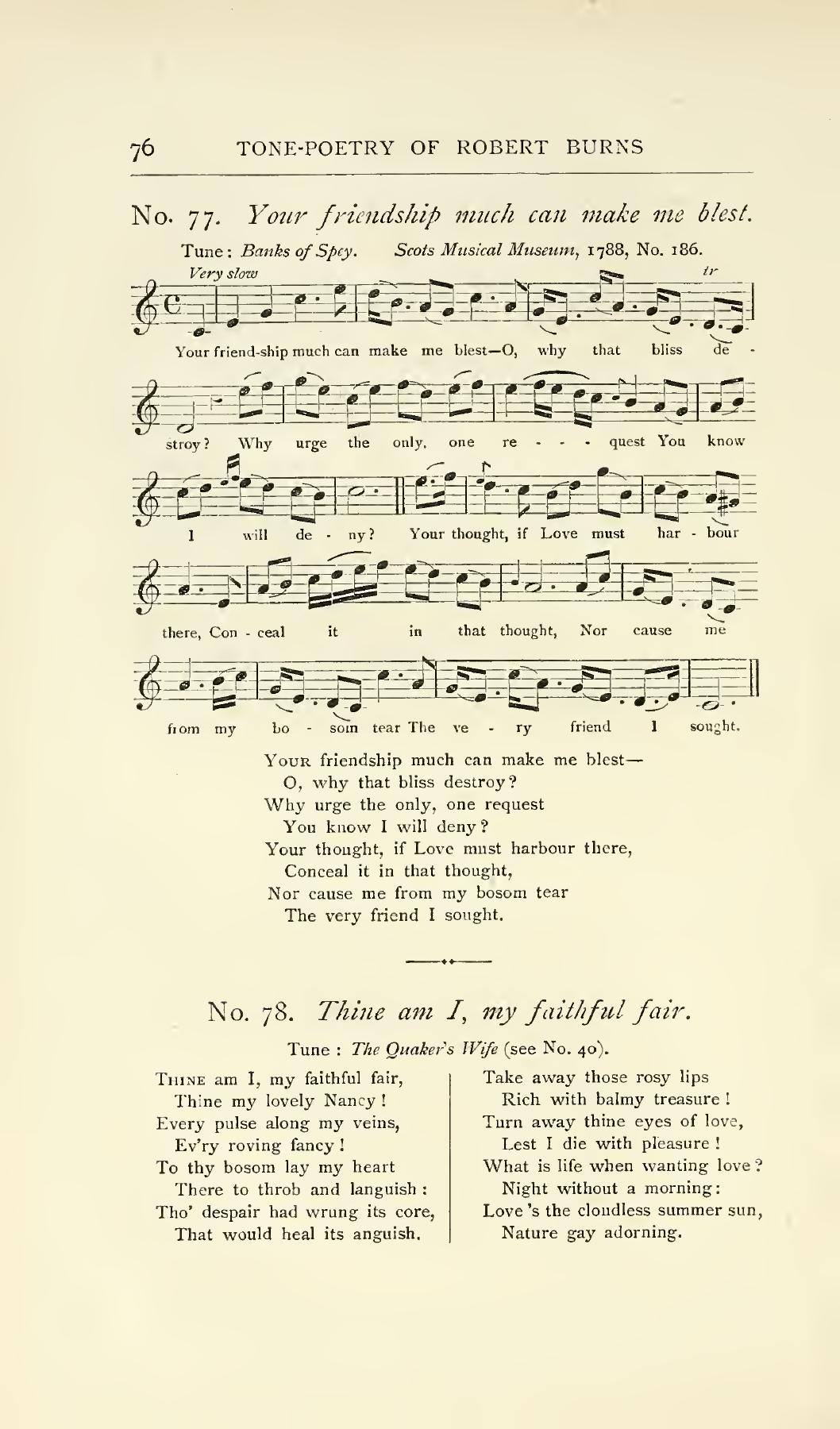 View score Dick’s Songs of Robert Burns (1903)
Lyrics
Dick (1903) · no. 77
Your friendship much can make me blest—
O, why that bliss destroy?
Why urge the only, one request
You know I will deny?
Your thought, if Love must harbour there,
Conceal it in that thought,
Nor cause me from my bosom tear
The very friend I sought.
Eight-line contribution printed in Dick’s 1903 edition.
View the source edition · Dick1903 no. 77; p. 76
About this edition
Syllables separated by the musical notation are joined into words in this reading.
Music
View historical scores
Dick’s Songs of Robert Burns (1903)
Dick1903 no. 77; p. 76