Out over the Forth, I look to the north
Behind the song
The singer looks north across the Forth, then turns through the other points of the compass. Only the west offers comfort: the man she loves lives there, dear to both her and her baby.[1]
Read the fuller story
The first four lines make distance restless. Highlands, foreign country and the sea all fail to ease her mind. The second verse gives the song its direction. Before sleeping she looks west, hoping the thought of her absent lover will bring happy dreams.[1]
Cunningham’s headnote says Burns quoted the last four lines in a letter dated 11 March 1791 and asked Cunningham how he liked them.[1]
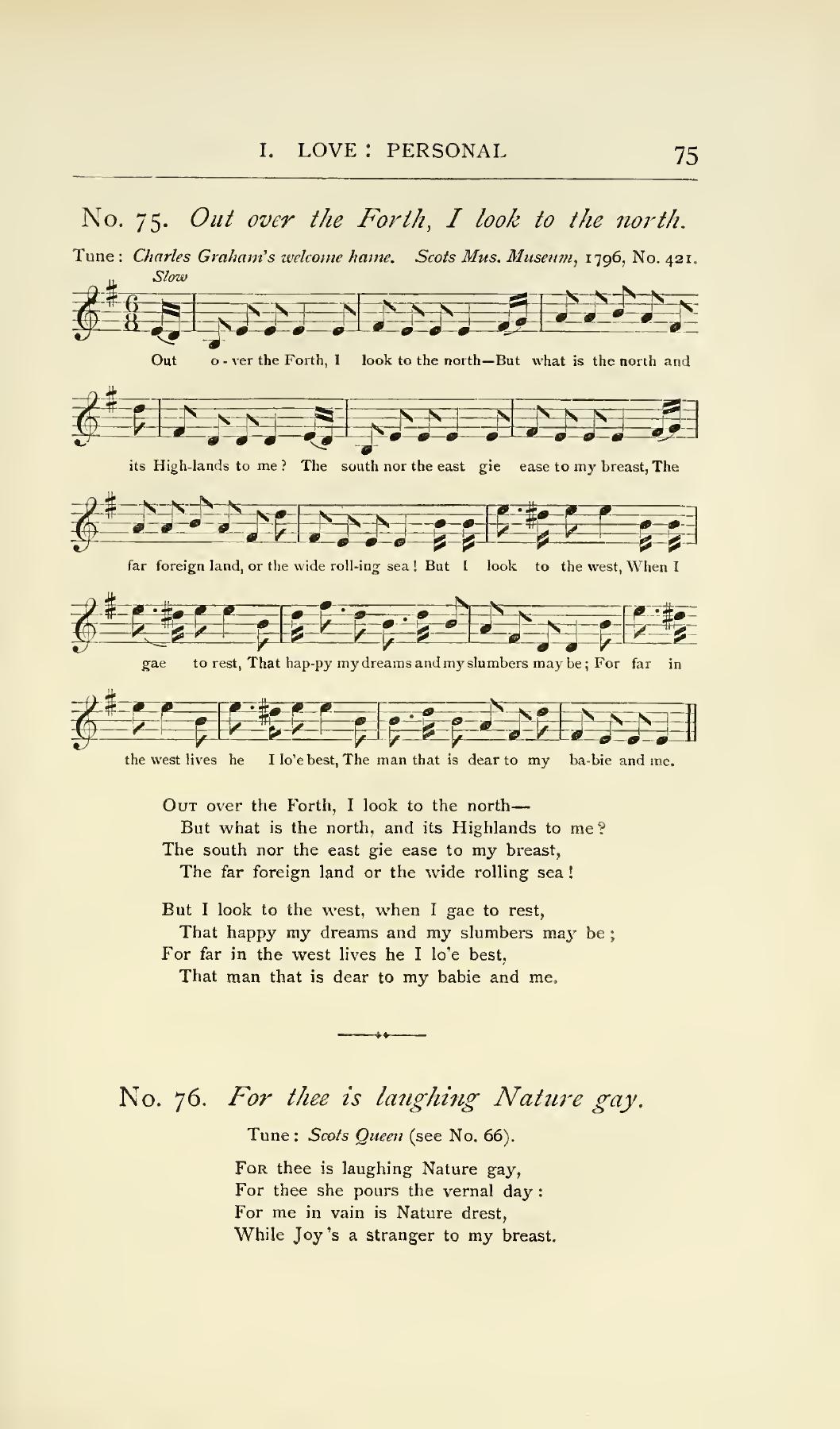 View score Dick’s Songs of Robert Burns (1903)
Lyrics
Choose an edition
Cunningham (1855)
Out over the Forth I look to the north,
  But what is the north and its Highlands to me?
The south nor the east gie ease to my breast,
  The far foreign land, or the wild rolling sea.

But I look to the west, when I gae to rest,
  That happy my dreams and my slumbers may be;
For far in the west lives he I Io’e best,
  The lad that is dear to my babie and me.
Digital text from Project Gutenberg.
View the source edition · p. 265
About this edition
Cunningham’s preface discusses several poems he left out of the collection.
Dick (1903) · no. 75
The words are on the score page.
View the source edition · no. 75; p. 75
Scots Musical Museum, vol. V (catalogued 1796) · no. 421
View the source edition · Volume 5, no. 421; p. 434
Music
View historical scores
Dick’s Songs of Robert Burns (1903)
no. 75; p. 75
Quoted in a letter by Burns
Cunningham reports Burns quoting the final four lines in a letter of11March1791.
Words Author uncertain
Burns’s role Quoted in a letter by Burns