O, were I on Parnassus' hill
Behind the song
The singer asks for the inspiration of Parnassus and Helicon, places sacred to the Muses of Greek mythology, then looks towards Corsincon and finds his Muse beside the Nith. Dick quotes a note in which Burns says he wrote the song for his wife, Jean Armour. He also quotes Burns praising her singing as the finest “woodnote wild” he had heard. [1][2]
Read the fuller story
Dick quotes a note attributed to Burns in the Interleaved Museum: he made the song as a compliment to Mrs Burns and identified the air as Oswald's. Cunningham similarly presents it as a welcome to the poet's wife in Nithsdale. The domestic reading therefore has a history in the editorial sources as well as in the poem's affectionate address. [2][3]
Dick sets the song beside Burns's letter to Peggy Chalmers of 16 September 1788. In the extract, Burns describes Jean's reading of the Bible, psalms, his own poems and local ballads, and praises her singing as the finest “woodnote wild” he had heard. That detail gives the compliment a musical setting in their married life: the woman praised could also be a singer of songs. [2]
Both editions name My love is lost to me as the tune. Dick's last line is “Till then—and then—I'd love thee!”, while Cunningham has “Till then—and then I love thee.” The small verbal difference changes the turn of the closing promise; both end with affection carried to the edge of mortality. [1][3]
Story references
- James C. Dick, The Songs of Robert Burns (1903), No. 74; printed pp. 74–74; PDF pp. 130–130
- James C. Dick, The Songs of Robert Burns (1903), Dick historical note 74; printed 377; PDF 433
- Allan Cunningham, The Complete Works of Robert Burns (1855), printed 236; HTML #songsLXXVII. Project Gutenberg transcription.
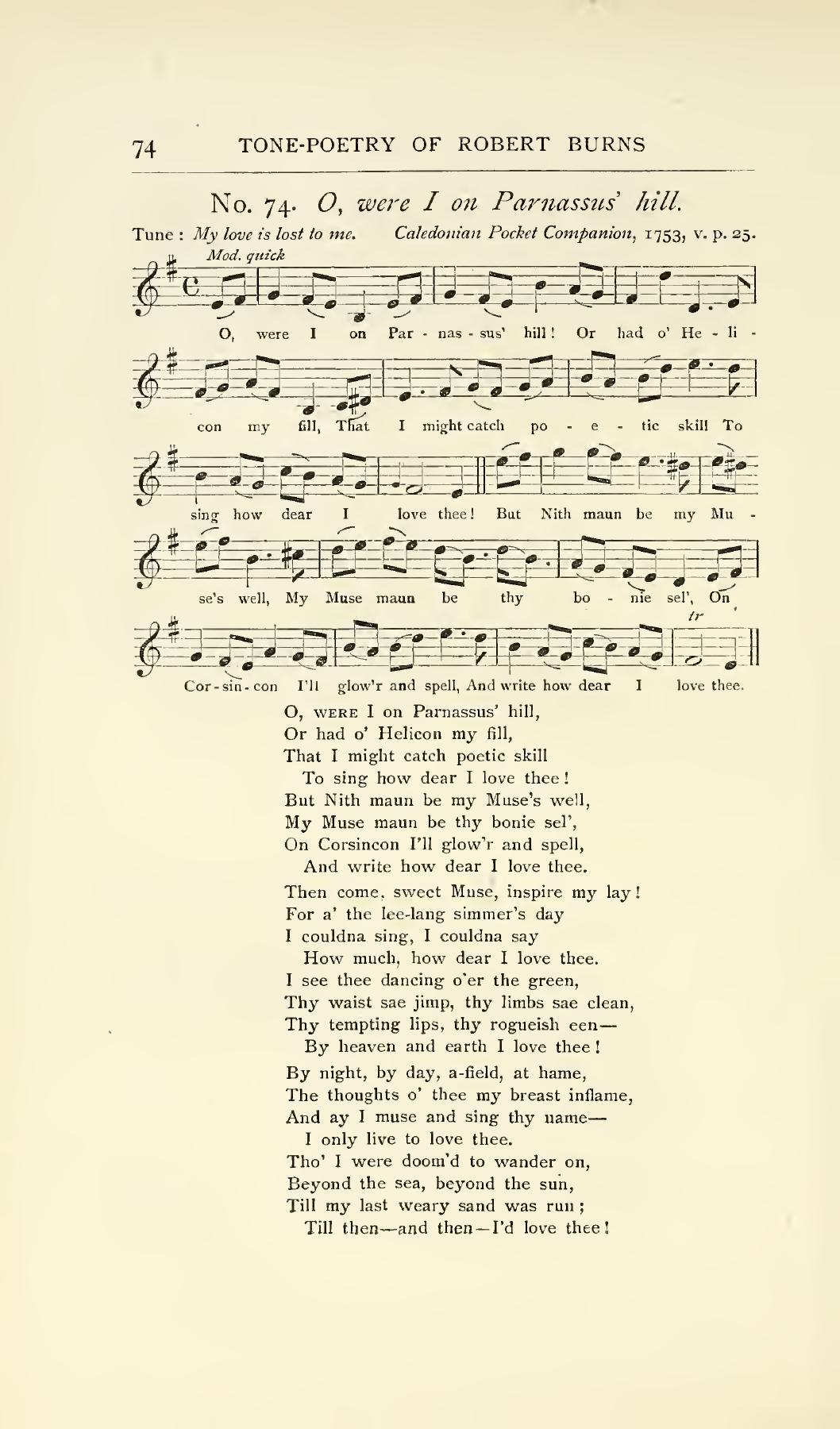 View score Dick’s Songs of Robert Burns (1903)
Lyrics
Choose an edition
Version notes
| Dick (1903) · no. 74 | Cunningham · 1855Ebook transcription |
|---|---|
| Till then—and then—I’d love thee! | Till then—and then I love thee. |
| couldna | coudna |
Dick (1903) · no. 74
O, were I on Parnassus' hill,
Or had o' Helicon my fill,
That I might catch poetic skill
To sing how dear I love thee!
But Nith maun be my Muse's well,
My Muse maun be thy bonie sel',
On Corsincon I'll glow'r and spell,
And write how dear I love thee.

Then come, sweet Muse, inspire my lay!
For a' the lee-lang simmer's day
I couldna sing, I couldna say,
How much, how dear I love thee.
I see thee dancing o'er the green,
Thy waist sae jimp, thy limbs sae clean,
Thy tempting lips, thy roguish een—
By heaven and earth I love thee!

By night, by day, a-field, at hame,
The thoughts o' thee my breast inflame,
And ay I muse and sing thy name—
I only live to love thee.
Tho' I were doom'd to wander on,
Beyond the sea, beyond the sun,
Till my last weary sand was run;
Till then—and then—I'd love thee!
These are the words printed below the score.
View the source edition · no. 74; p. 74
About this edition
Three octaves in both texts. Dick has “couldna”, Cunningham “coudna”; Dick ends “Till then—and then—I’d love thee!”, Cunningham “Till then—and then I love thee.” The tune’s extended compass is Dick’s editorial explanation of its reception, not a fresh performance assessment.
Cunningham (1855)
O, were I on Parnassus’ hill!
Or had of Helicon my fill;
That I might catch poetic skill,
  To sing how dear I love thee.
But Nith maun be my Muse’s well;
My Muse maun be thy bonnie sel’:
On Corsincon I’ll glow’r and spell,
  And write how dear I love thee.

Then come, sweet Muse, inspire my lay!
For a’ the lee-lang simmer’s day
I coudna sing, I coudna say,
  How much, how dear, I love thee.
I see thee dancing o’er the green,
Thy waist sae jimp, thy limbs sae clean,
Thy tempting lips, thy roguish een—
  By heaven and earth I love thee!

By night, by day, a-field, at hame,
The thoughts o’ thee my breast inflame;
And aye I muse and sing thy name—
  I only live to love thee.
Tho’ I were doom’d to wander on
Beyond the sea, beyond the sun,
Till my last weary sand was run;
  Till then—and then I love thee.
Digital text from Project Gutenberg.
View the source edition · p. 236
About this edition
Three octaves in both texts. Dick has “couldna”, Cunningham “coudna”; Dick ends “Till then—and then—I’d love thee!”, Cunningham “Till then—and then I love thee.” The tune’s extended compass is Dick’s editorial explanation of its reception, not a fresh performance assessment.
Scots Musical Museum, vol. III (1790) · no. 255
View the source edition · Volume 3, no. 255; p. 264
Music
View historical scores
Dick’s Songs of Robert Burns (1903)
no. 74; p. 74