Of a' the airts the wind can blaw
Behind the song
Burns said he wrote this song for his wife, Jean Armour, during their honeymoon. Dick places him at Ellisland and Jean at Mossgiel with his mother and sisters. The west wind gives his thoughts a route to her across rivers, woods and hills. Soon every flower recalls her face and every bird her voice. [1][2]
Read the fuller story
Dick quotes the note in which Burns says he composed the song in compliment to Mrs Burns during the honeymoon. Dick places its writing at Ellisland in June 1788, while Jean was at Mossgiel with his mother and sisters. The woods, rivers and hills of the lyric give that separation a form a listener can picture. [2]
The song also carries a substantial editorial dispute. Cunningham prints four eight-line stanzas and says his version comes from Burns's manuscripts. Dick rejects the two additional stanzas and attributes them to the music publisher John Hamilton. Cunningham's extra verses call on the west wind to bring Jean home and recall a painful parting; they extend the story beyond the two stanzas Dick accepts. [2][3]
Dick names Miss Admiral Gordon's Strathspey above the score, marks it “Slow” and cites the Scots Musical Museum of 1790. His note attributes the melody to William Marshall and traces its publication to Marshall's 1781 collection. The older instrumental title remains visible beside the song's intimate words. [1][2]
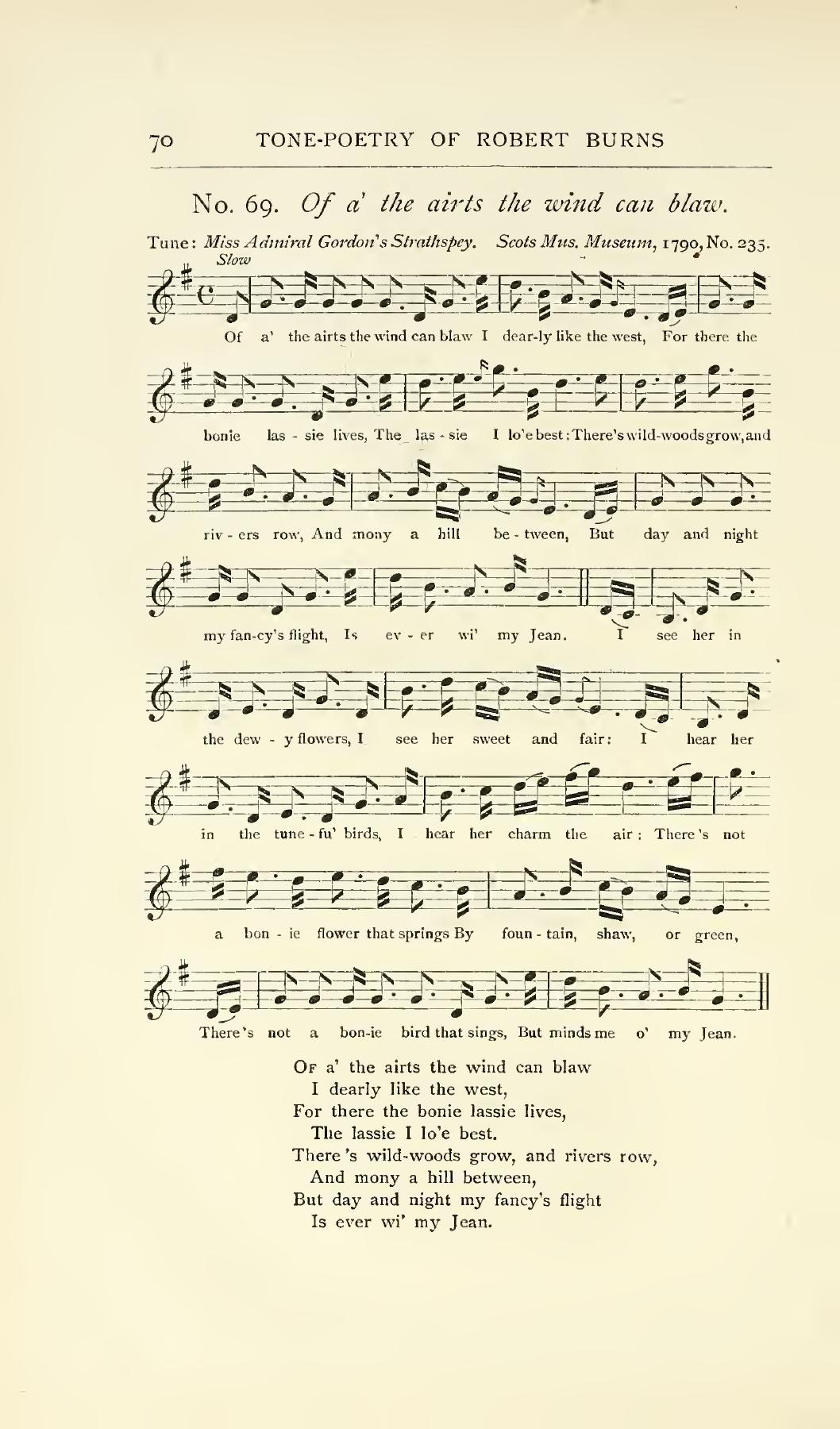 View score Dick’s Songs of Robert Burns (1903)
Lyrics
Choose an edition
Version notes
| Dick (1903) · no. 69 | Cunningham · 1855Ebook transcription |
|---|---|
| two eight-line stanzas | four eight-line stanzas |
| absent | O blaw, ye westlin winds, blaw saft |
| There's wild-woods grow | There wild-woods grow |
Dick (1903) · no. 69
Of a' the airts the wind can blaw
I dearly like the west,
For there the bonie lassie lives,
The lassie I lo'e best.
There's wild-woods grow, and rivers row,
And mony a hill between,
But day and night my fancy's flight
Is ever wi' my Jean.

I see her in the dewy flowers,
I see her sweet and fair:
I hear her in the tunefu' birds,
I hear her charm the air:
There's not a bonie flower that springs
By fountain, shaw, or green,
There's not a bonie bird that sings,
But minds me o' my Jean.
These are the words printed below the score.
View the source edition · no. 69; pp. 70–71
About this edition
Dick prints two eight-line stanzas; Cunningham prints four. Dick’s historical note attributes the additional pair to John Hamilton and challenges Cunningham’s manuscript claim. Cunningham’s introductory ebook wording “Joan Armour” is retained as a source anomaly, distinct from the lyric’s Jean.
Cunningham (1855)
Of a’ the airts the wind can blaw,
  I dearly like the west,
For there the bonnie lassie lives,
  The lassie I lo’e best:
There wild-woods grow, and rivers row,
  And mony a hill between;
But day and night my fancy’s flight
  Is ever wi’ my Jean.

I see her in the dewy flowers,
  I see her sweet and fair:
I hear her in the tunefu’ birds,
  I hear her charm the air:
There’s not a bonnie flower that springs
  By fountain, shaw, or green,
There’s not a bonnie bird that sings,
  But minds me o’ my Jean.

O blaw, ye westlin winds, blaw saft
  Among the leafy trees,
Wi’ balmy gale, frae hill and dale
  Bring hame the laden bees;
And bring the lassie back to me
  That’s aye sae neat and clean;
Ae smile o’ her wad banish care,
  Sae charming is my Jean.

What sighs and vows amang the knowes
  Hae passed atween us twa!
How fond to meet, how wae to part,
  That night she gaed awa!
The powers aboon can only ken,
  To whom the heart is seen,
That nane can be sae dear to me
  As my sweet lovely Jean!
Digital text from Project Gutenberg.
View the source edition · p. 235
About this edition
Dick prints two eight-line stanzas; Cunningham prints four. Dick’s historical note attributes the additional pair to John Hamilton and challenges Cunningham’s manuscript claim. Cunningham’s introductory ebook wording “Joan Armour” is retained as a source anomaly, distinct from the lyric’s Jean.
Scots Musical Museum, vol. III (1790) · no. 235
View the source edition · Volume 3, no. 235; p. 244
Music
View historical scores
Dick’s Songs of Robert Burns (1903)
no. 69; pp. 70–71