O thou pale Orb that silent shines
Behind the song
A sleepless lover addresses the moon that once shone on the couple’s happiness. Its pale light now accompanies his grief. Memory defeats the peace he seeks, carrying him through lost intimacy, troubled days and frightening nights towards an accusation of a broken vow.[1]
Read the fuller story
Cunningham’s ten-stanza Lament gives the speaker’s distress a long course. He recalls pledged faith and anticipated fatherhood, asks who will comfort the woman in future trouble, then describes work and sleep as different forms of suffering. The moon returns near the close as a witness to the earlier mutual affection.[1]
The speaker insists that his pain exceeds conventional pastoral lament. He accuses the woman as he describes his suffering. Cunningham identifies Burns and Jean Armour as the couple, quotes a letter to Moore about the affair and disputes Hogg and Motherwell’s account connecting the poem with Alexander Cunningham. He reports that their account was corrected in a later issue.[1]
The Dick page retained with this reader presents a shorter song setting, selecting three stanzas from the longer lament. The account here follows the complete Cunningham text.[1][2]
Story references
- Allan Cunningham, ed., The Complete Works of Robert Burns (1855), Lament, HTML #XLI, printed pp.112–113. Complete ten-stanza poem and disputed editorial occasion.
- James C. Dick, The Songs of Robert Burns (1903), no.66, printed p.67; retained full-page display BURNS-ASSET-0078. Three-stanza song setting.
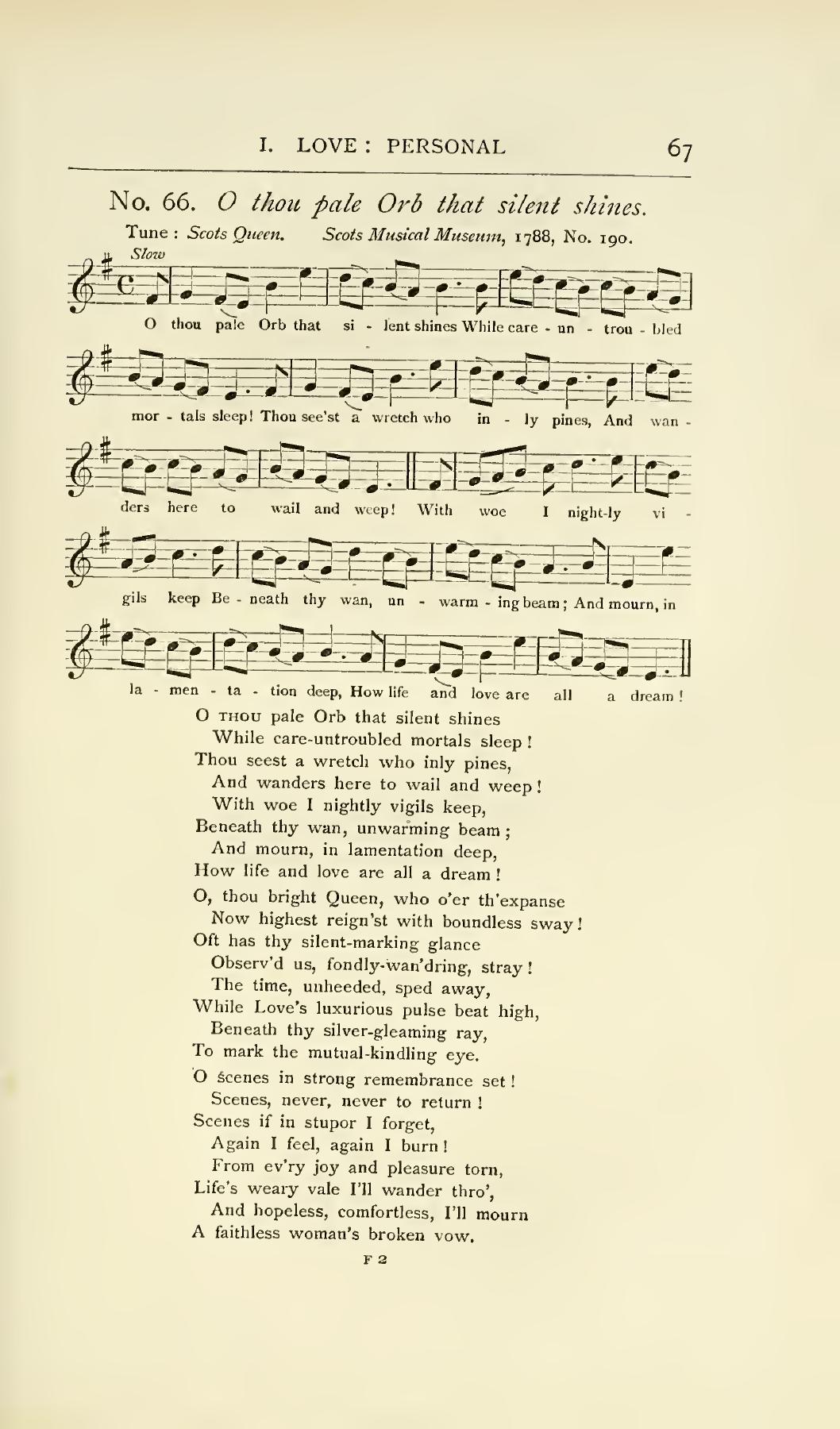 View score Dick’s Songs of Robert Burns (1903)
Music
View historical scores
Dick’s Songs of Robert Burns (1903)
no. 66; p. 67
Dick (1903) · no. 66
The words are on the score page.
View the source edition · no. 66; p. 67
About this edition
In the Corrections leaf, Dick changes “wand’ring” to “wan’ring” in this song.
Burns poem in Cunningham’s editorial account
Cunningham treats the Lament as Burns’s poem and relates it to Burns and Jean Armour. He disputes another editorial account of the occasion.
Words Robert Burns, according to Cunningham’s editorial account
Burns’s role Burns poem in Cunningham’s editorial account