Altho' my back be at the wa
Behind the song
The speaker’s back is against the wall, and the man she blames has left her facing rejection and local gossip. Yet she repeatedly drinks his health in water. Cunningham says Burns took a hint from an older song and supplied these words, which he places in the Musical Museum.[1]
Read the fuller story
The repeated opening admits the speaker’s difficult position and assigns fault to the absent man. The middle lines turn upon his persuasive flattery and its consequences: for his sake she is slighted and must endure the countryside’s talk. A curse upon his wanton ways sits beside the continuing toast.[1]
That combination gives the short lyric its emotional force. The speaker can recognise the injury and accuse its author while still wishing him well. The return of the opening lines leaves her holding both feelings, with the modest drink in the title carrying the gesture of loyalty.[1]
Cunningham’s headnote reports a suggestion that the song alluded to Jean Armour before marriage, then rejects that interpretation. His separate account of an older source distinguishes a borrowed hint from the words attributed to Burns. The lyric itself leaves the woman unnamed and concentrates her situation into twelve insistent lines.[1]
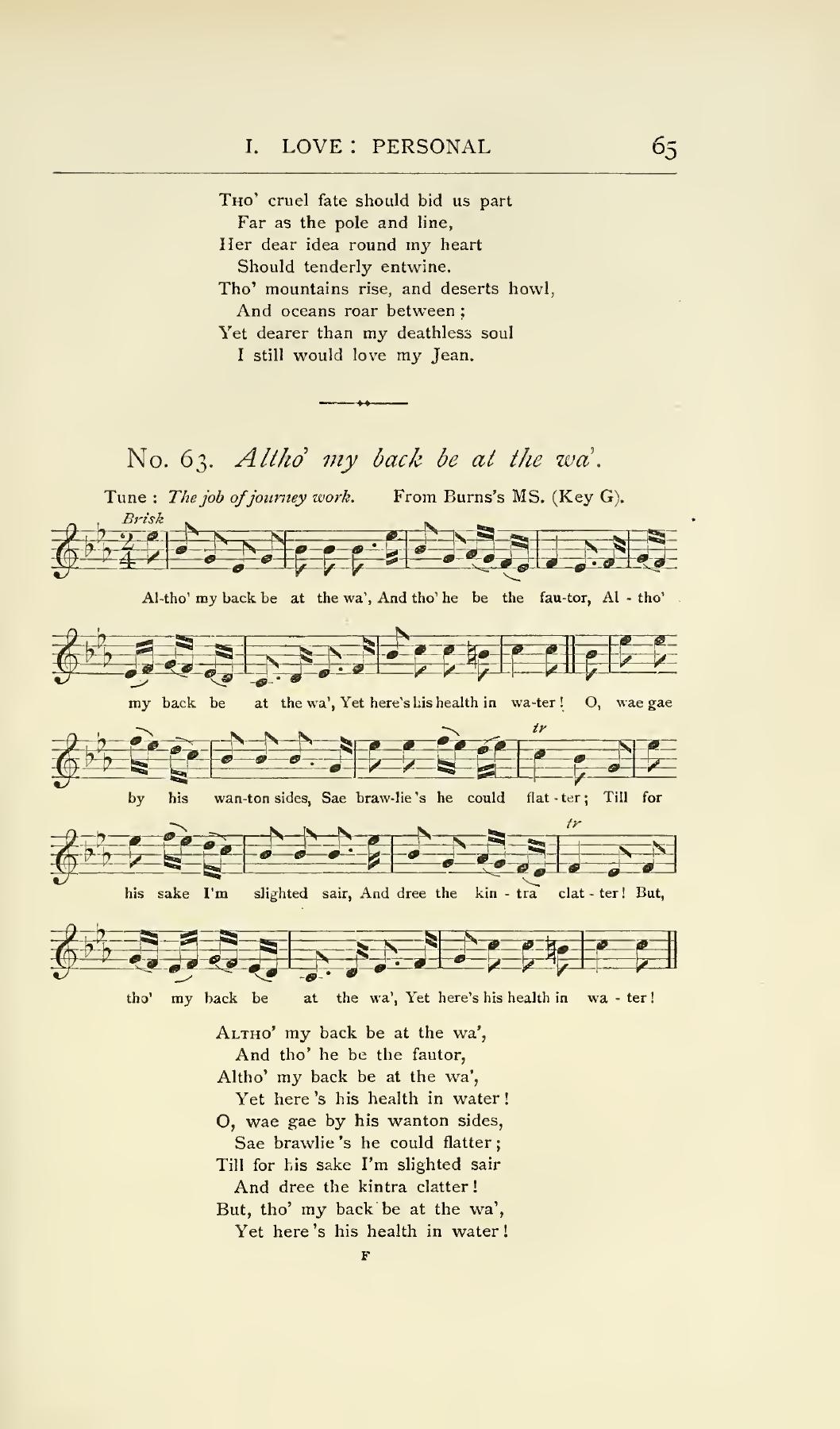 View score Dick’s Songs of Robert Burns (1903)
Lyrics
Choose an edition
Cunningham (1855)
Altho’ my back be at the wa’,
  An’ tho’ he be the fautor;
Altho’ my back be at the wa’,
  Yet here’s his health in water!
O! wae gae by his wanton sides,
  Sae brawlie he could flatter;
Till for his sake I’m slighted sair,
  And dree the kintra clatter.
But tho’ my back be at the wa’,
  And tho’ he be the fautor;
But tho’ my back be at the wa’,
  Yet here’s his health in water!
Digital text from Project Gutenberg.
View the source edition · p. 271
About this edition
Cunningham’s preface discusses several poems he left out of the collection.
Dick (1903) · no. 63
The words are on the score page.
View the source edition · no. 63; p. 65
Scots Musical Museum, vol. V (catalogued 1796) · no. 480
View the source edition · Volume 5, no. 480; p. 494
Music
View historical scores
Dick’s Songs of Robert Burns (1903)
no. 63; p. 65
Words attributed to Burns
Cunningham attributes these words to Burns while explicitly recording a hint taken from an older song; the earlier text has not been independently compared.
Words Robert Burns
Burns’s role Wrote the words