Highland Mary
Behind the song
The banks around Montgomery Castle hold a last memory of Mary: an embrace beneath birch and hawthorn, and a promise to meet again. In November 1792 Burns told George Thomson that the song drew on one of the most interesting passages of his youth. Dick identifies Mary as Mary Campbell. [1][2]
Read the fuller story
Dick identifies the song with Mary Campbell. He quotes a letter to Thomson dated 14 November 1792 in which Burns calls its subject one of the most interesting passages of his youth and hopes for an air that would give it lasting currency. In Dick’s account Burns particularly wanted the song in Thomson’s first volume; he places its publication in Scotish Airs of 1799. [2]
Cunningham supplies a much fuller romantic account, including a stream-side exchange of vows and Bibles, Mary’s illness and their final separation. The lyric itself gives an embrace, vows, parting and death; Cunningham adds the scene in his later biographical account. The tenderness of the remembered parting remains beside the shock of the loss. [1][3]
Dick prints Lady Catherine Ogle from Apollo’s Banquet of 1686. His historical note also uses the name Katherine Ogle, and Cunningham heads the song Katherine Ogie. The four eight-line stanzas in the two editions closely agree, while punctuation and forms such as “monie” and “mony” differ. [1][2][3]
Story references
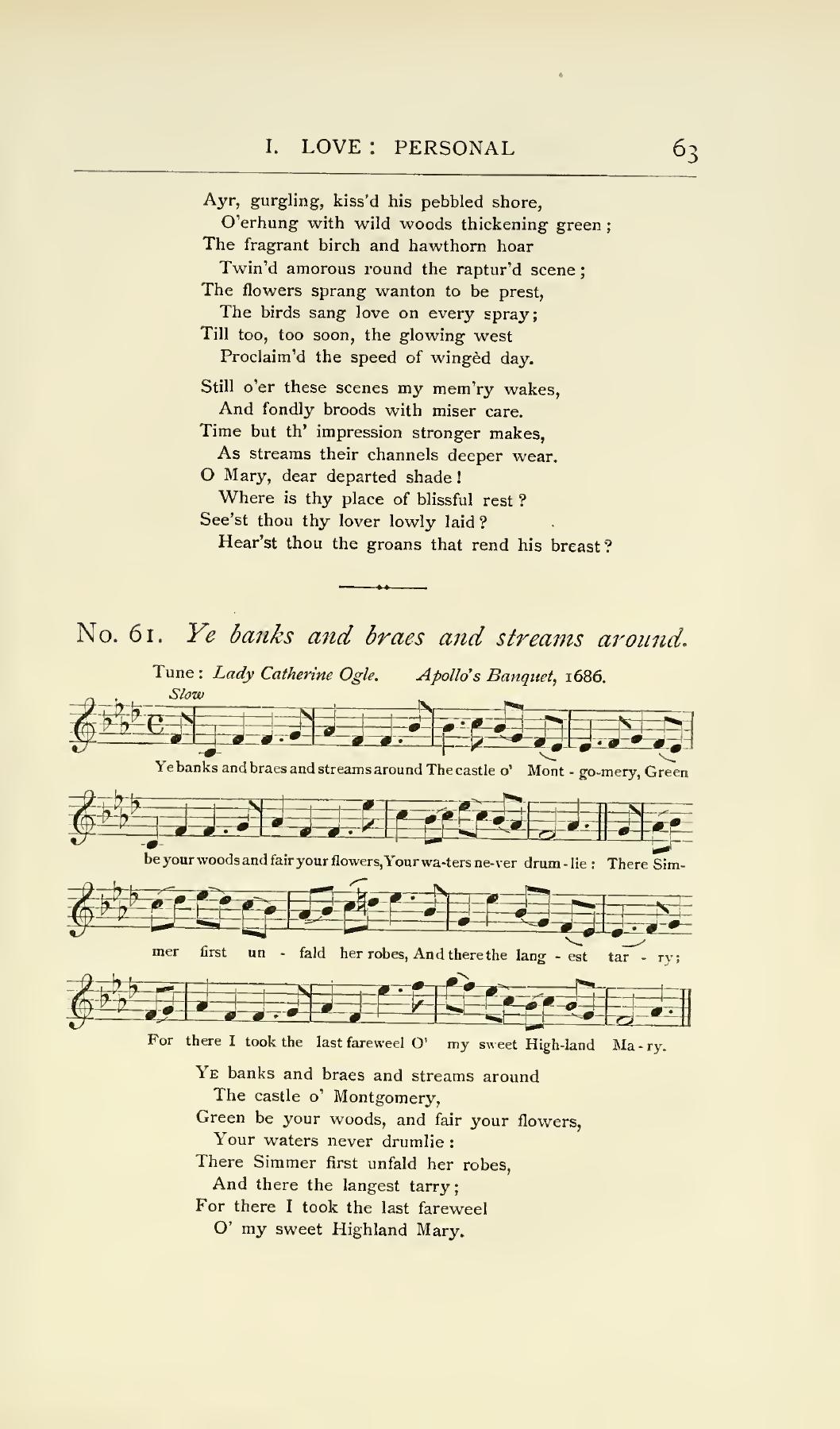 View score Dick’s Songs of Robert Burns (1903)
Lyrics
Choose an edition
Version notes
| Dick (1903) · no. 61 | Cunningham · 1855Ebook transcription |
|---|---|
| Ye banks and braes and streams around | Ye banks, and braes, and streams around |
| How sweetly bloom’d the gay, green birk, | How sweetly bloom’d the gay green birk, |
| As underneath their fragrant shade, | As underneath their fragrant shade |
| The golden hours on angel wings | The golden hours, on angel wings, |
More differences between these editions
| Dick (1903) · no. 61 | Cunningham · 1855Ebook transcription |
|---|---|
| Shall live my Highland Mary. | Shall live my Highland Mary! |
Dick (1903) · no. 61
Ye banks and braes and streams around
    The castle o’ Montgomery,
Green be your woods, and fair your flowers,
    Your waters never drumlie:
There Simmer first unfald her robes,
    And there the langest tarry;
For there I took the last farewell
    O’ my sweet Highland Mary.

How sweetly bloom’d the gay, green birk,
    How rich the hawthorn’s blossom,
As underneath their fragrant shade,
    I clasp’d her to my bosom!
The golden hours on angel wings
    Flew o’er me and my dearie;
For dear to me as light and life
    Was my sweet Highland Mary.

Wi’ monie a vow and lock’d embrace
    Our parting was fu’ tender;
And, pledging aft to meet again,
    We tore oursels asunder.
But O, fell Death’s untimely frost,
    That nipt my flower sae early!
Now green’s the sod, and cauld’s the clay,
    That wraps my Highland Mary!

O, pale, pale now, those rosy lips
    I aft hae kiss’d sae fondly;
And clos’d for ay the sparkling glance
    That dwalt on me sae kindly;
And mouldering now in silent dust
    That heart that lo’ed me dearly!
But still within my bosom’s core
    Shall live my Highland Mary.
View the source edition · no. 61; pp. 63–64
About this edition
Both editions print four eight-line stanzas. Dick has “Simmer first unfald”, “monie” and “dwalt”; Cunningham gives “Simmer first unfauld”, “mony” and “dwelt”. Cunningham’s long introductory narrative includes the Bible exchange; the lyric’s own parting scene is shorter and should be read separately.
Cunningham (1855)
Ye banks, and braes, and streams around
  The castle o’ Montgomery,
Green be your woods, and fair your flowers,
  Your waters never drumlie!
There Simmer first unfauld her robes,
  And there the langest tarry;
For there I took the last farewell
  O’ my sweet Highland Mary.

How sweetly bloom’d the gay green birk,
  How rich the hawthorn’s blossom,
As underneath their fragrant shade
  I clasp’d her to my bosom!
The golden hours, on angel wings,
  Flew o’er me and my dearie;
For dear to me, as light and life,
  Was my sweet Highland Mary!

Wi’ mony a vow, and lock’d embrace,
  Our parting was fu’ tender;
And, pledging aft to meet again,
  We tore oursels asunder;
But oh! fell death’s untimely frost,
  That nipt my flower sae early!—
Now green’s the sod, and cauld’s the clay,
  That wraps my Highland Mary!

O pale, pale now, those rosy lips
  I aft hae kissed sae fondly!
And clos’d for ay the sparkling glance
  That dwelt on me sae kindly!
And mouldering now in silent dust,
  That heart that lo’ed me dearly—
But still within my bosom’s core
  Shall live my Highland Mary!
Digital text from Project Gutenberg.
View the source edition · p. 275
About this edition
Both editions print four eight-line stanzas. Dick has “Simmer first unfald”, “monie” and “dwalt”; Cunningham gives “Simmer first unfauld”, “mony” and “dwelt”. Cunningham’s long introductory narrative includes the Bible exchange; the lyric’s own parting scene is shorter and should be read separately.
Music
View historical scores
Dick’s Songs of Robert Burns (1903)
no. 61; pp. 63–64