Thou ling'ring star with less'ning ray
Behind the song
A star fading into morning brings back the day Mary died. He asks whether she can hear him, then goes back in memory to the banks of the Ayr, where they embraced without knowing it was the last time. Dick connects the song with Mary Campbell and cautiously dates it to the third anniversary of her death, in 1789. [1][2]
Read the fuller story
Dick places the song, cautiously, in October 1789, the third anniversary of Mary Campbell's death. He names Cromek as the first to connect it with her and recounts Cromek's story of Burns remaining beside a corn-stack through the night. He also points to Lockhart's fuller version, given on Mrs Burns's authority. The familiar scene comes to us through these later tellings. [2]
Cunningham adds the image of Burns gazing at a particular star until his wife brought him inside. Dick also quotes a December 1789 letter in which Burns imagines recognising his “ever dear Mary” in heaven. That passage shows the language of grief and reunion attached to Mary in the correspondence as Dick transmits it; the corn-stack narrative remains a separate account of composition. [2][3]
The two editions make a small but telling difference at the final return. Dick repeats “O Mary”, while Cunningham prints “My Mary”. Both supply four eight-line stanzas and identify the tune through Captain Cook's death. Dick prints a slow musical setting, allowing the repeated questions to close the same long melodic shape. [1][3]
Story references
- James C. Dick, The Songs of Robert Burns (1903), No. 60; printed pp. 62–63; PDF pp. 118–119
- James C. Dick, The Songs of Robert Burns (1903), Dick historical note 60; printed 372,373; PDF 428,429
- Allan Cunningham, The Complete Works of Robert Burns (1855), printed 239; HTML #songsLXXXV. Project Gutenberg transcription.
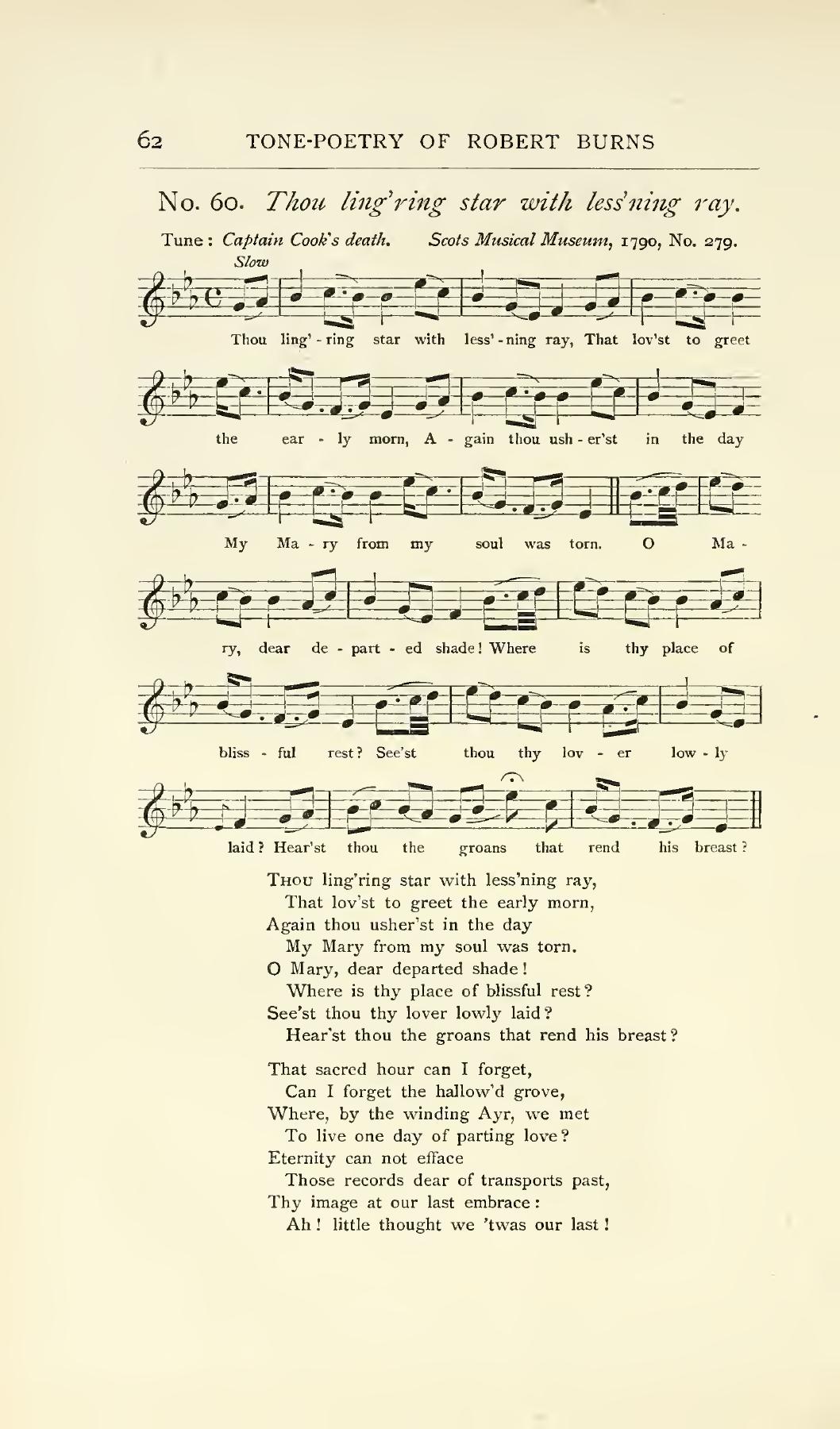 View score Dick’s Songs of Robert Burns (1903)
Lyrics
Choose an edition
Dick (1903) · no. 60
Thou ling'ring star with less'ning ray,
That lov'st to greet the early morn,
Again thou usher'st in the day
My Mary from my soul was torn.
O Mary, dear departed shade!
Where is thy place of blissful rest?
See'st thou thy lover lowly laid?
Hear'st thou the groans that rend his breast?

That sacred hour can I forget,
Can I forget the hallow'd grove,
Where, by the winding Ayr, we met
To live one day of parting love?
Eternity can not efface
Those records dear of transports past,
Thy image at our last embrace:
Ah! little thought we 'twas our last!

Ayr, gurgling, kiss'd his pebbled shore,
O'erhung with wild woods thickening green;
The fragrant birch and hawthorn hoar
Twin'd amorous round the raptur'd scene;
The flowers sprang wanton to be prest,
The birds sang love on every spray;
Till too, too soon, the glowing west
Proclaim'd the speed of winged day.

Still o'er these scenes my mem'ry wakes,
And fondly broods with miser care.
Time but th' impression stronger makes,
As streams their channels deeper wear.
O Mary, dear departed shade!
Where is thy place of blissful rest?
See'st thou thy lover lowly laid?
Hear'st thou the groans that rend his breast?
These are the words printed below the score.
View the source edition · no. 60; pp. 62–63
About this edition
Both texts have four octaves. In the final stanza Dick repeats “O Mary”, while Cunningham has “My Mary”. Dick has “thickening”, “amorous” and “flowers”, against Cunningham’s “thick’ning”, “am’rous” and “flow’rs”. This song remains distinct from Ye banks and braes and streams around, Dick61, the separate Highland Mary lyric.
Scots Musical Museum, vol. III (1790) · no. 279
View the source edition · Volume 3, no. 279; p. 288
Music
View historical scores
Dick’s Songs of Robert Burns (1903)
no. 60; pp. 62–63