Nae Gentle Dames, tho' Ne'er sae Fair
Behind the song
The singer asks his Highland lassie to sit and sing with him in the glen. Fortune is sending him overseas and he hopes to bring back enough money to make her life easier. Cunningham identifies her as Mary Campbell and quotes Burns remembering the warmth of her affection. [1]
Read the fuller story
Six stanzas carry the promise from a sheltered glen towards the billows and foreign lands. The opening invitation to sit and sing becomes a closing farewell to the same landscape. His beloved’s faithful heart and his own pledged hand remain the song’s assurances through that departure.[1]
Cunningham identifies the Highland lassie as Mary Campbell and quotes Burns remembering her warmth and generous love. His headnote also recalls her early death and the poet’s later lament for her; that retrospective sorrow surrounds a lyric whose speaker is still anticipating separation.[1]
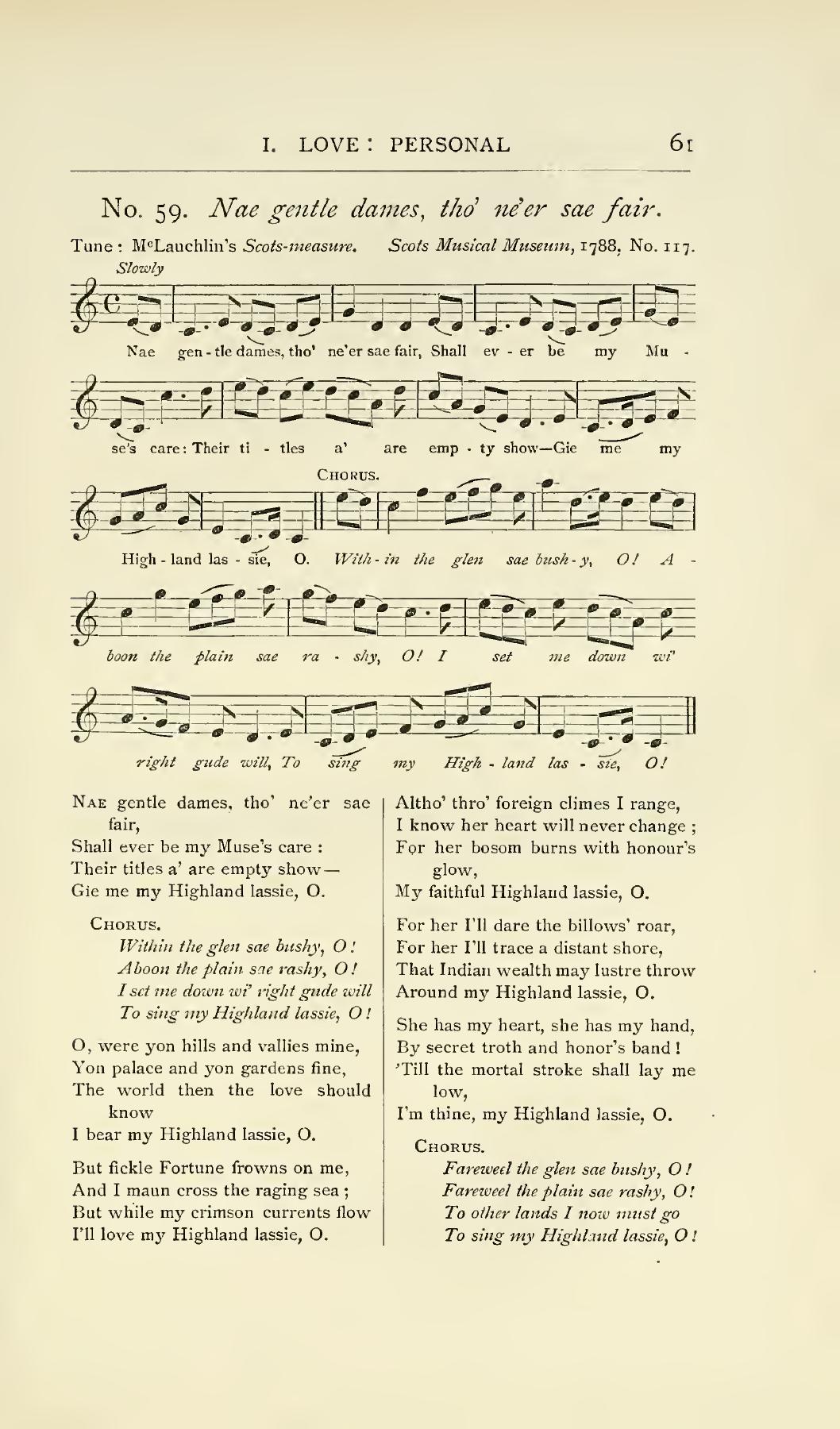 View score Dick’s Songs of Robert Burns (1903)
Music
View historical scores
Dick’s Songs of Robert Burns (1903)
no. 59; p. 61
Choose an edition
Dick (1903) · no. 59
The words are on the score page.
View the source edition · no. 59; p. 61
Scots Musical Museum, vol. II (1788) · no. 117
View the source edition · Volume 2, no. 117; p. 121