Flow Gently, Sweet Afton
Behind the song
Mary is asleep by the Afton. The singer asks the river to quieten, then calls on the stock-dove, blackbirds and lapwing to let her rest. He remembers her gathering flowers and wading in the clear stream. By the last verse she sleeps again, and the singer repeats his request to the river. [1]
Read the fuller story
Dick sets out conflicting explanations of the song’s origin. He reports Currie’s association with Mrs Stewart, Gilbert Burns’s identification of Mary Campbell, and a later account that emphasised the river and a copy sent to Mrs Dunlop in 1789. Dick himself allows a possible reminiscence of Mary Campbell. The name Mary carries the poem’s affection, while the identification remains a matter of editorial interpretation. [2]
Cunningham presents the song as a compliment to Mrs General Stewart of Afton Lodge and to the scenery of Afton Water. His introductory paragraph is a later account of the occasion. Dick also records a copy sent to Mrs Stewart of Stair in 1791. These accounts of the song’s occasion and circulation leave the identity of its sleeping woman uncertain. [2][3]
Both editions name Afton Water as the tune. Dick prints a slow setting in 3/4 and cites Museum 1792, no. 386. His separate lyric has six quatrains. Cunningham retains the same sequence, with “Thy crystal stream” where Dick prints “The crystal stream” and “mild evening” for Dick’s “mild ev’ning”. [1][3]
Story references
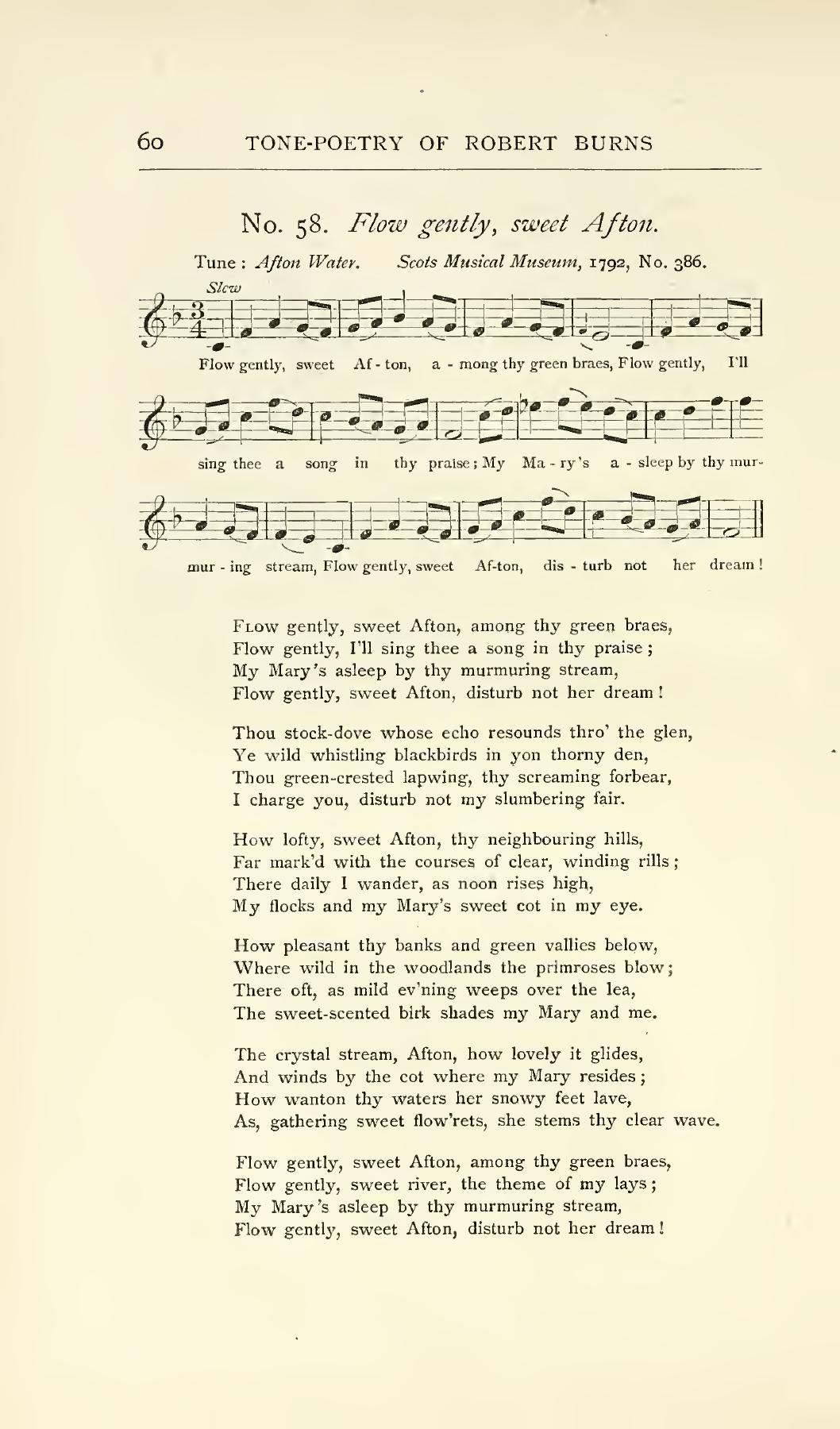 View score Dick’s Songs of Robert Burns (1903)
Lyrics
Choose an edition
Version notes
| Dick (1903) · no. 58 | Cunningham · 1855Ebook transcription |
|---|---|
| Flow gently, sweet Afton, among thy green braes, | Flow gently, sweet Afton! among thy green braes, |
| There daily I wander, as noon rises high, | There daily I wander as noon rises high, |
| The crystal stream, Afton, how lovely it glides, | Thy crystal stream, Afton, how lovely it glides, |
Dick (1903) · no. 58
Flow gently, sweet Afton, among thy green braes,
Flow gently, I’ll sing thee a song in thy praise;
My Mary’s asleep by thy murmuring stream,
Flow gently, sweet Afton, disturb not her dream!

Thou stock-dove whose echo resounds thro’ the glen,
Ye wild whistling blackbirds in yon thorny den,
Thou green-crested lapwing, thy screaming forbear,
I charge you, disturb not my slumbering fair.

How lofty, sweet Afton, thy neighbouring hills,
Far mark’d with the courses of clear, winding rills;
There daily I wander, as noon rises high,
My flocks and my Mary’s sweet cot in my eye.

How pleasant thy banks and green vallies below,
Where wild in the woodlands the primroses blow;
There oft, as mild ev’ning weeps over the lea,
The sweet-scented birk shades my Mary and me.

The crystal stream, Afton, how lovely it glides,
And winds by the cot where my Mary resides;
How wanton thy waters her snowy feet lave,
As, gathering sweet flow’rets, she stems thy clear wave.

Flow gently, sweet Afton, among thy green braes,
Flow gently, sweet river, the theme of my lays;
My Mary’s asleep by thy murmuring stream,
Flow gently, sweet Afton, disturb not her dream!
View the source edition · no. 58; p. 60
About this edition
Both readings have six quatrains. Dick prints “The crystal stream” and “mild ev’ning”; Cunningham has “Thy crystal stream” and “mild evening”. Dick’s “vallies” is retained. Cunningham’s introductory association with Mrs Stewart is an editorial account of occasion, distinct from a secure identification of Mary.
Cunningham (1855)
Flow gently, sweet Afton! among thy green braes,
Flow gently, I’ll sing thee a song in thy praise;
My Mary’s asleep by thy murmuring stream—
Flow gently, sweet Afton, disturb not her dream.

Thou stock-dove, whose echo resounds thro’ the glen;
Ye wild whistling blackbirds in yon thorny den;
Thou green-crested lapwing, thy screaming forbear—
I charge you disturb not my slumbering fair.

How lofty, sweet Afton! thy neighbouring hills,
Far mark’d with the courses of clear, winding rills;
There daily I wander as noon rises high,
My flocks and my Mary’s sweet cot in my eye.

How pleasant thy banks and green valleys below,
Where wild in the woodlands the primroses blow!
There, oft as mild evening weeps over the lea,
The sweet-scented birk shades my Mary and me.

Thy crystal stream, Afton, how lovely it glides,
And winds by the cot where my Mary resides;
How wanton thy waters her snowy feet lave,
As gathering sweet flow’rets she stems thy clear wave.

Flow gently, sweet Afton! among thy green braes,
Flow gently, sweet river, the theme of my lays!
My Mary’s asleep by thy murmuring stream—
Flow gently, sweet Afton! disturb not her dream.
Digital text from Project Gutenberg.
View the source edition · p. 261
About this edition
Both readings have six quatrains. Dick prints “The crystal stream” and “mild ev’ning”; Cunningham has “Thy crystal stream” and “mild evening”. Dick’s “vallies” is retained. Cunningham’s introductory association with Mrs Stewart is an editorial account of occasion, distinct from a secure identification of Mary.
Scots Musical Museum, vol. IV (1792) · no. 386
View the source edition · Volume 4, no. 386; p. 400
Music
View historical scores
Dick’s Songs of Robert Burns (1903)
no. 58; p. 60