O Wert Thou in the Cauld Blast
Behind the song
A plaid held against the wind is the first thing the singer can offer. As the weather becomes a figure for misfortune, the pledge grows: whatever the other person suffers, the singer will share. Companionship would make a wilderness paradise. [1]
A story Dick takes from Chambers describes the ailing Burns asking Jessie Lewars to play her favourite tune. She repeats it on the harpsichord until he knows it by ear and can write words for it. [2]
Read the fuller story
Dick relates the composition to Jessie Lewars through an anecdote he expressly takes from Chambers. In that account Burns, ill and in pain, asks Jessie to play her favourite tune and offers to write words for it. She plays Lenox love to Blantyre on the harpsichord until he knows it by ear. The episode gives a tender later frame to the promise of shelter. [2]
Cunningham presents the Jessie connection as tradition and prints the song with Lass o' Livistone as its tune. His introduction also points to its place in Thomson's collection. Cunningham names Jessie in his account of the song's origin; the lyric addresses its beloved simply as “thou”. [1][3]
Dick's score instead uses Lenox love to Blantyre, marked “Slow”. The difference between the edition headings is part of the song's musical history. Their words remain close: where Cunningham has “monarch o' the globe”, Dick prints “monarch of the globe”. Both preserve the repeated phrases that make the pledges sound renewed as they are sung. [1][3]
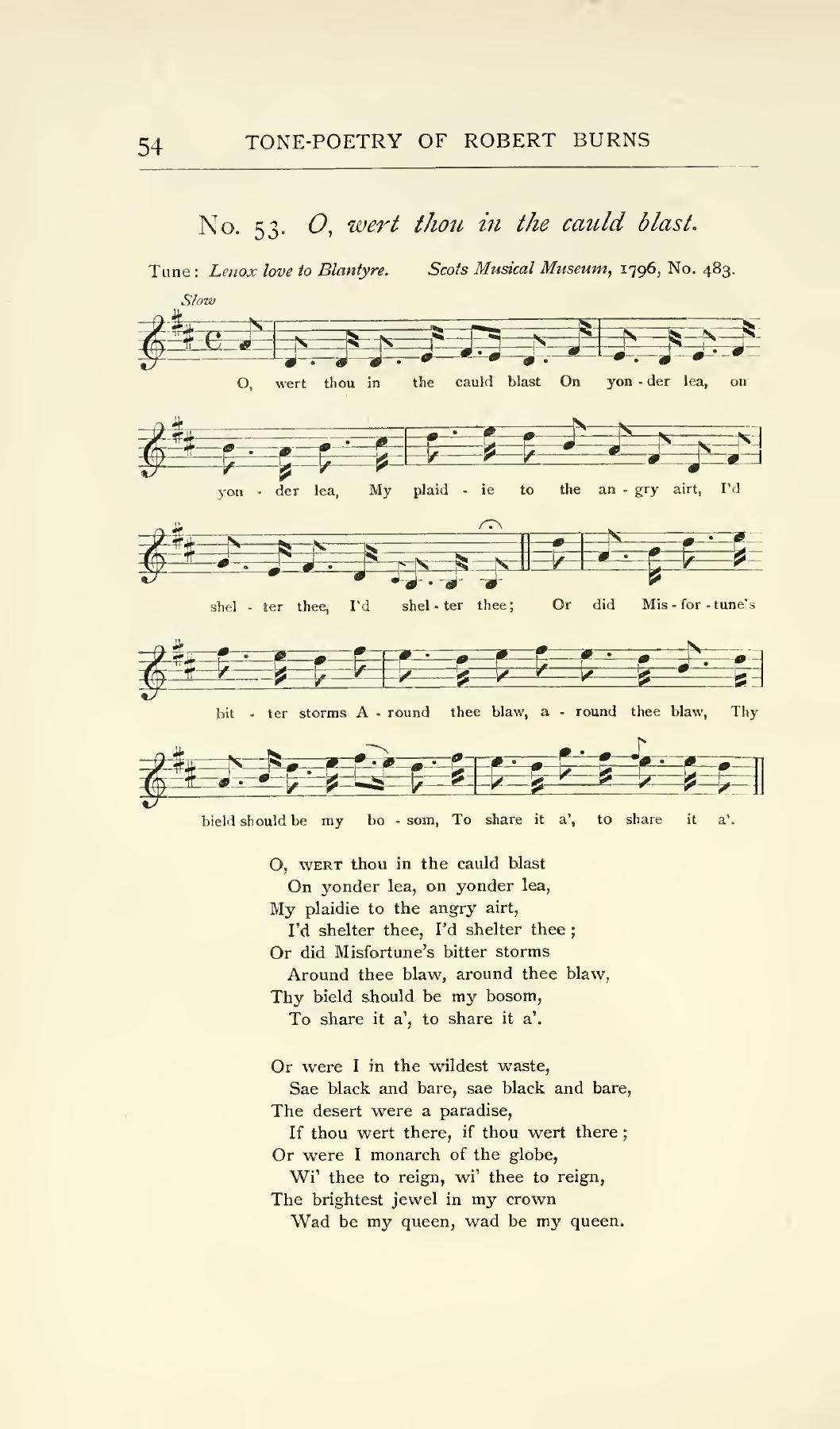 View score Dick’s Songs of Robert Burns (1903)
Lyrics
Choose an edition
Version notes
| Dick (1903) · no. 53 | Cunningham · 1855Ebook transcription |
|---|---|
| monarch of the globe | monarch o’ the globe |
| Lenox love to Blantyre | Lass o’ Livistone |
Dick (1903) · no. 53
O, wert thou in the cauld blast
On yonder lea, on yonder lea,
My plaidie to the angry airt,
I'd shelter thee, I'd shelter thee;
Or did Misfortune's bitter storms
Around thee blaw, around thee blaw,
Thy bield should be my bosom,
To share it a', to share it a'.

Or were I in the wildest waste,
Sae black and bare, sae black and bare,
The desert were a paradise,
If thou wert there, if thou wert there;
Or were I monarch of the globe,
Wi' thee to reign, wi' thee to reign,
The brightest jewel in my crown
Wad be my queen, wad be my queen.
These are the words printed below the score.
View the source edition · no. 53; p. 54
About this edition
Both editions print two eight-line stanzas. Dick has “monarch of the globe”; Cunningham “monarch o’ the globe”. Their tune headings differ: Lenox love to Blantyre and Lass o’ Livistone.
Cunningham (1855)
Oh, wert thou in the cauld blast,
  On yonder lea, on yonder lea,
My plaidie to the angry airt,
  I’d shelter thee, I’d shelter thee:
Or did misfortune’s bitter storms
  Around thee blaw, around thee blaw,
Thy bield should be my bosom,
  To share it a’, to share it a’.

Or were I in the wildest waste,
  Sae black and bare, sae black and bare,
The desert were a paradise,
  If thou wert there, if thou wert there:
Or were I monarch o’ the globe,
  Wi’ thee to reign, wi’ thee to reign,
The brightest jewel in my crown
  Wad be my queen, wad be my queen.
Digital text from Project Gutenberg.
View the source edition · p. 292
About this edition
Both editions print two eight-line stanzas. Dick has “monarch of the globe”; Cunningham “monarch o’ the globe”. Their tune headings differ: Lenox love to Blantyre and Lass o’ Livistone.
Music
View historical scores
Dick’s Songs of Robert Burns (1903)
no. 53; p. 54