Adown -winding Nith I did wander
Behind the song
Burns asked George Thomson to make room for Phillis M’Murdo in his song collection, on behalf of her music teacher Clarke. Beside the Nith, the singer finds a flower for each quality he sees in her: a daisy for simplicity, a rosebud for her blush and a lily for purity. [1]
Read the fuller story
The daisy suggests simplicity, the rosebud a blush and the lily purity. Woodbine supplies her breath, a dew-drop her eye, and morning birdsong her voice. These comparisons build from flowers close at hand towards the waking landscape.[1]
The last verse turns to the brevity of beauty. Summer bloom fades, while Phillis’s worth of mind will endure. The opening dismissal of rival beauties returns after this more lasting quality has been named.[1]
Cunningham’s headnote quotes Burns asking for Phillis to have a place in Thomson’s book on behalf of Mr Clarke. It identifies her as Phillis M’Murdo, sister of “Bonnie Jean”, and says both sisters were Clarke’s pupils. Those identifications accompany the song in this edition.[1]
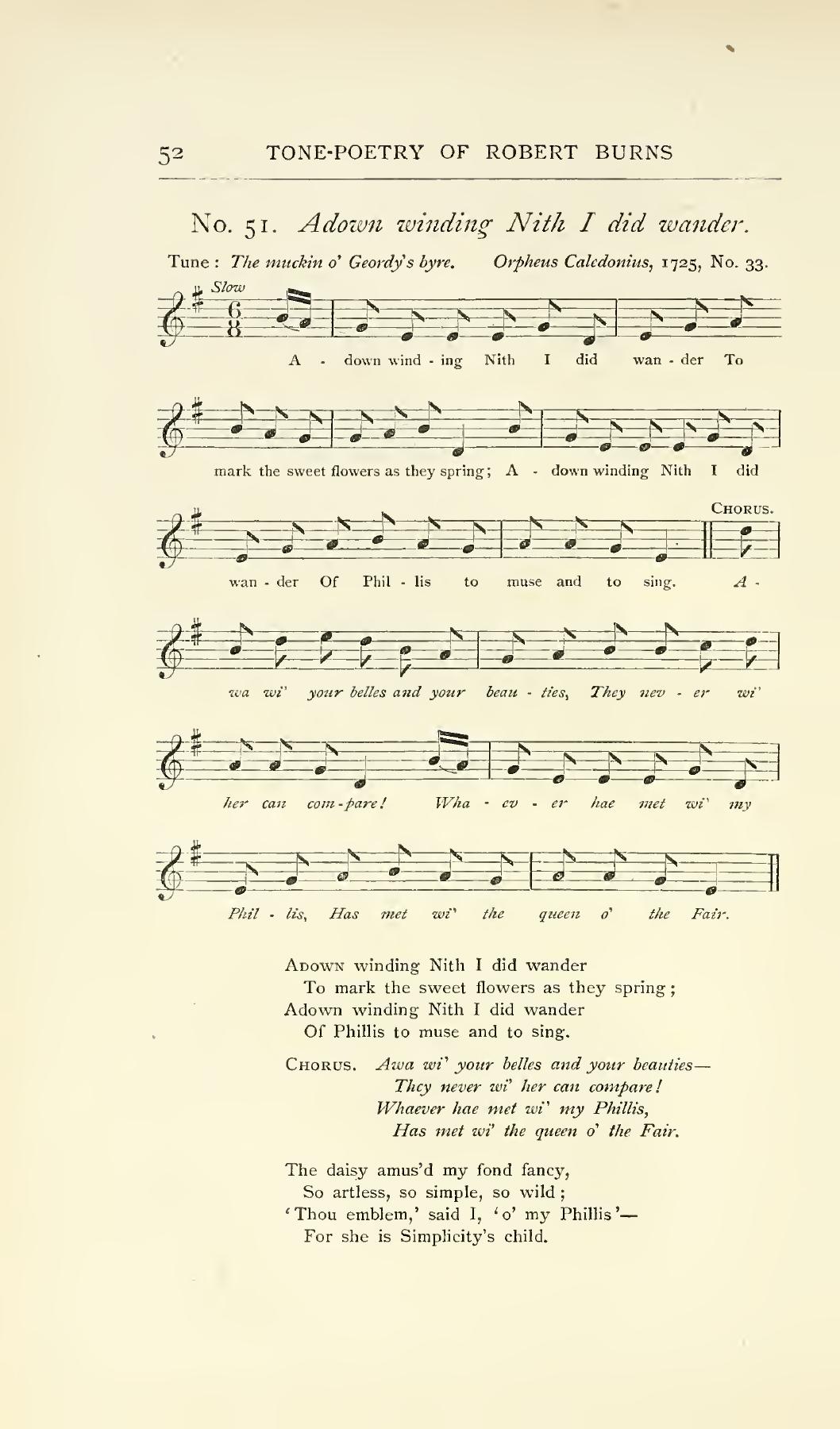 View score Dick’s Songs of Robert Burns (1903)
Lyrics
Choose an edition
Cunningham (1855)
Adown winding Nith I did wander,
  To mark the sweet flowers as they spring;
Adown winding Nith I did wander,
  Of Phillis to muse and to sing.
Awa wi’ your belles and your beauties,
  They never wi’ her can compare:
Whaever has met wi’ my Phillis,
  Has met wi’ the queen o’ the fair.

The daisy amus’d my fond fancy,
  So artless, so simple, so wild;
Thou emblem, said I, o’ my Phillis,
  For she is simplicity’s child.

The rose-bud’s the blush o’ my charmer,
  Her sweet balmy lip when ’tis prest:
How fair and how pure is the lily,
  But fairer and purer her breast.

Yon knot of gay flowers in the arbour,
  They ne’er wi’ my Phillis can vie:
Her breath is the breath o’ the woodbine,
  Its dew-drop o’ diamond, her eye.

Her voice is the song of the morning,
  That wakes thro’ the green-spreading grove,
When Phœbus peeps over the mountains,
  On music, and pleasure, and love.

But beauty how frail and how fleeting,
  The bloom of a fine summer’s day!
While worth in the mind o’ my Phillis
  Will flourish without a decay.
Awa wi’ your belles and your beauties,
  They never wi’ her can compare:
Whaever has met wi’ my Phillis
  Has met wi’ the queen o’ the fair.
Digital text from Project Gutenberg.
View the source edition · p. 284
About this edition
Cunningham’s preface discusses several poems he left out of the collection.
Dick (1903) · no. 51
The words are on the score page.
View the source edition · no. 51; pp. 52–53
Music
View historical scores
Dick’s Songs of Robert Burns (1903)
no. 51; pp. 52–53
Recommended to Thomson by Burns
Cunningham quotes Burns requesting a place for Phillis in Thomson’s book on Clarke’s behalf.
Words Burns’s share is uncertain
Burns’s role Recommended to Thomson by Burns