O Philly, happy be that day
Behind the song
Burns told the song collector George Thomson that he had finished this duet on a frosty walk before breakfast. Philly and Willy sing of hay, sunshine and flowering woodbine. Each answers the other’s compliments before they agree on how little they care for wealth. [1]
Read the fuller story
The ten four-line stanzas alternate between “He” and “She”. Willy remembers losing his heart among the gathered hay; Philly recalls the grove where she acknowledged her love and heard his promise. The paired voices give each lover a memory and a declaration of their own.[1]
Their exchanges follow the natural year. Birdsong and a budding rose express affection growing stronger; sunshine, harvest and the swallow describe the pleasure of meeting. When Willy compares a kiss to a bee gathering nectar, Philly answers with the sweetness of woodbine in the evening dew. The images repeatedly pass from one voice to the other, making the song’s tenderness reciprocal.[1]
At the close, Fortune’s turning wheel and the wealth gold can purchase lose their attraction. Each singer names the other as the centre of contentment. Cunningham prints “The Sow’s Tail” as the tune. His headnote places Burns’s completion of the duet during a frosty walk before breakfast: a sharply different season from the warmth and flowering countryside imagined by its lovers.[1]
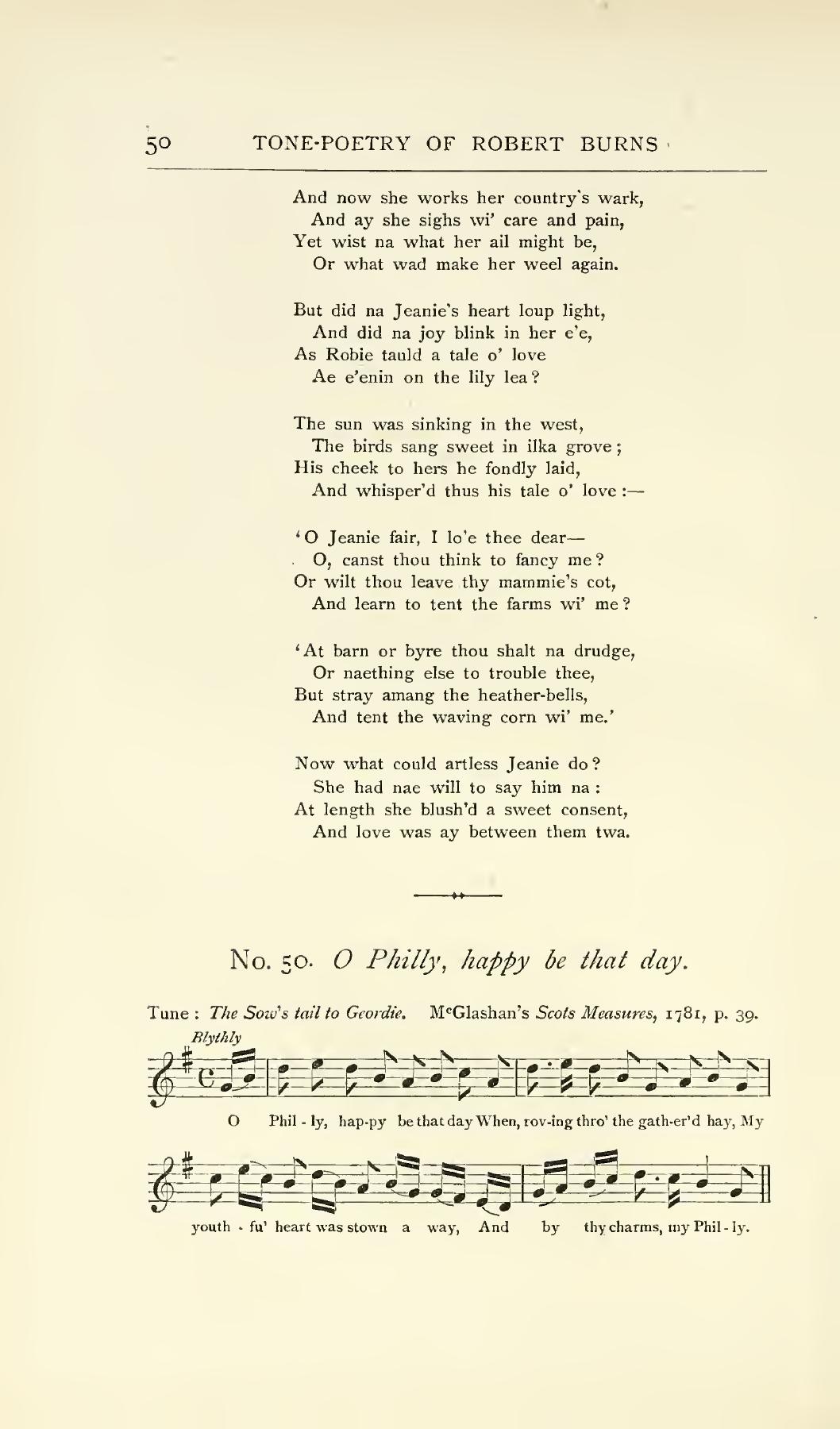 View score Dick’s Songs of Robert Burns (1903)
Lyrics
Choose an edition
Cunningham (1855)
O Philly, happy be that day,
When roving through the gather’d hay,
My youthfu’ heart was stown away,
  And by thy charms, my Philly.

O Willy, ay I bless the grove
Where first I own’d my maiden love,
Whilst thou didst pledge the powers above,
  To be my ain dear Willy.

As songsters of the early year
Are ilka day mair sweet to hear,
So ilka day to me mair dear
  And charming is my Philly.

As on the brier the budding rose
Still richer breathes and fairer blows,
So in my tender bosom grows
  The love I bear my Willy.

The milder sun and bluer sky
That crown my harvest cares wi’ joy,
Were ne’er sae welcome to my eye
  As is a sight o’ Philly.

The little swallow’s wanton wing,
Tho’ wafting o’er the flowery spring,
Did ne’er to me sic tidings bring,
  As meeting o’ my Willy.

The bee that thro’ the sunny hour
Sips nectar in the opening flower,
Compar’d wi’ my delight is poor,
  Upon the lips o’ Philly.

The woodbine in the dewy weet
When evening shades in silence meet,
Is nocht sae fragrant or sae sweet
  As is a kiss o’ Willy.

Let Fortune’s wheel at random rin,
And fools may tyne, and knaves may win
My thoughts are a’ bound up in ane,
  And that’s my ain dear Philly.

What’s a’ joys that gowd can gie?
I care nae wealth a single flie;
The lad I love’s the lad for me,
  And that’s my ain dear Willy.
Digital text from Project Gutenberg.
View the source edition · p. 297
About this edition
Cunningham’s preface discusses several poems he left out of the collection.
Dick (1903) · no. 50
The words are on the score page.
View the source edition · no. 50; pp. 50–51
Music
View historical scores
Dick’s Songs of Robert Burns (1903)
no. 50; pp. 50–51