Turn again, thou fair Eliza!
Behind the song
The speaker asks Eliza to turn back and give him one kind look before they part. He hopes for love, but will accept the appearance of friendship if it softens her refusal. The song holds that painful compromise at its centre: the reassurance he asks for could conceal the answer that would hurt him.[1]
Read the fuller story
“Ae kind blink” is one kindly glance. The smallness of the request contrasts with the emotional weight he gives it: a look might spare a faithful heart, while refusal seems capable of destroying his peace. His question about offending her supplies its own answer—the offence is loving her. The appeal makes his suffering the argument for her kindness. We hear his urgent case throughout; Eliza’s answer remains outside the song.[1]
The final eight lines expand beyond the moment of parting. A bee on a blossom, a fairy beneath a summer moon and a poet at the instant of inspiration all provide measures of pleasure, yet the speaker claims that none knows the delight her presence brings him. “Ilka” means every, and “kens” means knows. The imagery carries the voice from a single desired glance to a world transformed by affection. Its imaginative brightness makes the threatened separation feel more severe.[1]
James C. Dick records the song in the 1792 Scots Musical Museum, signed B, and quotes Burns’s 1788 request to James Johnson for a woman and an air to celebrate in verse. Dick also reports that the manuscript opening used “Rabina”, a name Johnson had suggested. These details show names and musical choices taking shape during the song’s preparation. They leave the woman behind the published Eliza unidentified here.[2]
The tune heading in Dick is simply “A Gaelic air”, with the instruction “Slow”. His note describes Burns discussing two possible melodies from McDonald’s collection of Highland airs, with detailed advice about changing notes, and says that Johnson used the latter, an Argyleshire air, with slight variation. The published lyric’s repeated appeal therefore sits within a history of musical choice and adjustment. The slow setting gives the request to turn back room to linger.[1][2]
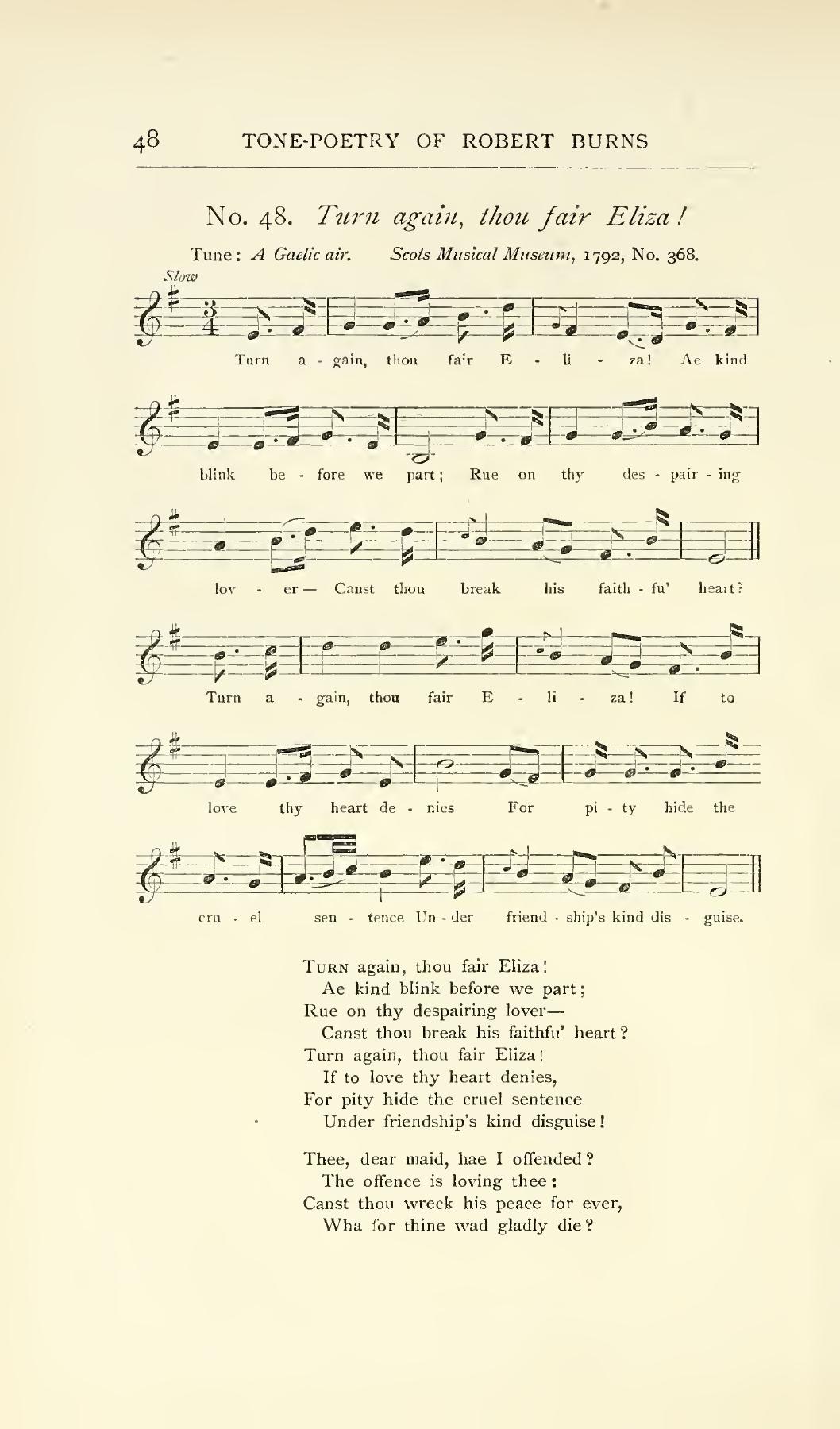 View score Dick’s Songs of Robert Burns (1903)
Lyrics
Dick (1903) · no. 48
Turn again, thou fair Eliza!
Ae kind blink before we part;
Rue on thy despairing lover—
Canst thou break his faithfu' heart?
Turn again, thou fair Eliza!
If to love thy heart denies,
For pity hide the cruel sentence
Under friendship's kind disguise!

Thee, dear maid, hae I offended?
The offence is loving thee:
Canst thou wreck his peace for ever,
Wha for thine wad gladly die?

While the life beats in my bosom,
Thou shalt mix in ilka throe:
Turn again, thou lovely maiden,
Ae sweet smile on me bestow!

Not the bee upon the blossom,
In the pride o' sinny noon;
Not the little sporting fairy
All beneath the simmer moon,
Not the poet, in the moment
Fancy lightens in his e'e,
Kens the pleasure, feels the rapture,
That thy presence gies to me.
View the source edition · Dick1903 no. 48; pp. 48–49
About this edition
Syllables separated by the musical notation are joined into words in this reading.
Music
View historical scores
Dick’s Songs of Robert Burns (1903)
Dick1903 no. 48; pp. 48–49