Farewell, thou stream that winding flows
Behind the song
The stream beside Eliza’s home marks the place the lover must leave. He tries to hide his anguish, but sighs and involuntary groans betray him. His one remaining appeal asks her forgiveness for a love she cannot relieve.[1]
Read the fuller story
Three eight-line stanzas turn private suffering into a gathering danger. The opening image of a hopeless chain gives way to the music of Eliza’s voice and the power of her eyes. By the final lines the lover resembles an unwary sailor, discovering the circling torrent only when escape has become impossible.[1]
Cunningham dates the song to November 1794 and reports Thomson’s praise of it as excellent. His short headnote leaves Eliza’s identity unexplained; the lyric presents her through the distressed speaker’s address.[1]
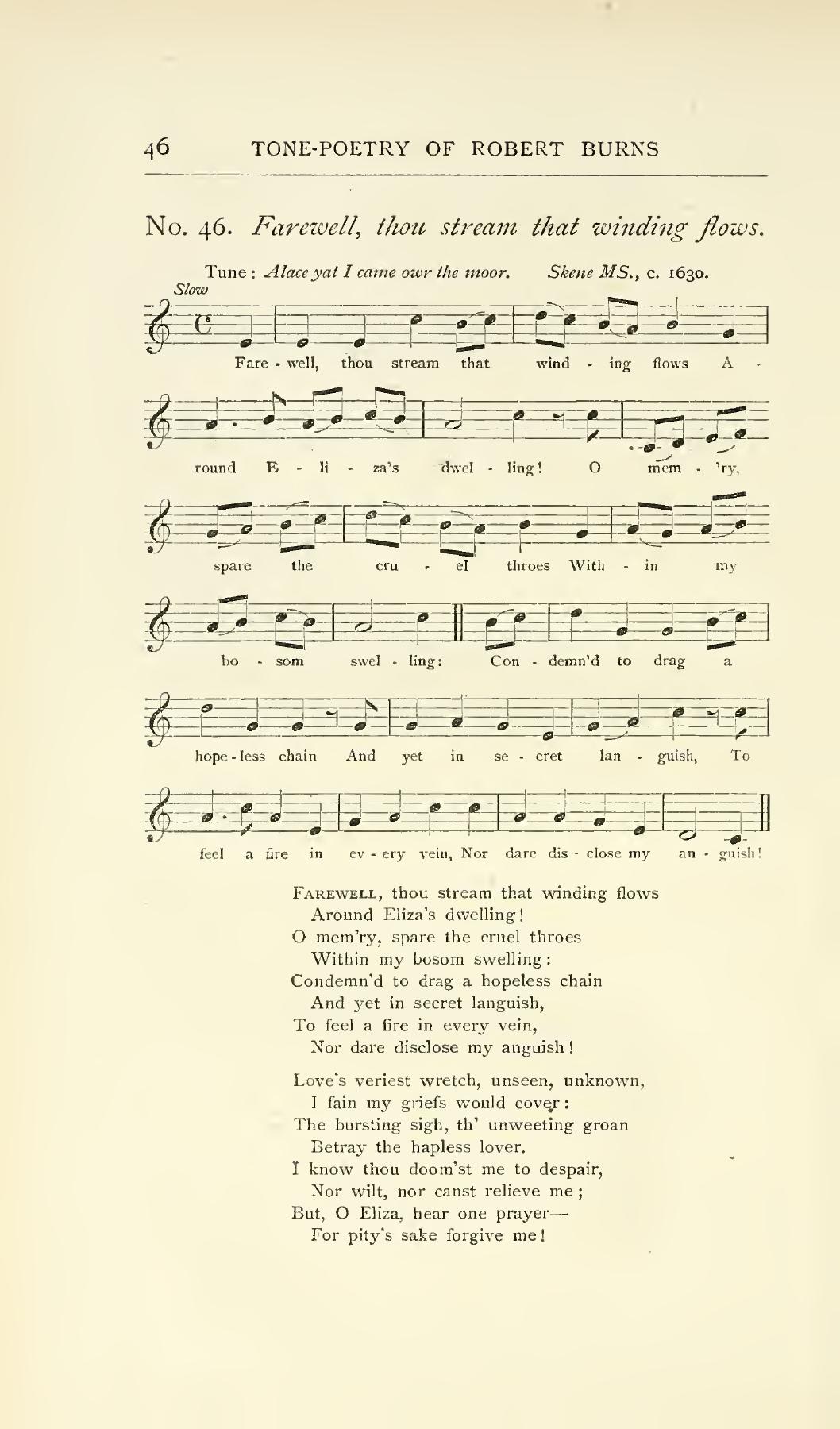 View score Dick’s Songs of Robert Burns (1903)
Lyrics
Choose an edition
Cunningham (1855)
Farewell, thou stream that winding flows
  Around Eliza’s dwelling!
O mem’ry! spare the cruel throes
  Within my bosom swelling:
Condemn’d to drag a hopeless chain,
  And yet in secret languish,
To feel a fire in ev’ry vein,
  Nor dare disclose my anguish.

Love’s veriest wretch, unseen, unknown,
  I fain my griefs would cover;
The bursting sigh, th’ unweeting groan,
  Betray the hapless lover.
I know thou doom’st me to despair,
  Nor wilt, nor canst relieve me;
But oh, Eliza, hear one prayer—
  For pity’s sake forgive me!

The music of thy voice I heard,
  Nor wist while it enslav’d me;
I saw thine eyes, yet nothing fear’d,
  ’Till fears no more had sav’d me:
The unwary sailor thus aghast,
  The wheeling torrent viewing;
‘Mid circling horrors sinks at last
  In overwhelming ruin.
Digital text from Project Gutenberg.
View the source edition · p. 296
About this edition
Cunningham’s preface discusses several poems he left out of the collection.
Dick (1903) · no. 46
The words are on the score page.
View the source edition · no. 46; pp. 46–47
Music
View historical scores
Dick’s Songs of Robert Burns (1903)
no. 46; pp. 46–47