While larks with little wing
Behind the song
The musician Stephen Clarke asked Burns for these verses, Cunningham says, and their subject was Clarke’s pupil Phyllis M’Murdo. A walk at sunrise gives the singer flowers and birds with which to praise her. A hawk caught in a snare prompts a sharper wish for anyone who harms her. [1]
Read the fuller story
The first stanza begins with larks, spring air and the sun rising above the hills. The speaker carries the brightness of the scene into an exclamation about Phillis’s own morning. The next stanza repeats that movement through flowers and dew, turning the opening rosebuds into a compliment to her bloom.[1]
The third stanza changes the mood. Cooing doves occupy a shaded walk, but the watcher notices a hawk caught in a snare. The predatory bird’s helplessness suggests the punishment the speaker wishes upon anyone who would injure Phillis. Admiration becomes a protective blessing, and her name closes each stanza.[1]
Cunningham prints the song to “Robin Adair”. His headnote places it within the M’Murdo family circle and connects its making with Clarke’s interest in his pupil. The lyric itself lets its speaker’s affections emerge through the things encountered along a spring walk, ending with concern for the woman’s safety.[1]
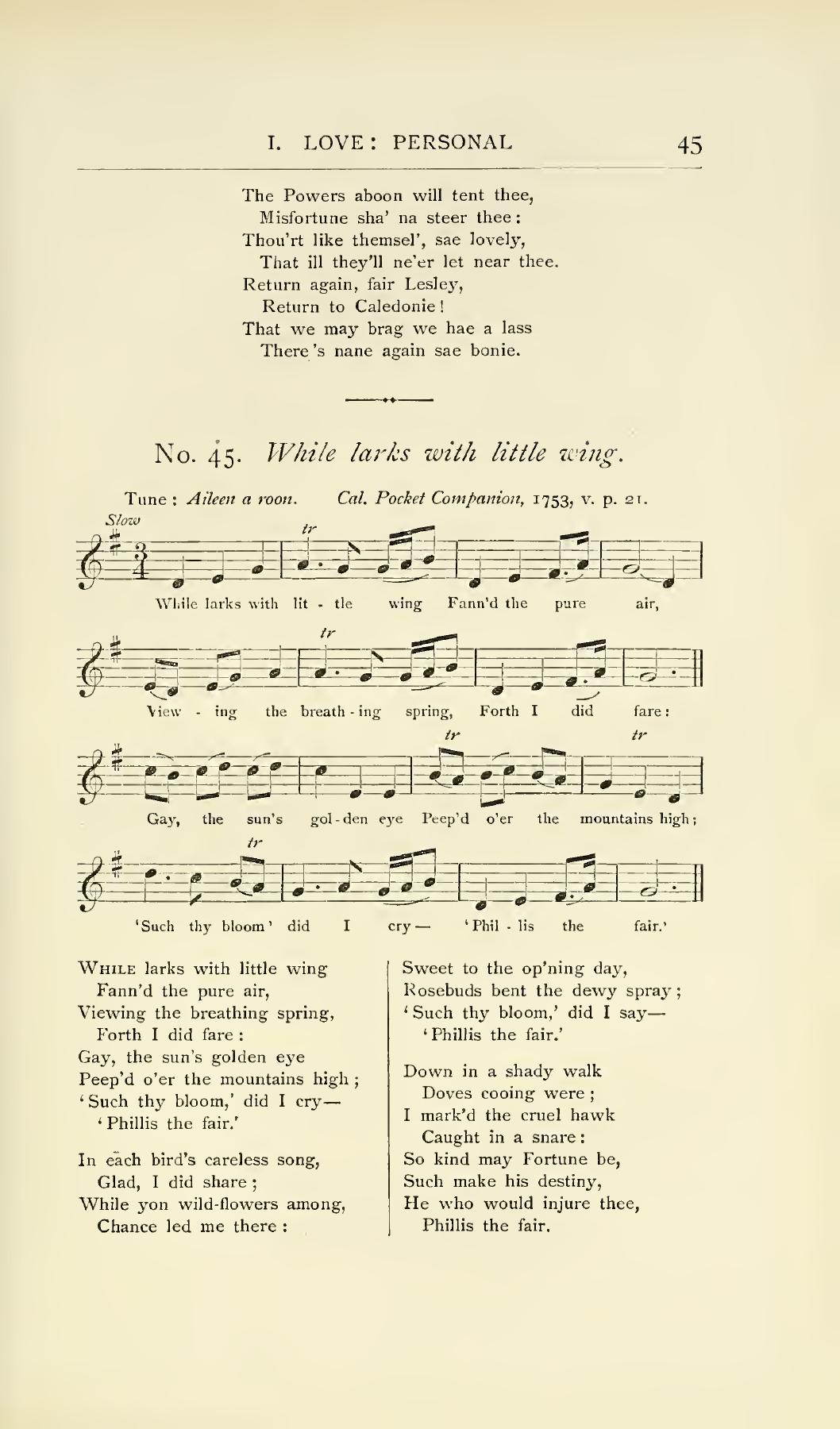 View score Dick’s Songs of Robert Burns (1903)
Lyrics
Choose an edition
Cunningham (1855)
While larks with little wing
  Fann’d the pure air,
Tasting the breathing spring,
  Forth I did fare:
Gay the sun’s golden eye
Peep’d o’er the mountains high;
Such thy morn! did I cry,
  Phillis the fair.

In each bird’s careless song,
  Glad I did share;
While yon wild flowers among,
  Chance led me there:
Sweet to the opening day,
Rosebuds bent the dewy spray;
Such thy bloom! did I say,
  Phillis the fair.

Down in a shady walk
  Doves cooing were,
I mark’d the cruel hawk,
  Caught in a snare:
So kind may fortune be,
Such make his destiny!
He who would injure thee,
  Phillis the fair.
Digital text from Project Gutenberg.
View the source edition · p. 283
About this edition
Cunningham’s preface discusses several poems he left out of the collection.
Dick (1903) · no. 45
The words are on the score page.
View the source edition · no. 45; p. 45
Music
View historical scores
Dick’s Songs of Robert Burns (1903)
no. 45; p. 45