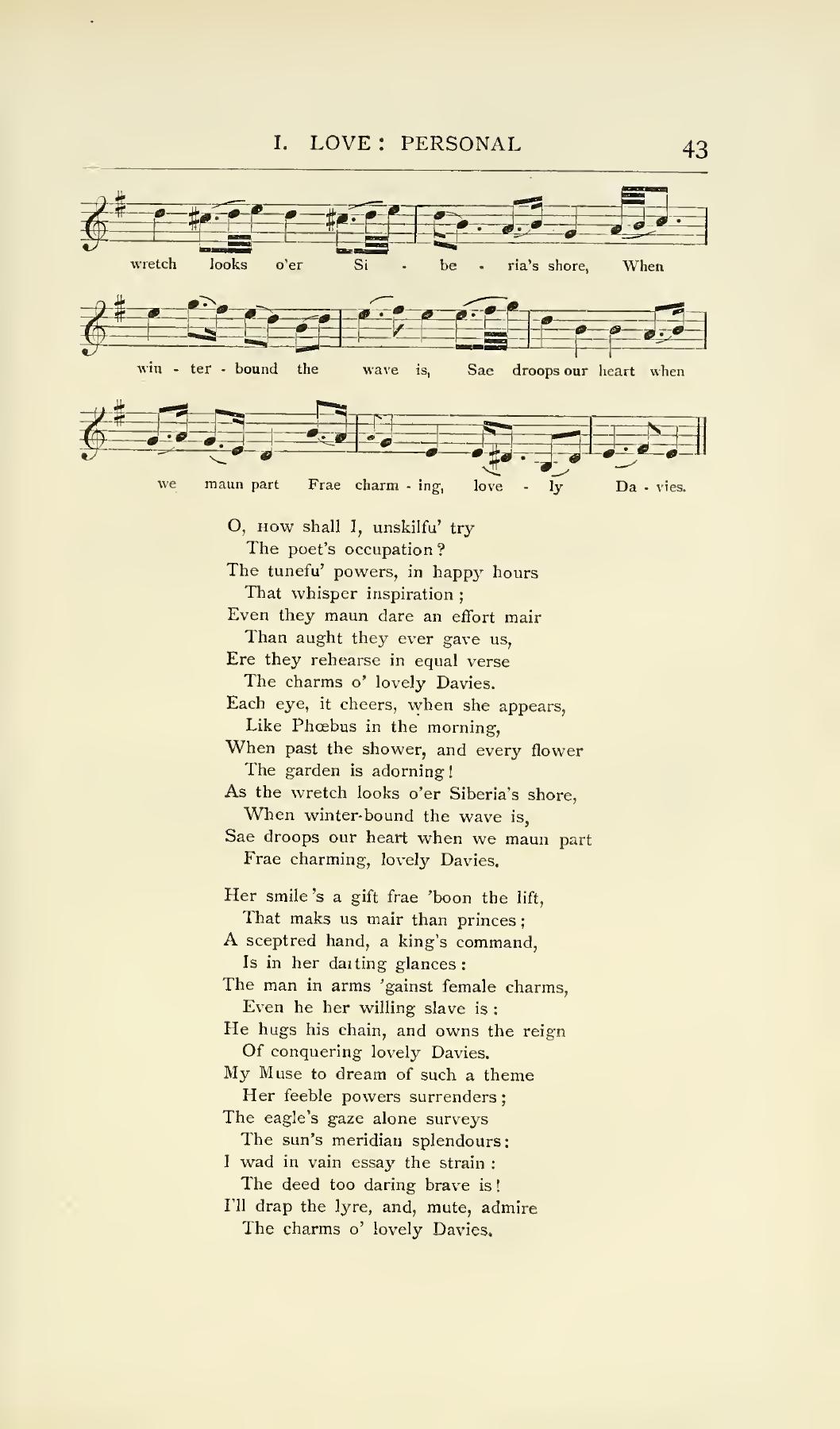
O, how shall I, unskilfu', try
Behind the song
Burns sent these verses to Deborah Davies, whom he knew through the Glenriddell circle. He begins by asking how any poet could do justice to her. Her presence brings morning sunlight, her glance wins willing subjects, and at last he drops his lyre in silent admiration. [1][2]
Read the fuller story
The song’s two long stanzas move between delight at her presence and desolation at parting. Sunlit flowers give way to a winter-bound Siberian shore; a supposedly resistant man embraces the chains of her rule. These changes enlarge the compliment into a whole imagined climate and kingdom.[1]
At the close, the speaker compares his task with an eagle looking into the midday sun and drops his lyre in silent admiration. The elaborate song has made its tribute through the very act of declaring the task beyond its powers. Cunningham’s brief headnote calls it a Museum song honouring Miss Davies, whom he describes as witty, handsome and unfortunate.[1]
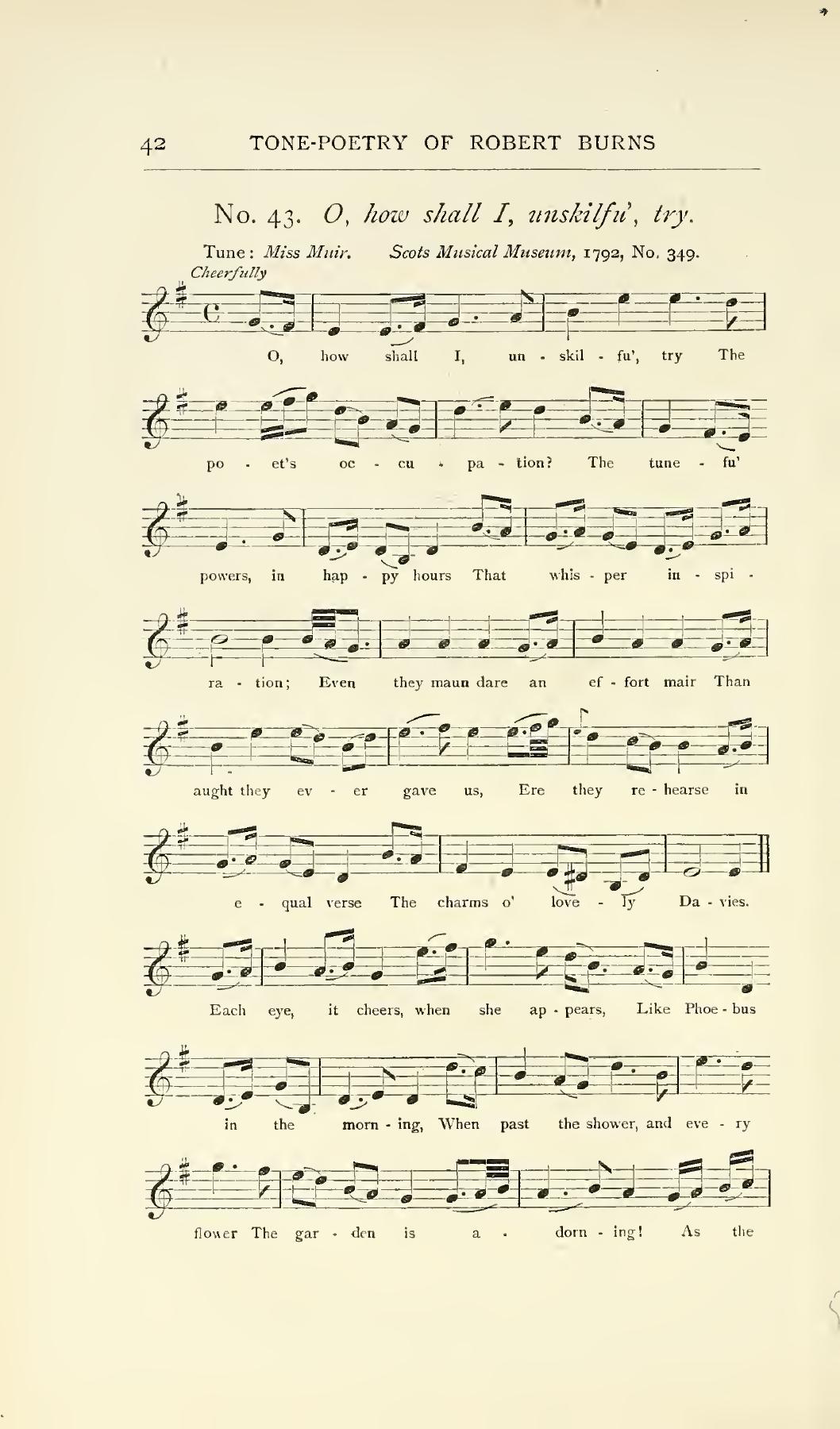 View score Dick’s Songs of Robert Burns (1903)
Lyrics
Choose an edition
Cunningham (1855)
O how shall I, unskilfu’, try
  The poet’s occupation,
The tunefu’ powers, in happy hours,
  That whispers inspiration?
Even they maun dare an effort mair,
  Than aught they ever gave us,
Or they rehearse, in equal verse,
  The charms o’ lovely Davies.
Each eye it cheers, when she appears,
  Like Phœbus in the morning.
When past the shower, and ev’ry flower
  The garden is adorning.
As the wretch looks o’er Siberia’s shore,
  When winter-bound the wave is;
Sae droops our heart when we maun part
  Frae charming lovely Davies.

Her smile’s a gift, frae ‘boon the lift,
  That maks us mair than princes;
A scepter’d hand, a king’s command,
  Is in her darting glances:
The man in arms, ‘gainst female charms,
  Even he her willing slave is;
He hugs his chain, and owns the reign
  Of conquering, lovely Davies.
My muse to dream of such a theme,
  Her feeble pow’rs surrender:
The eagle’s gaze alone surveys
  The sun’s meridian splendour:
I wad in vain essay the strain,
  The deed too daring brave is!
I’ll drap the lyre, and mute admire
  The charms o’ lovely Davies.
Digital text from Project Gutenberg.
View the source edition · p. 251
About this edition
Cunningham’s preface discusses several poems he left out of the collection.
Dick (1903) · no. 43
The words are on the score page.
View the source edition · no. 43; pp. 42–43
Scots Musical Museum, vol. IV (1792) · no. 349
View the source edition · Volume 4, no. 349; pp. 360–361
Music
View historical scores
Dick’s Songs of Robert Burns (1903)
no. 43; pp. 42–43
View source · Download citation