Yestreen I had a pint o' wine
Behind the song
The singer chooses Anna’s embrace over the world’s empires. His private evening of wine and intimacy expands into a declaration that neither royal splendour nor the commands of kirk and state can outweigh her.[1]
Read the fuller story
Biblical manna supplies the first comparison for his delight. The next verse offers monarchs the lands from the Indus to Savannah while keeping Anna for himself. He then dismisses the sun, moon and stars and welcomes night as the time when they can meet.[1]
The final verse gives his attachment its most defiant form. Kirk and state may forbid the lovers’ behaviour, but the speaker rejects their authority. Anna becomes the light of his life and the first of any three wishes he might receive.[1]
Cunningham says Burns recommended the song to Thomson. His headnote also disputes an earlier editor’s claim that Burns called it one of his best love songs. Its identification of Anna with a woman at Burns’s Dumfries drinking place is the editor’s account.[1]
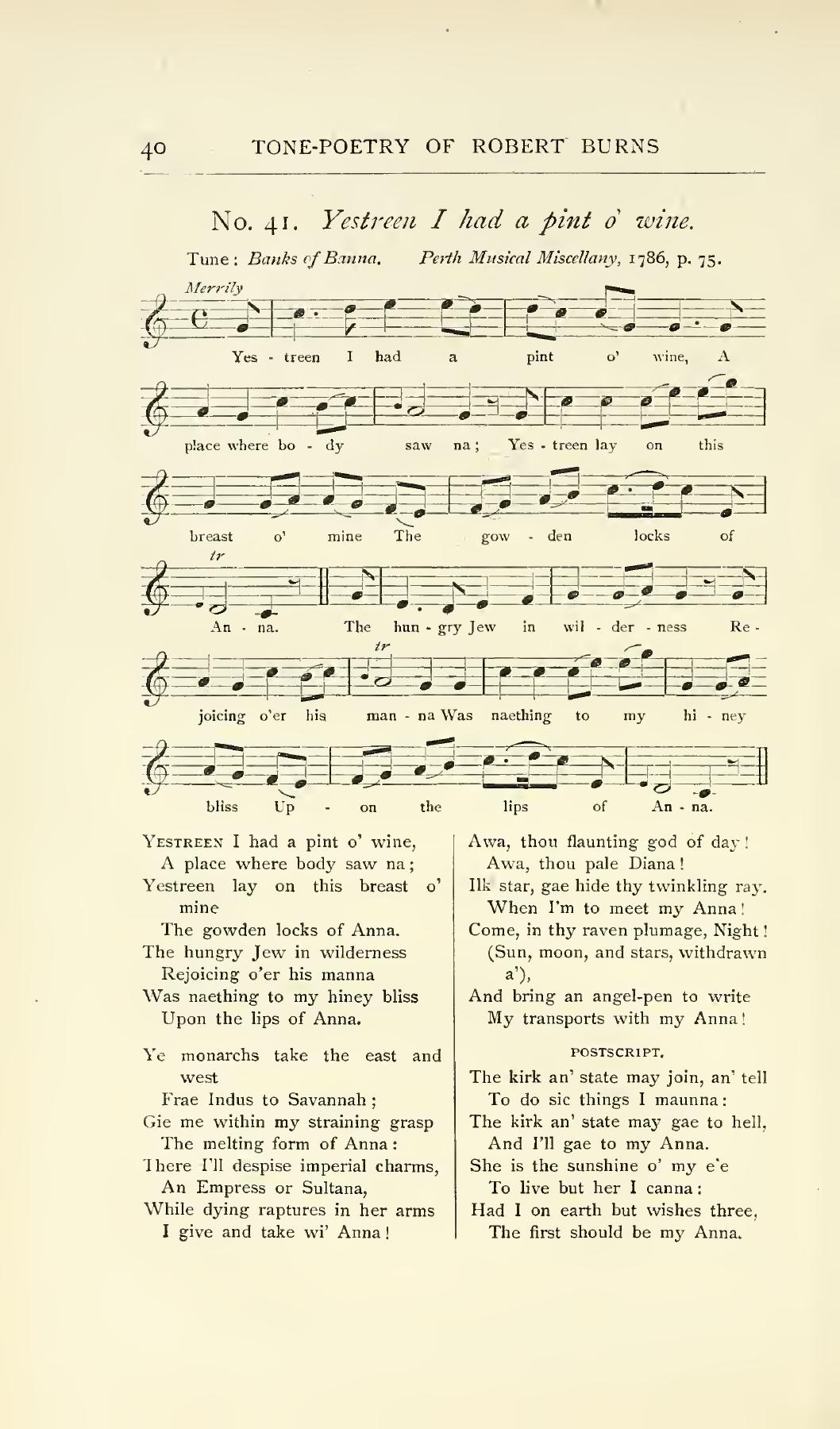 View score Dick’s Songs of Robert Burns (1903)
Lyrics
Choose an edition
Cunningham (1855)
Yestreen I had a pint o’ wine,
  A place where body saw na’;
Yestreen lay on this breast o’ mine
  The gowden locks of Anna.
The hungry Jew in wilderness
  Rejoicing o’er his manna,
Was naething to my hinny bliss
  Upon the lips of Anna.

Ye monarchs tak the east and west,
  Frae Indus to Savannah!
Gie me within my straining grasp
  The melting form of Anna.
There I’ll despise imperial charms,
  An empress or sultana,
While dying raptures in her arms
  I give and take with Anna!

Awa, thou flaunting god o’ day!
  Awa, thou pale Diana!
Ilk star gae hide thy twinkling ray,
  When I’m to meet my Anna.
Come, in thy raven plumage, night!
  Sun, moon, and stars withdrawn a’;
And bring an angel pen to write
  My transports wi’ my Anna!

The kirk an’ state may join and tell—
  To do sic things I maunna:
The kirk and state may gang to hell,
  And I’ll gae to my Anna.
She is the sunshine of my e’e,
  To live but her I canna:
Had I on earth but wishes three,
  The first should be my Anna.
Digital text from Project Gutenberg.
View the source edition · p. 273
About this edition
Cunningham’s preface discusses several poems he left out of the collection.
Dick (1903) · no. 41
The words are on the score page.
View the source edition · no. 41; p. 40
Music
View historical scores
Dick’s Songs of Robert Burns (1903)
no. 41; p. 40
Recommended to Thomson by Burns
Cunningham records Burns recommending this text to Thomson and contests attributed words of self-praise.
Words Authorship separately evidenced for related Anna text; current selected role minimum transmission
Burns’s role Recommended to Thomson by Burns