Blythe hae I been on yon hill
Behind the song
Even the lambs on the hill remind the singer how carefree he was before he fell for Lesley Baillie. Now he can only stare, sigh and stay silent. By the end, the green turf of the opening has become the place he imagines for his grave. Cunningham says Burns rated the song highly. [1]
Read the fuller story
The first stanza sets former happiness against present distress. Sport, singing and play once belonged to an easy life outdoors; now they have lost their power to please. Lesley’s beauty and reserve become the centre of a feeling the speaker cannot master.[1]
The second stanza slows into repeated words and broken actions. The lover can only stare, sigh and remain silent. Declaring hopeless affection seems a task beyond him, and he imagines the green turf as his dwelling if Lesley will not relieve his pain. The landscape that began with living lambs ends with the thought of a grave.[1]
Cunningham prints “Liggeram Cosh” as the tune. His headnote says Burns described the song to Thomson as among his finest compositions and associated it with an exceptionally beautiful woman. The lyric sustains its own concentrated progression: freedom remembered, pleasure lost and a declaration that can scarcely find a voice.[1]
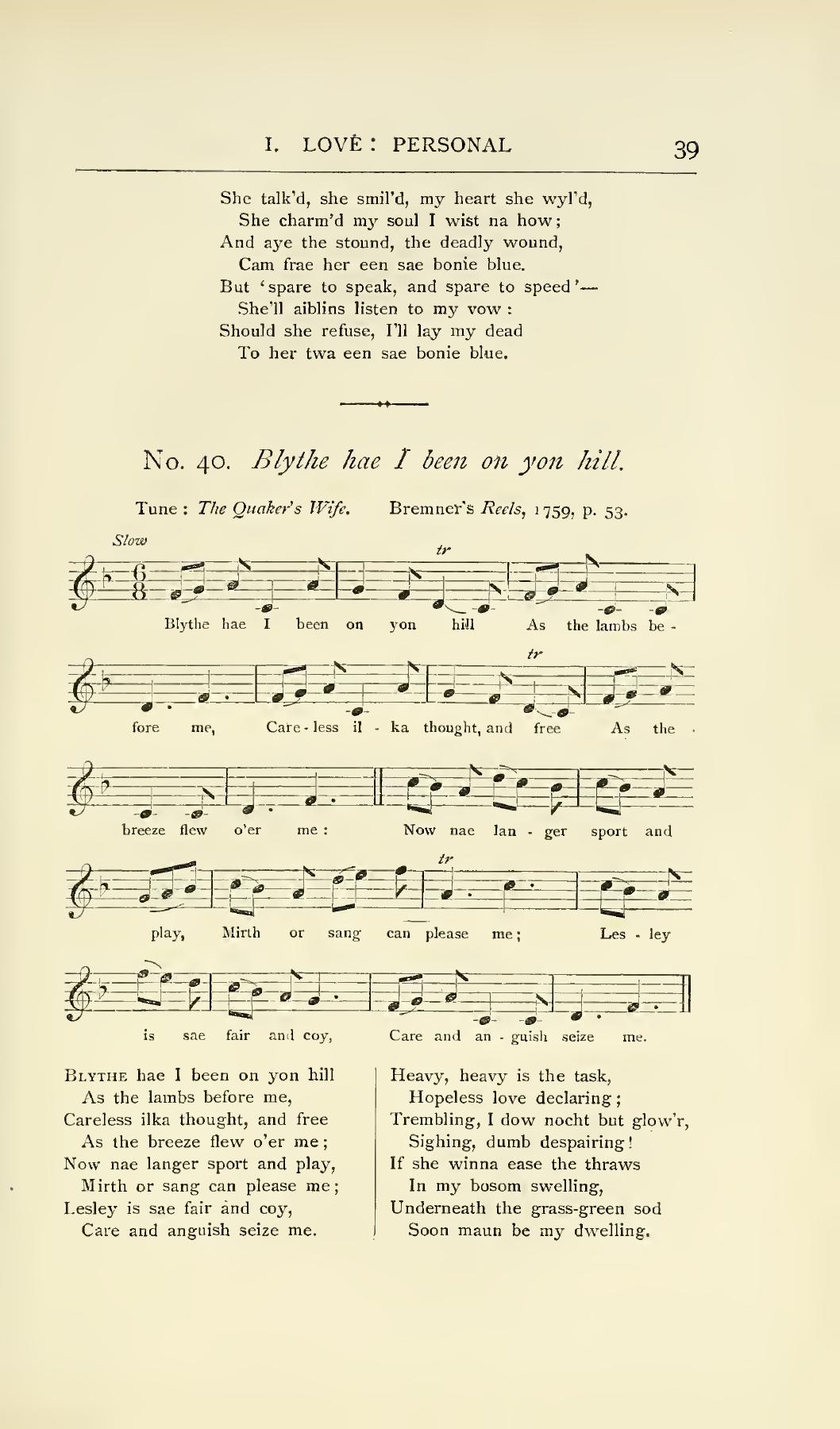 View score Dick’s Songs of Robert Burns (1903)
Lyrics
Choose an edition
Cunningham (1855)
Blythe hae I been on yon hill
  As the lambs before me;
Careless ilka thought and free
  As the breeze flew o’er me.
Now nae langer sport and play,
  Mirth or sang can please me;
Lesley is sae fair and coy,
  Care and anguish seize me.

Heavy, heavy is the task,
  Hopeless love declaring:
Trembling, I dow nocht but glow’r,
  Sighing, dumb, despairing!
If she winna ease the thraws
  In my bosom swelling,
Underneath the grass-green sod
  Soon maun be my dwelling.
Digital text from Project Gutenberg.
View the source edition · p. 281
About this edition
Cunningham’s preface discusses several poems he left out of the collection.
Dick (1903) · no. 40
The words are on the score page.
View the source edition · no. 40; p. 39
Music
View historical scores
Dick’s Songs of Robert Burns (1903)
no. 40; p. 39