The day returns, my bosom burns
Behind the song
On his wedding anniversary the singer finds winter sweeter than summer. Crowns and cargoes of riches mean little beside the person he married. Then comes the one thing he fears: the “iron hand” of death that will part them. [1]
Read the fuller story
Cunningham describes the seventh of November as the wedding anniversary of Mr and Mrs Riddell of Friars-Carse. Dick quotes a recollection attributed to Burns praising Robert Riddell and his wife as exceptionally happy and worthy, and recalling evenings at their fireside. The account thanks them for hospitality and for many of the happiest hours of his life. It connects the formal compliment of the song with a sustained friendship. [2][3]
Dick also quotes a letter to Peggy Chalmers dated 16 September 1788. In it Burns describes making two stanzas for an air composed by a musical acquaintance for the anniversary of his wedding on 7 November. Dick identifies Riddell’s tune with his New Music of 1787. Both held song editions name Seventh of November above the words; Dick supplies the notation and marks it Not fast. The anniversary is built into the musical title as well as the opening line. [3][1][2]
Story references
- James C. Dick, The Songs of Robert Burns (1903), No. 37; printed pp. 36–36; PDF pp. 92–92
- Allan Cunningham, The Complete Works of Robert Burns (1855), printed 234; HTML #songsLXIX. Project Gutenberg transcription.
- James C. Dick, The Songs of Robert Burns (1903), Dick note 37; printed 363,364; PDF 419,420
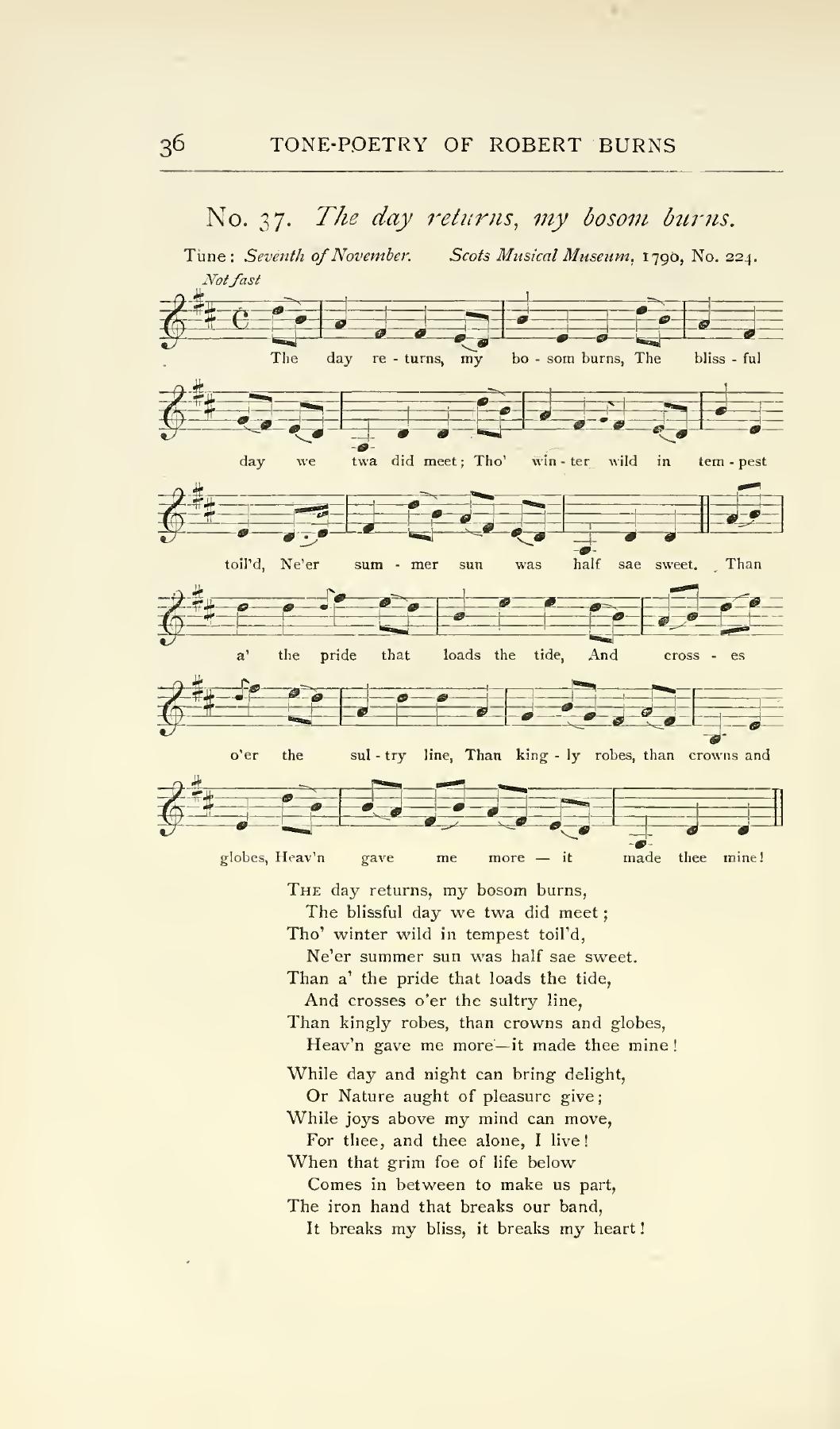 View score Dick’s Songs of Robert Burns (1903)
Lyrics
Choose an edition
Version notes
| Dick (1903) · no. 37 | Cunningham · 1855Ebook transcription |
|---|---|
| Heav’n | Heaven |
| summer sun | summer-sun |
| heart! | heart. |
| below / Comes in between to make us part, | below, / Comes in between to make us part, |
Dick (1903) · no. 37
The day returns, my bosom burns,
The blissful day we twa did meet;
Tho' winter wild in tempest toil'd,
Ne'er summer sun was half sae sweet.
Than a' the pride that loads the tide,
And crosses o'er the sultry line,
Than kingly robes, than crowns and globes,
Heav'n gave me more—it made thee mine!

While day and night can bring delight,
Or Nature aught of pleasure give;
While joys above my mind can move,
For thee, and thee alone, I live!
When that grim foe of life below
Comes in between to make us part,
The iron hand that breaks our band,
It breaks my bliss, it breaks my heart!
These are the words printed below the score.
View the source edition · no. 37; p. 36
About this edition
Both editions have two eight-line stanzas. Dick has “Heav’n” where Cunningham has “Heaven”, and “summer sun” where Cunningham has “summer-sun”. Dick uses an exclamation after the final “heart”; Cunningham ends with a full stop. Cunningham places a comma after “below”; Dick carries that line directly through. Dick’s note transmits both the fireside recollection and the September 1788 letter.
Cunningham (1855)
The day returns, my bosom burns,
  The blissful day we twa did meet,
Tho’ winter wild in tempest toil’d,
  Ne’er summer-sun was half sae sweet.
Than a’ the pride that loads the tide,
  And crosses o’er the sultry line;
Than kingly robes, than crowns and globes,
  Heaven gave me more—it made thee mine!

While day and night can bring delight,
  Or nature aught of pleasure give,
While joys above my mind can move,
  For thee, and thee alone I live.
When that grim foe of life below,
  Comes in between to make us part,
The iron hand that breaks our band,
  It breaks my bliss—it breaks my heart.
Digital text from Project Gutenberg.
View the source edition · p. 234
About this edition
Both editions have two eight-line stanzas. Dick has “Heav’n” where Cunningham has “Heaven”, and “summer sun” where Cunningham has “summer-sun”. Dick uses an exclamation after the final “heart”; Cunningham ends with a full stop. Cunningham places a comma after “below”; Dick carries that line directly through. Dick’s note transmits both the fireside recollection and the September 1788 letter.
Scots Musical Museum, vol. III (1790) · no. 224
View the source edition · Volume 3, no. 224; p. 233
Music
View historical scores
Dick’s Songs of Robert Burns (1903)
no. 37; p. 36