Fate Gave the Word, the Arrow Sped
Behind the song
A mother grieves for the son whose life had held her hopes for the future. The lament joins the image of a felled sapling to that of a bird mourning its stolen young. Cunningham quotes Burns saying the verses were composed partly with Mrs Fergusson of Craigdarroch and partly with Mrs Stewart of Afton in view.[1]
Read the fuller story
Fate’s arrow strikes the son at the opening, taking the mother’s earthly joys with him. The next image gives that loss a future as well as a present: the young tree has fallen before it could provide the shade she expected in old age. The mother has lost a child and the support she imagined receiving from him.[1]
The second stanza brings the grief into the natural world through the mother linnet. Its lament for its young mirrors the woman’s unending mourning. The final appeal changes her relation to death. Once feared, it is now invited to bring the rest she imagines beside her son.[1]
Cunningham introduces the composition statement as words found in a copy of the verses before him. Its two named associations accompany a lyric spoken by one bereaved mother, whose images make the loss both protective and intimate: young life destroyed, shelter withdrawn and the desire for reunion left with death.[1]
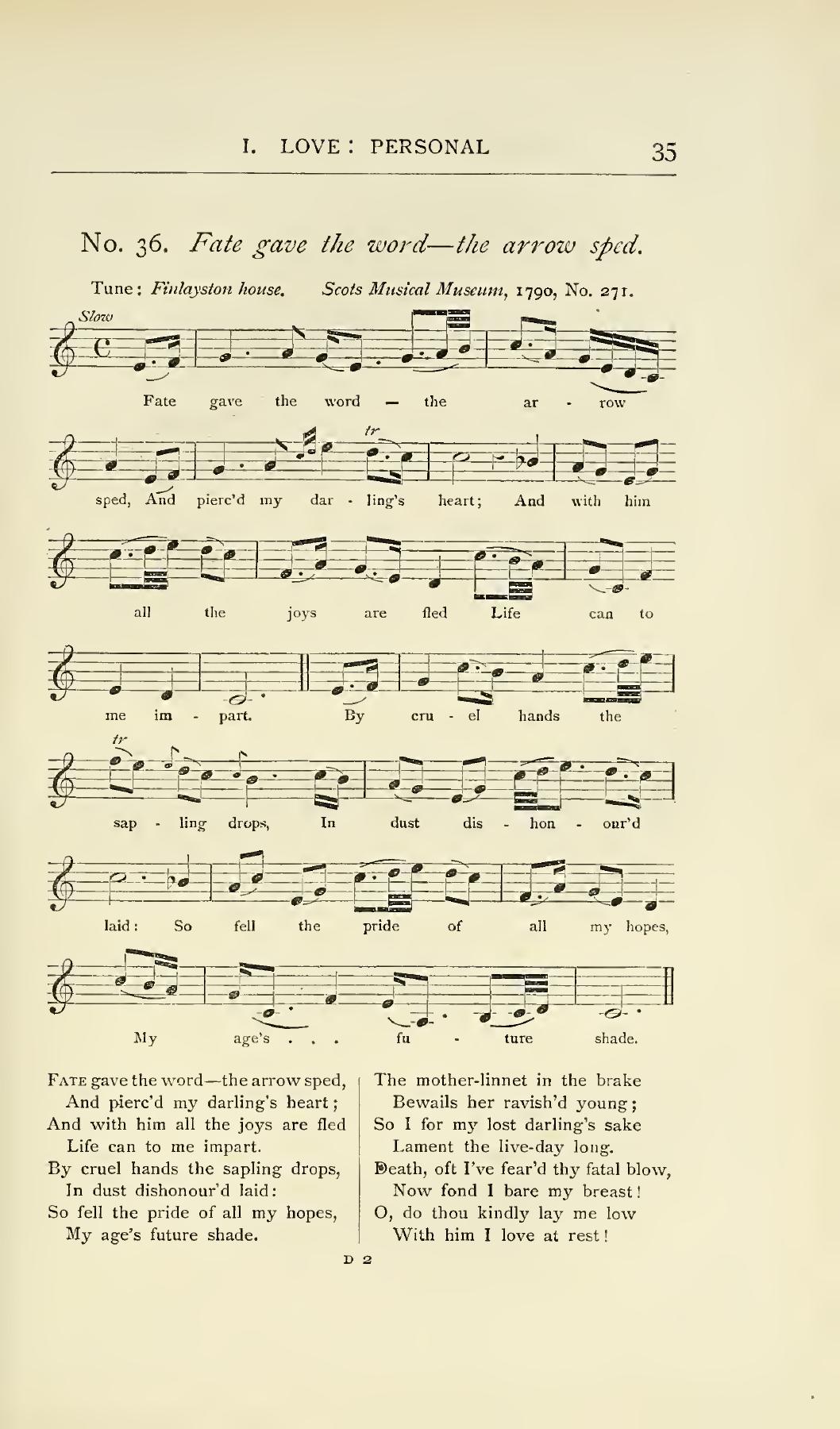 View score Dick’s Songs of Robert Burns (1903)
Lyrics
Choose an edition
Cunningham (1855)
Fate gave the word, the arrow sped,
  And pierc’d my darling’s heart;
And with him all the joys are fled
  Life can to me impart.
By cruel hands the sapling drops,
  In dust dishonour’d laid:
So fell the pride of all my hopes,
  My age’s future shade.

The mother-linnet in the brake
  Bewails her ravish’d young;
So I, for my lost darling’s sake,
  Lament the live day long.
Death, oft I’ve fear’d thy fatal blow,
  Now, fond I bare my breast,
O, do thou kindly lay me low
  With him I love, at rest!
Digital text from Project Gutenberg.
View the source edition · p. 152
About this edition
Cunningham’s preface discusses several poems he left out of the collection.
Dick (1903) · no. 36
The words are on the score page.
View the source edition · no. 36; p. 35
Scots Musical Museum, vol. III (1790) · no. 271
View the source edition · Volume 3, no. 271; p. 280
Music
View historical scores
Dick’s Songs of Robert Burns (1903)
no. 36; p. 35