Tibbie Dunbar
Behind the song
Would Tibbie Dunbar rather ride, take a carriage or walk beside the singer? He asks her to go with him “for better or waur”, with her ordinary coat and without the wealth or connections of her family. [1]
Read the fuller story
Dick places the words in the Scots Musical Museum of 1790, no. 207, and quotes Burns’s description of them as “old words”. He gives the tune as Johnny McGill. In the same note he distinguishes Robert Riddell’s annotation about a possible composer from Burns’s own remarks. Riddell attributes the tune, tentatively, to John McGill, a fiddler in Girvan. [2]
That attributed detail gives the air a local connection while leaving its origin open. Dick also records disputed national claims and other songs attached to the tune. His 1903 score marks it “Briskly”, in 6/8, carrying both quatrains beneath a single continuous setting. The spare text and the forward movement of the music work together around the repeated invitation. [1][2]
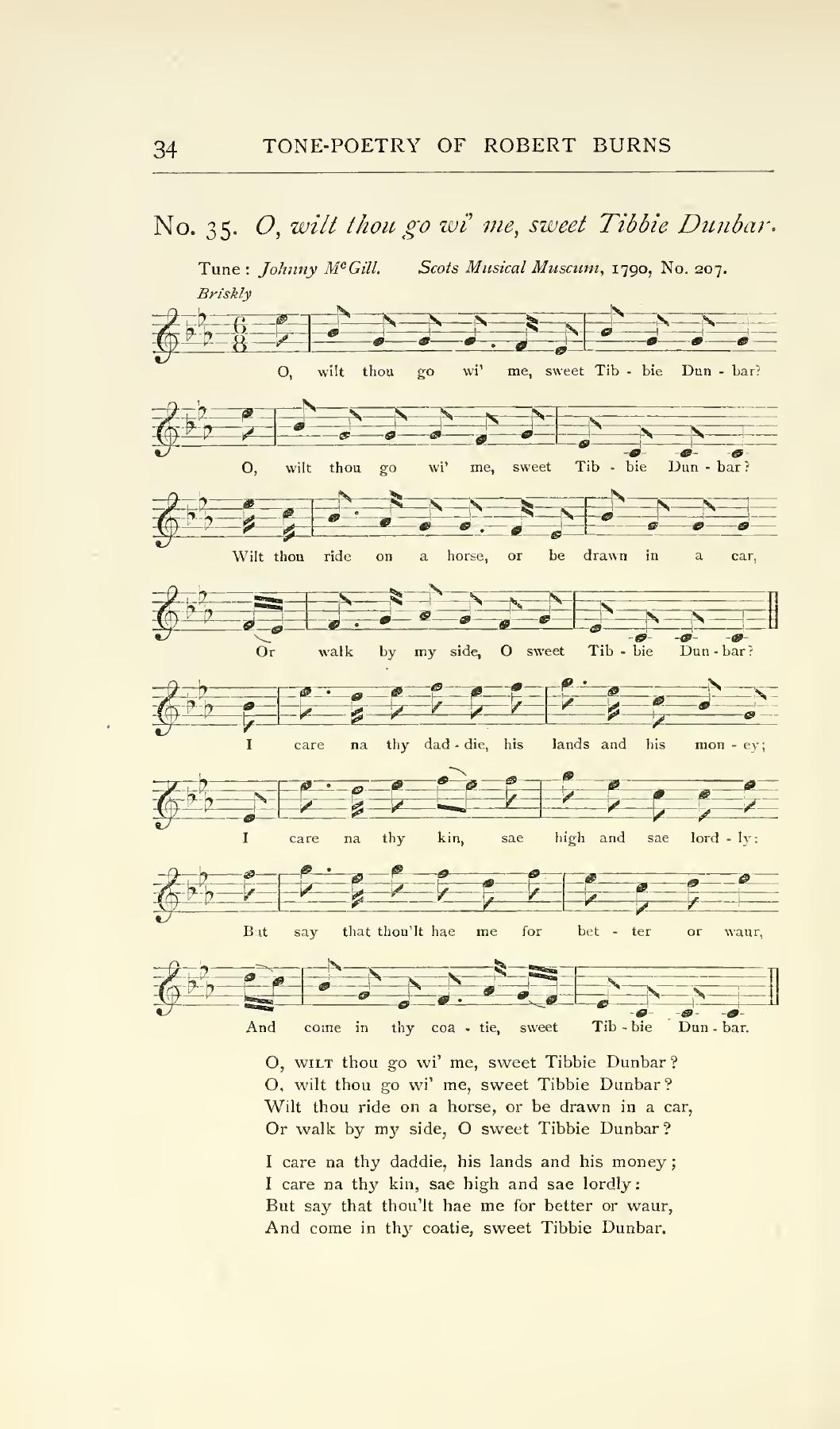 View score Dick’s Songs of Robert Burns (1903)
Lyrics
Choose an edition
Dick (1903) · no. 35
O, wilt thou go wi’ me, sweet Tibbie Dunbar?
O, wilt thou go wi’ me, sweet Tibbie Dunbar?
Wilt thou ride on a horse, or be drawn in a car,
Or walk by my side, O sweet Tibbie Dunbar?

I care na thy daddie, his lands and his money;
I care na thy kin, sae high and sae lordly:
But say that thou’lt hae me for better or waur,
And come in thy coatie, sweet Tibbie Dunbar.
View the source edition · no. 35; p. 34
About this edition
Dick’s complete eight-line reading is supplied here. His heading and score name Johnny McGill. The wording “This tune is said to be the composition of John McGill, fiddler, in Girvan” belongs to Robert Riddell’s note as quoted by Dick. The attached Dick excerpt and complete volume are the same editorial witness.
Scots Musical Museum, vol. III (1790) · no. 207
View the source edition · Volume 3, no. 207; p. 216
Music
View historical scores
Dick’s Songs of Robert Burns (1903)
no. 35; p. 34