She 's fair and fause that causes my smart
Behind the song
A wealthy rival has taken the place of the singer in the affections of a woman he loved “meikle and lang”. His complaint moves quickly from her broken vow and his broken heart to the rival’s possessions. He calls the newcomer a coof, a fool, with plenty of gear; wealth has succeeded where affection failed. [1]
The singer tries to dismiss the loss by declaring woman herself to be worldly goods and letting the bonie lass go. The second stanza widens this personal grievance into an attack on women’s faithfulness. Its final compliment is a trap: the woman has an angel’s form, then the closing line withholds the angel’s mind. The elaborate sarcasm gives the rejected voice its sharpness, while the language of ownership keeps money and love entangled. [1]
Read the fuller story
Dick connects the song with Ann Stewart, whom he describes as having broken an engagement with Burns’s friend Alexander Cunningham. He places its composition around the middle of January 1789, after Burns read news of her marriage, and reports an indignant letter of condolence to Cunningham. This is Dick’s explanation of the personal occasion behind the song’s angry speaker. [2]
Dick prints the tune as The lads of Leith, marked Slowly, citing the Caledonian Pocket Companion of 1752. His note reports an earlier appearance in Walsh’s Caledonian Country Dances on Mr Glen’s authority. Cunningham names the air She’s fair and fause and praises the song’s sarcasm in his introduction. The tune headings therefore give the reader two routes into the same bitter sixteen-line lyric. [1][2][3]
Story references
- James C. Dick, The Songs of Robert Burns (1903), No. 33; printed pp. 32–32; PDF pp. 88–88
- James C. Dick, The Songs of Robert Burns (1903), Dick note 33; printed 362,363; PDF 418,419
- Allan Cunningham, The Complete Works of Robert Burns (1855), printed 263; HTML #songsCXLVI. Project Gutenberg transcription.
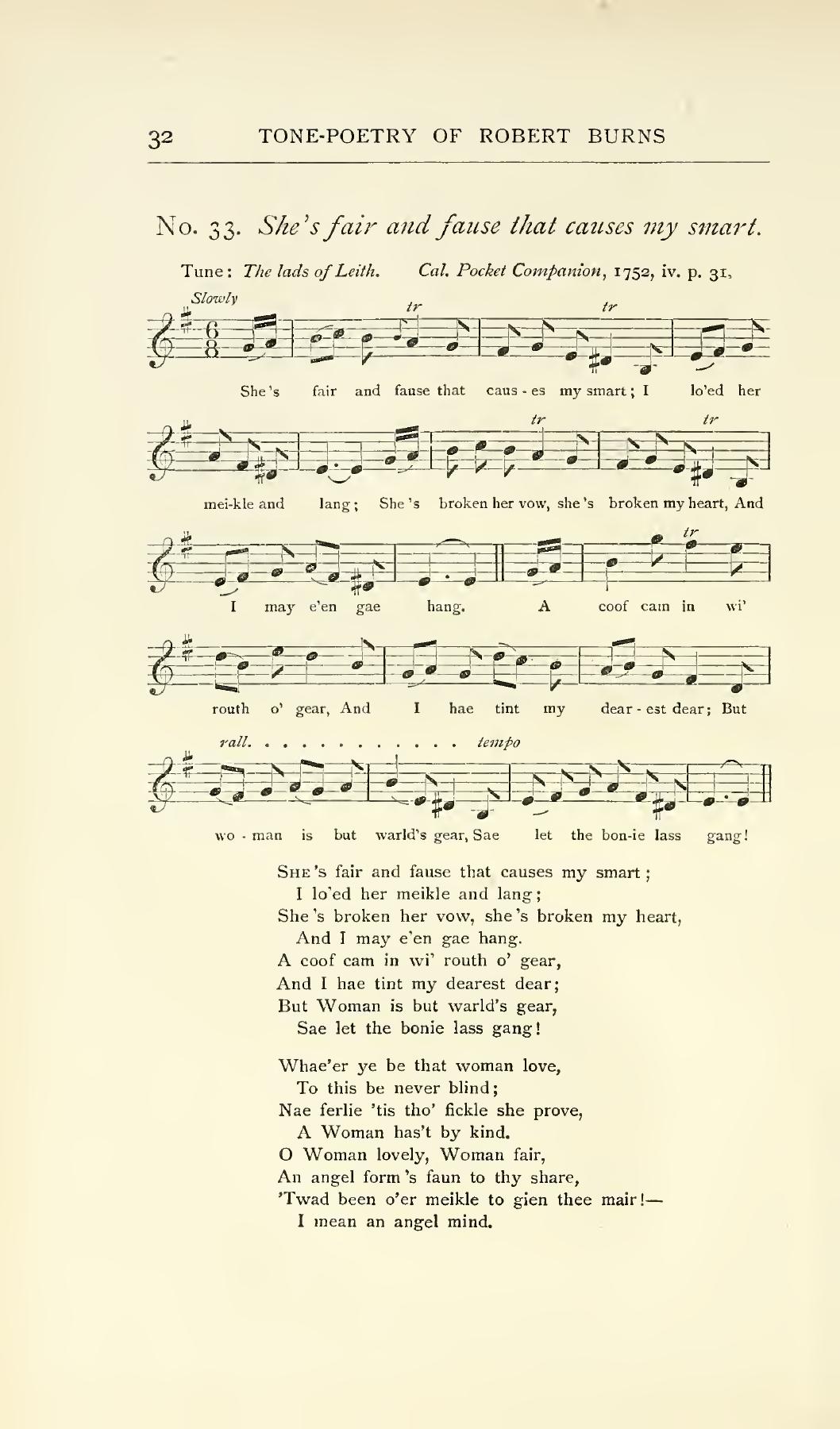 View score Dick’s Songs of Robert Burns (1903)
Lyrics
Choose an edition
Version notes
| Dick (1903) · no. 33 | Cunningham · 1855Ebook transcription |
|---|---|
| The lads of Leith | She’s fair and fause |
| faun | fa’n |
| bonie | bonnie |
| smart; | smart, |
More differences between these editions
| Dick (1903) · no. 33 | Cunningham · 1855Ebook transcription |
|---|---|
| gang! / fair, / mair!— | gang. / fair! / mair— |
| Woman capitalised in lines7/12/13 | woman lower-case |
Dick (1903) · no. 33
She's fair and fause that causes my smart;
I lo'ed her meikle and lang;
She's broken her vow, she's broken my heart,
And I may e'en gae hang.
A coof cam in wi' routh o' gear,
And I hae tint my dearest dear;
But Woman is but warld's gear,
Sae let the bonie lass gang!

Whae'er ye be that woman love,
To this be never blind;
Nae ferlie 'tis tho' fickle she prove,
A Woman has't by kind.
O Woman lovely, Woman fair,
An angel form's faun to thy share,
'Twad been o'er meikle to gien thee mair!—
I mean an angel mind.
View the source edition · no. 33; p. 32
About this edition
Both readings have two eight-line stanzas. Dick prints bonie and faun where Cunningham has bonnie and fa’n, capitalises Woman at several points and ends the first stanza gang! Cunningham ends gang. The tune headings differ: The lads of Leith in Dick and She’s fair and fause in Cunningham.
Cunningham (1855)
She’s fair and fause that causes my smart,
  I lo’ed her meikle and lang;
She’s broken her vow, she’s broken my heart,
  And I may e’en gae hang.
A coof cam in wi’ routh o’ gear,
And I hae tint my dearest dear;
But woman is but warld’s gear,
  Sae let the bonnie lass gang.

Whae’er ye be that woman love,
  To this be never blind,
Nae ferlie ’tis tho’ fickle she prove,
  A woman has’t by kind.
O woman, lovely woman fair!
An angel form’s fa’n to thy share,
’Twad been o’er meikle to gien thee mair—
  I mean an angel mind.
Digital text from Project Gutenberg.
View the source edition · p. 263
About this edition
Both readings have two eight-line stanzas. Dick prints bonie and faun where Cunningham has bonnie and fa’n, capitalises Woman at several points and ends the first stanza gang! Cunningham ends gang. The tune headings differ: The lads of Leith in Dick and She’s fair and fause in Cunningham.
Scots Musical Museum, vol. IV (1792) · no. 398
View the source edition · Volume 4, no. 398; p. 411
Music
View historical scores
Dick’s Songs of Robert Burns (1903)
no. 33; p. 32