Musing on the roaring ocean
Behind the song
A woman thinks of the ocean that separates her from the man she loves, and prays for his safety wherever he may be. The movement of the water becomes the movement of her thoughts: hope and fear rise in an “alternate billow” until exhaustion brings sleep. [1]
Sleep offers a conversation that daylight cannot provide. The whispering spirits around her pillow speak of the absent man; she asks them to return, leaving bright day to people who have escaped sorrow. The closing request repeats the words heard beside the pillow, making the song return to the comfort it has briefly found. [1]
Read the fuller story
Dick connects the verses with Mrs M’Lachlan, whose husband was an officer serving abroad with the East India Company, citing the account in Reliques of 1808. Cunningham gives the name as Mrs M’Lauchlan and describes the verses as a compliment to her feelings. [2][3]
Dick prints the air as Druimionn dubh, with the direction Slow and a reference to McDonald’s Highland Airs of 1784. His note translates the title as The black cow and distinguishes another air with the same name. The measured musical direction accompanies a lyric whose strongest action happens in the restless passage from prayer to dreams. [1][2]
Story references
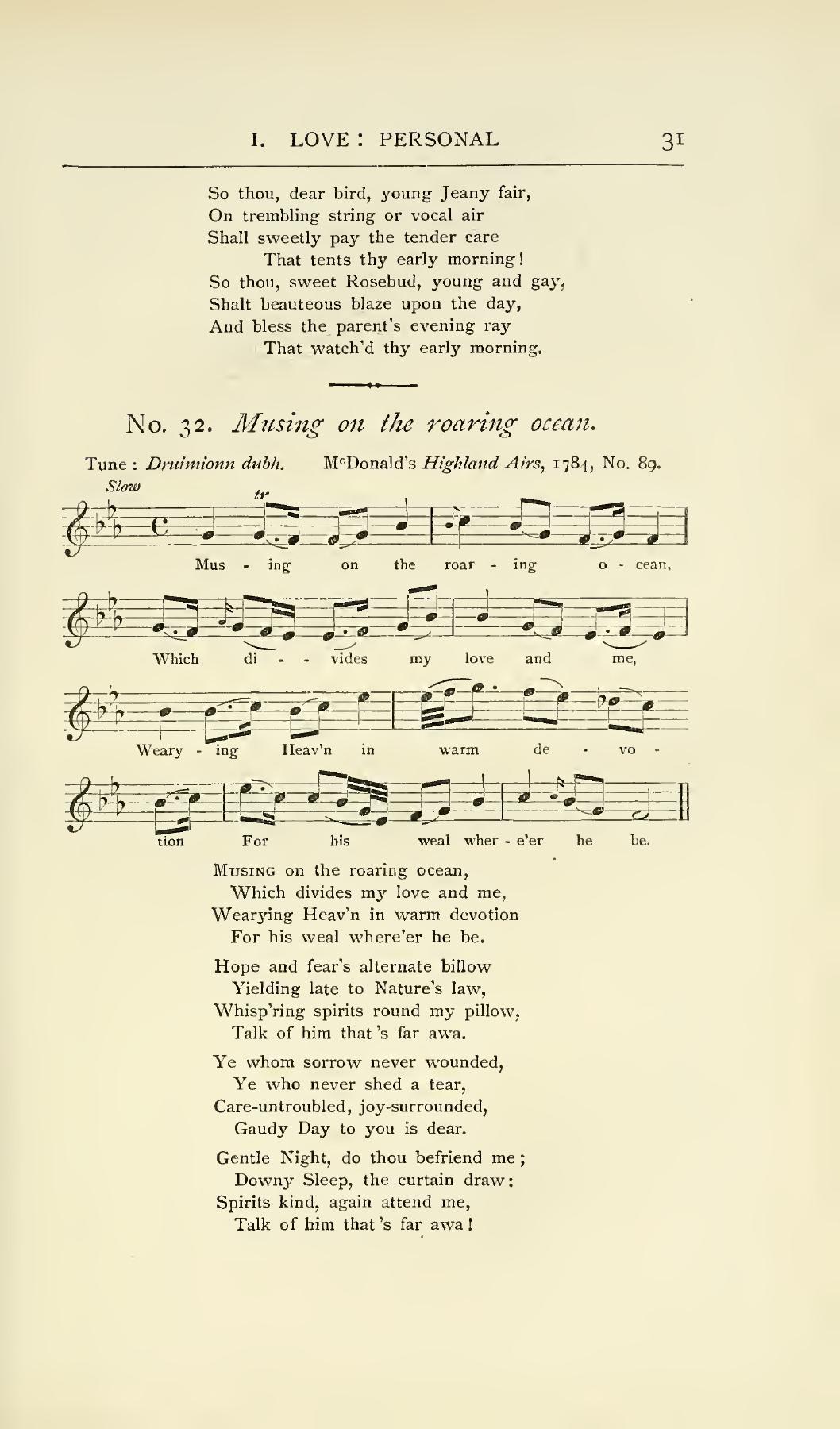 View score Dick’s Songs of Robert Burns (1903)
Lyrics
Choose an edition
Version notes
| Dick (1903) · no. 32 | Cunningham · 1855Ebook transcription |
|---|---|
| Wearying Heav’n | Wearying heaven |
| Nature / Day / Night / Sleep | nature / day / night / sleep |
| four unnumbered quatrains | four numbered quatrains |
Dick (1903) · no. 32
Musing on the roaring ocean,
Which divides my love and me,
Wearying Heav'n in warm devotion
For his weal where'er he be.

Hope and fear's alternate billow
Yielding late to Nature's law,
Whisp'ring spirits round my pillow,
Talk of him that's far awa.

Ye whom sorrow never wounded,
Ye who never shed a tear,
Care-untroubled, joy-surrounded,
Gaudy Day to you is dear.

Gentle Night, do thou befriend me;
Downy Sleep, the curtain draw;
Spirits kind, again attend me,
Talk of him that's far awa!
View the source edition · no. 32; p. 31
About this edition
Both editions print four quatrains; Cunningham numbers them and Dick leaves them unnumbered. Dick contracts Heav’n, capitalises Nature, Day, Night and Sleep, and has commas after me and pillow; Cunningham prints heaven, lower-case personifications and a semicolon after me. Cunningham also puts a comma after devotion. The surnames differ in the editorial accounts: M’Lachlan in Dick and M’Lauchlan in Cunningham.
Cunningham (1855)
Musing on the roaring ocean,
  Which divides my love and me;
Wearying heaven in warm devotion,
  For his weal where’er he be.

Hope and fear’s alternate billow
  Yielding late to nature’s law,
Whisp’ring spirits round my pillow
  Talk of him that’s far awa.

Ye whom sorrow never wounded,
  Ye who never shed a tear,
Care-untroubled, joy-surrounded,
  Gaudy day to you is dear.

Gentle night, do thou befriend me;
  Downy sleep, the curtain draw;
Spirits kind, again attend me,
  Talk of him that’s far awa!
Digital text from Project Gutenberg.
View the source edition · p. 229
About this edition
Both editions print four quatrains; Cunningham numbers them and Dick leaves them unnumbered. Dick contracts Heav’n, capitalises Nature, Day, Night and Sleep, and has commas after me and pillow; Cunningham prints heaven, lower-case personifications and a semicolon after me. Cunningham also puts a comma after devotion. The surnames differ in the editorial accounts: M’Lachlan in Dick and M’Lauchlan in Cunningham.
Scots Musical Museum, vol. II (1788) · no. 179
View the source edition · Volume 2, no. 179; p. 187
Music
View historical scores
Dick’s Songs of Robert Burns (1903)
no. 32; p. 31