A rosebud, by my early walk
Behind the song
Jeany Cruikshank was twelve and played the harpsichord. According to Dick, she sang and played songs Burns was preparing for the Scots Musical Museum while he lodged with her family in Edinburgh. [2]
In the song a rosebud bends over a path through the corn and a linnet keeps her nest warm despite the dew. The last stanza names Jeany and looks ahead to the pleasure her music will bring as she grows up. [1]
Read the fuller story
Dick identifies Jeany as the twelve-year-old daughter of William Cruikshank, an Edinburgh High School master with whom Burns lodged. His account describes her as an accomplished harpsichord player who sang and played songs Burns was preparing for the Museum. Trying words with melodies gives the household story particular interest: the young musician helped make songs audible while they were being prepared. These details come through Dick’s later account. [2]
Cunningham also identifies Jean Cruikshank, later Mrs Henderson, as the Rose-bud. Dick quotes a note attributed to Burns naming David Sillar as the composer of the air and identifying him as the Davie addressed in a poetic epistle. Dick’s own score is headed A rosebud and marked Slow; Cunningham calls the tune The Rose-bud. The child’s singing in the lyric therefore has a useful counterpart in the song’s transmitted musical history. [3][2][1]
Story references
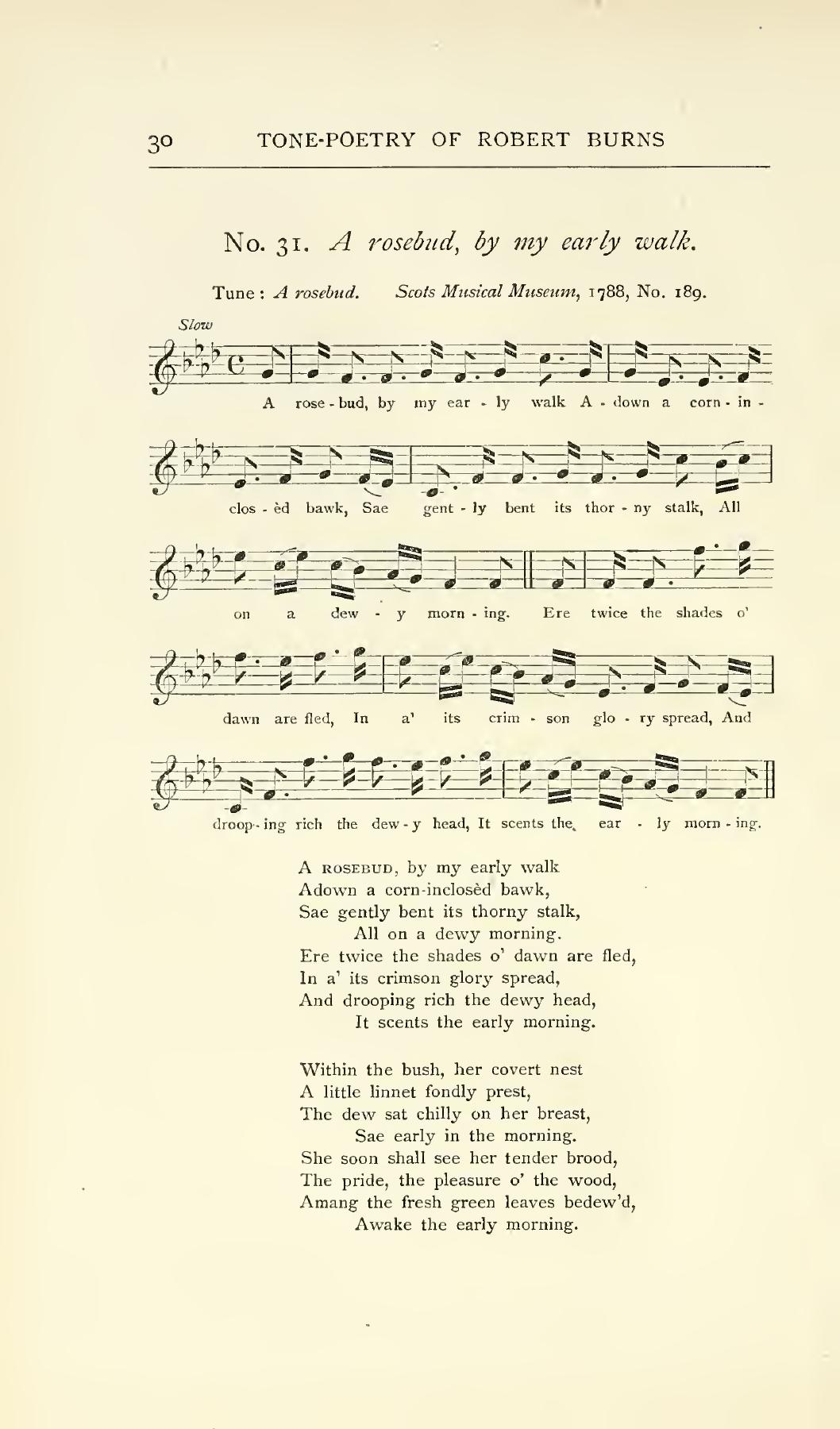 View score Dick’s Songs of Robert Burns (1903)
Lyrics
Choose an edition
Version notes
| Dick (1903) · no. 31 | Cunningham · 1855Ebook transcription |
|---|---|
| corn-inclosed | corn-enclosed |
| A rosebud / sweet Rosebud | A rose-bud / sweet rose-bud |
| early morning! | early morning. |
| A rosebud | The Rose-bud |
Dick (1903) · no. 31
A rosebud, by my early walk
Adown a corn-inclosed bawk,
Sae gently bent its thorny stalk,
All on a dewy morning.
Ere twice the shades o' dawn are fled,
In a' its crimson glory spread,
And drooping rich the dewy head,
It scents the early morning.

Within the bush, her covert nest
A little linnet fondly prest,
The dew sat chilly on her breast,
Sae early in the morning.
She soon shall see her tender brood,
The pride, the pleasure o' the wood,
Amang the fresh green leaves bedew'd,
Awake the early morning.

So thou, dear bird, young Jeany fair,
On trembling string or vocal air,
Shall sweetly pay the tender care
That tends thy early morning!
So thou, sweet Rosebud, young and gay,
Shalt beauteous blaze upon the day,
And bless the parent's evening ray
That watch'd thy early morning.
These are the words printed below the score.
View the source edition · no. 31; pp. 30–31
About this edition
Both readings have three eight-line stanzas. Dick has “corn-inclosed”, “shades o’ dawn” and the capitalised “Rosebud” in the last stanza; Cunningham has “corn-enclosed”, “shades o’ dawn” and “rose-bud”. Cunningham’s first stanza has “Ere twice the shades o’ dawn are fled” as does Dick. Dick puts an exclamation after “early morning” midway through the final stanza; Cunningham uses a full stop. Both print “Shall sweetly pay”.
Cunningham (1855)
A rose-bud by my early walk,
Adown a corn-enclosed bawk,
Sae gently bent its thorny stalk,
  All on a dewy morning.
Ere twice the shades o’ dawn are fled,
In a’ its crimson glory spread,
And drooping rich the dewy head,
  It scents the early morning.

Within the bush, her covert nest
A little linnet fondly prest,
The dew sat chilly on her breast
  Sae early in the morning.
She soon shall see her tender brood,
The pride, the pleasure o’ the wood,
Amang the fresh green leaves bedew’d,
  Awake the early morning.

So thou, dear bird, young Jeany fair,
On trembling string or vocal air,
Shall sweetly pay the tender care
  That tends thy early morning.
So thou, sweet rose-bud, young and gay,
Shalt beauteous blaze upon the day,
And bless the parent’s evening ray
  That watch’d thy early morning.
Digital text from Project Gutenberg.
View the source edition · p. 230
About this edition
Both readings have three eight-line stanzas. Dick has “corn-inclosed”, “shades o’ dawn” and the capitalised “Rosebud” in the last stanza; Cunningham has “corn-enclosed”, “shades o’ dawn” and “rose-bud”. Cunningham’s first stanza has “Ere twice the shades o’ dawn are fled” as does Dick. Dick puts an exclamation after “early morning” midway through the final stanza; Cunningham uses a full stop. Both print “Shall sweetly pay”.
Scots Musical Museum, vol. II (1788) · no. 189
View the source edition · Volume 2, no. 189; p. 197
Music
View historical scores
Dick’s Songs of Robert Burns (1903)
no. 31; pp. 30–31