By Oughtertyre grows the aik
Behind the song
Dick identifies Phemie as Euphemia Murray, known as the Flower of Strathmore. In the song her smile is like a summer morning and her eyes outshine the evening sun. The singer ranges from oak at Oughtertyre to birch beside Yarrow and always comes back to Phemie, the liveliest woman he has seen. [1][2]
Her song shares an air with “Andro and his cutty gun”. Dick’s examples of older words take the tune into an alehouse, where cheese and toasted cakes help the drink go down. [2]
Read the fuller story
Dick identifies Phemie as Euphemia Murray, a cousin of Burns’s host Sir William Murray of Ochtertyre, and connects the song with a Highland visit. He calls her eighteen and says she was known as the Flower of Strathmore. Cunningham’s introduction uses the same epithet and places the writing at Ochtertyre in June 1787; Dick’s account associates it with the later visit. [2][3]
Both editions name Andro and his cutty gun as the air. Dick traces it through a convivial song and quotes an alehouse scene in which cheese and toasted cakes help the drink go down. He also prints a different, bawdy stanza from the Merry Muses. Those older words give the musical heading a social history alongside the bright portrait of Phemie. Their presence helps explain how one tune could support several kinds of song. [1][2][3]
Story references
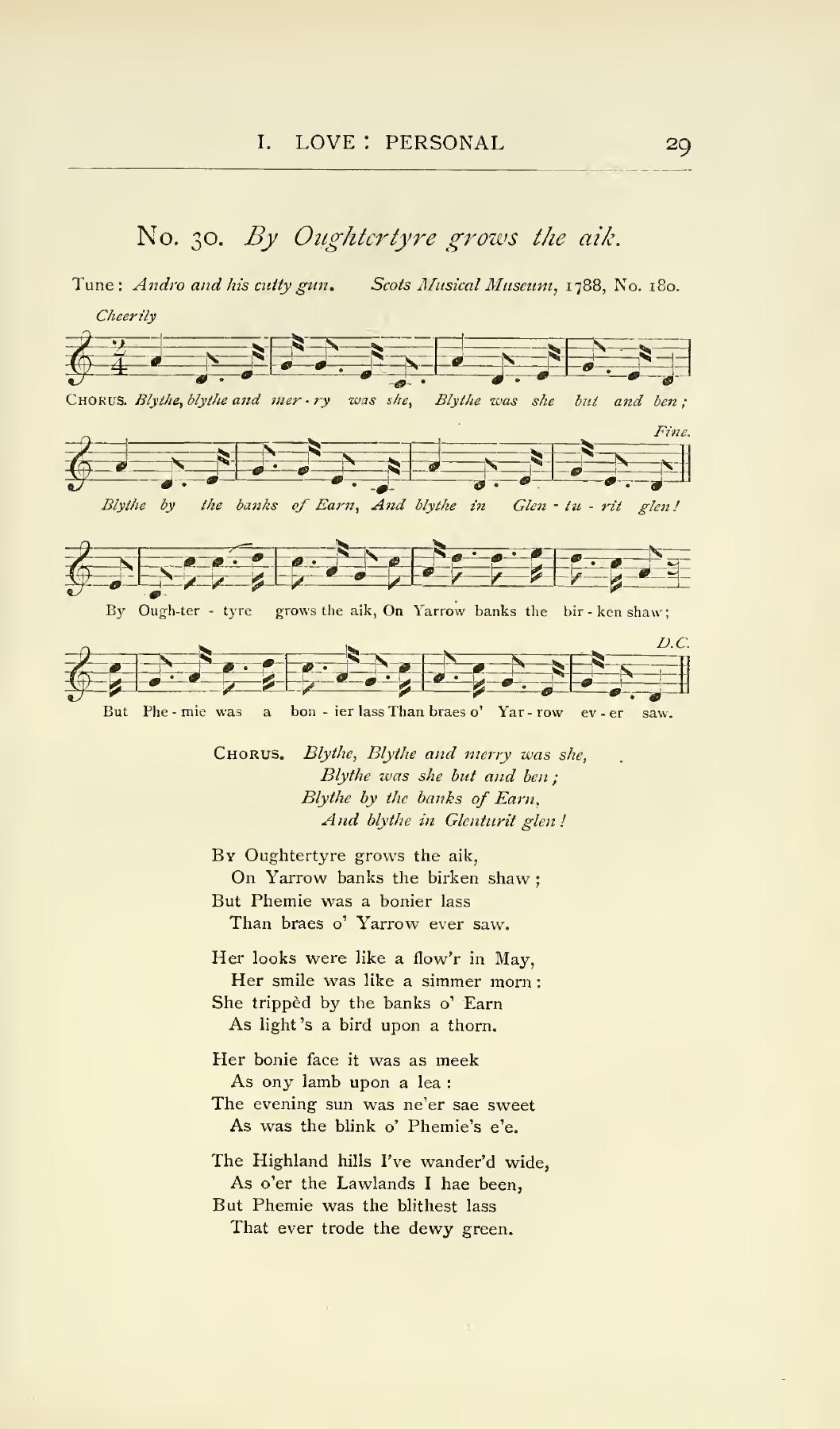 View score Dick’s Songs of Robert Burns (1903)
Lyrics
Dick (1903) · no. 30
Chorus. Blythe, Blythe and merry was she,
Blythe was she but and ben;
Blythe by the banks of Earn,
And blythe in Glenturit glen!

By Oughtertyre grows the aik,
On Yarrow banks the birken shaw;
But Phemie was a bonier lass
Than braes o' Yarrow ever saw.

Her looks were like a flow'r in May,
Her smile was like a simmer morn;
She tripped by the banks o' Earn
As light's a bird upon a thorn.

Her bonie face it was as meek
As ony lamb upon a lea;
The evening sun was ne'er sae sweet
As was the blink o' Phemie's e'e.

The Highland hills I've wander'd wide,
As o'er the Lawlands I hae been,
But Phemie was the blythest lass
That ever trode the dewy green.
These are the words printed below the score.
View the source edition · no. 30; p. 29
About this edition
Dick titles the entry By Oughtertyre grows the aik; Cunningham titles it Blithe was she and begins the verse By Auchtertyre. Dick has Earn, As o’er the Lawlands, bonie/bonier/blythest; Cunningham has Ern, And o’er the Lowlands, bonnie/bonnier/blithest. Cunningham repeats the chorus in full at the close; Dick prints it before the verses. Cunningham’s June 1787 date differs from Dick’s later-visit account. The Cunningham witness retains its separate catalogue identity. Dick’s closing line has “trode”; Cunningham has “trod”.
Music
View historical scores
Dick’s Songs of Robert Burns (1903)
no. 30; p. 29