Where, braving angry winter's storms
Behind the song
The singer discovers Peggy by a remote stream below the Ochils, like a gem found in the wild. In the lines Cunningham quotes, Burns identifies her as Peggy Chalmers, later Mrs Lewis Hay. The song blesses the place they met and imagines a love that could outlast death. [1]
Read the fuller story
The first stanza makes admiration an act of discovery. Peggy appears like a gem found beside a remote stream: its natural brilliance astonishes the observer as powerfully as any polished jewel. The wild setting gives the compliment its force. Beauty needs no fashionable surroundings to command attention.[1]
In the second stanza, the speaker blesses the place and moment of that discovery. The language then turns abruptly from grateful recollection to Death, personified as a tyrant. Death may end the speaker’s life; the closing declaration imagines a still greater power would be needed to remove Peggy from his soul. The two eight-line stanzas carry the song from a particular landscape into a claim of enduring attachment.[1]
Cunningham prints the air as “Neil Gow’s Lamentations for Abercairny”. His quoted composition statement supplies the personal association with Peggy Chalmers. The speaker’s extravagant vow extends the admiration expressed in the landscape. Together they make a portrait in which the remembered place remains inseparable from the woman admired there.[1]
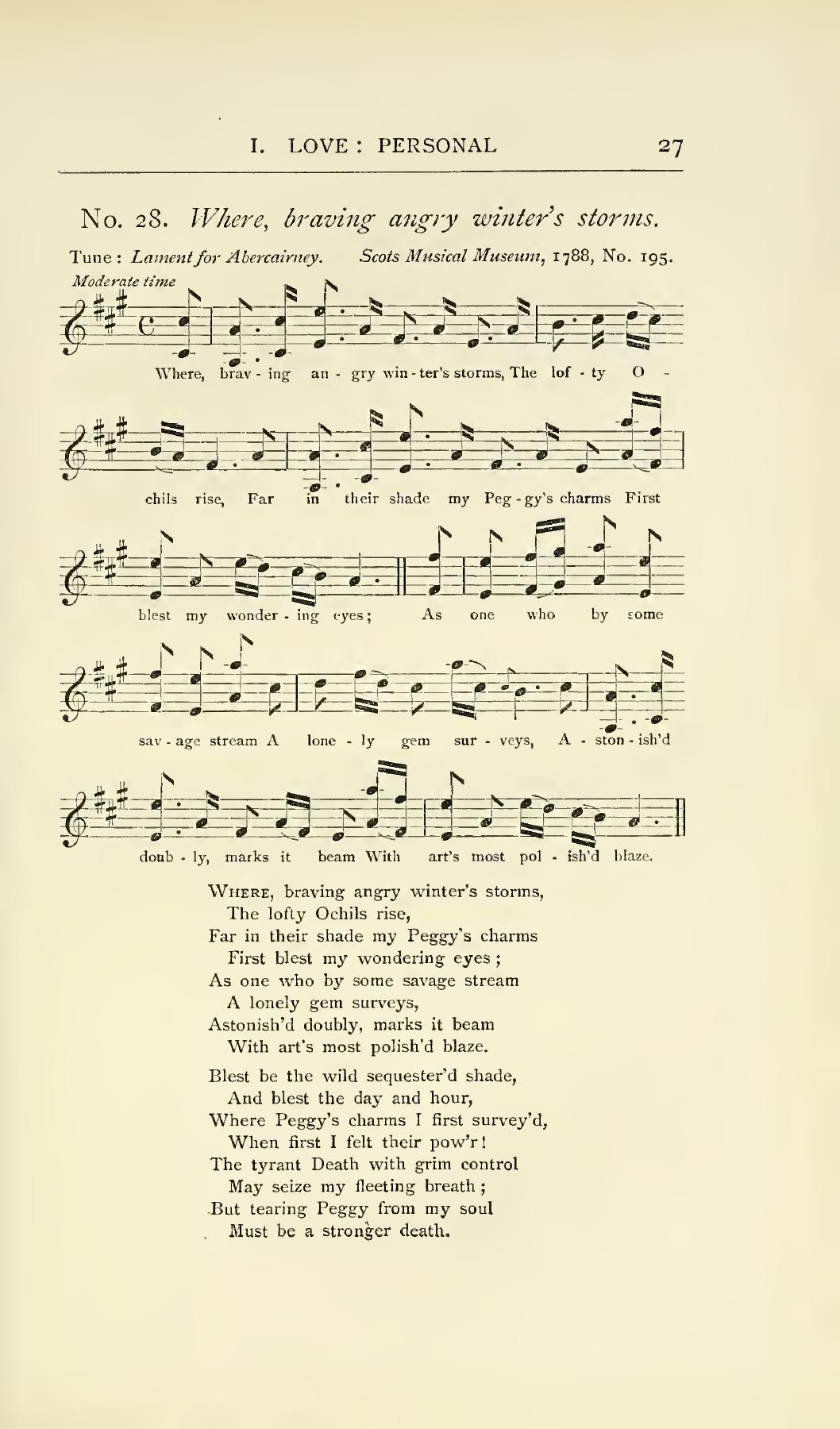 View score Dick’s Songs of Robert Burns (1903)
Lyrics
Choose an edition
Cunningham (1855)
Where, braving angry winter’s storms,
  The lofty Ochels rise,
Far in their shade my Peggy’s charms
  First blest my wondering eyes;
As one who by some savage stream,
  A lonely gem surveys,
Astonish’d, doubly marks its beam,
  With art’s most polish’d blaze.

Blest be the wild, sequester’d shade,
  And blest the day and hour,
Where Peggy’s charms I first survey’d,
  When first I felt their power!
The tyrant Death, with grim control,
  May seize my fleeting breath;
But tearing Peggy from my soul
  Must be a stronger death.
Digital text from Project Gutenberg.
View the source edition · p. 231
About this edition
Cunningham’s preface discusses several poems he left out of the collection.
Dick (1903) · no. 28
The words are on the score page.
View the source edition · no. 28; p. 27
Scots Musical Museum, vol. II (1788) · no. 195
View the source edition · Volume 2, no. 195; p. 203
Music
View historical scores
Dick’s Songs of Robert Burns (1903)
no. 28; p. 27