The flower it blaws, it fades, it fa's
Behind the song
Polly Stewart is praised as fairer than any flower in May. The next stanza immediately reminds the listener what happens to flowers: they bloom, fade and fall. The song answers that loss with a different kind of value, imagining worth and truth giving Polly an enduring youth. Its compliment turns from appearance towards character. [1]
Read the fuller story
The three verbs in the opening verse move quickly through a flower’s whole life. “Blaws” means blooms, and “fa’s” means falls. Art cannot restore the flower once it has gone. Against that natural limit, the singer offers the permanence of qualities which can continue to be valued beyond a brief season of beauty. The promise of eternal youth praises her character as something that can outlast the flower used to describe her. [1]
The final stanza becomes a wish for the person who will embrace her. He should have a loyal and true heart, and he should recognise the happiness he holds. “Leal” means faithful, and “ken” means know. The praise of Polly therefore places an obligation on her future partner: he must be worthy of her and understand what her affection means. The song ends by imagining her valued as well as admired. [1]
Dick identifies the piece in the Museum of 1796 as “Lovely Polly Stewart” and describes Polly as William Stewart’s daughter. His note connects her father with Burns’s song “You’re welcome, Willie Stewart”. The lyric itself stays with praise and good wishes. Its emotional shape comes from the movement between the repeated chorus, the fading flower and the hope for a faithful partner. [2]
The setting names the tune “Ye’re welcome Charlie Stewart” and is marked “Lively”. Fine and D.C. direct the singer back to the chorus, renewing Polly’s name after the reflections on transience and loyalty. Dick connects the song with a Jacobite ballad tradition and discusses other names for the melody. His account shows how an air associated with one kind of welcome could carry a new personal compliment. The printed return to the chorus keeps that compliment at the centre. [1][2]
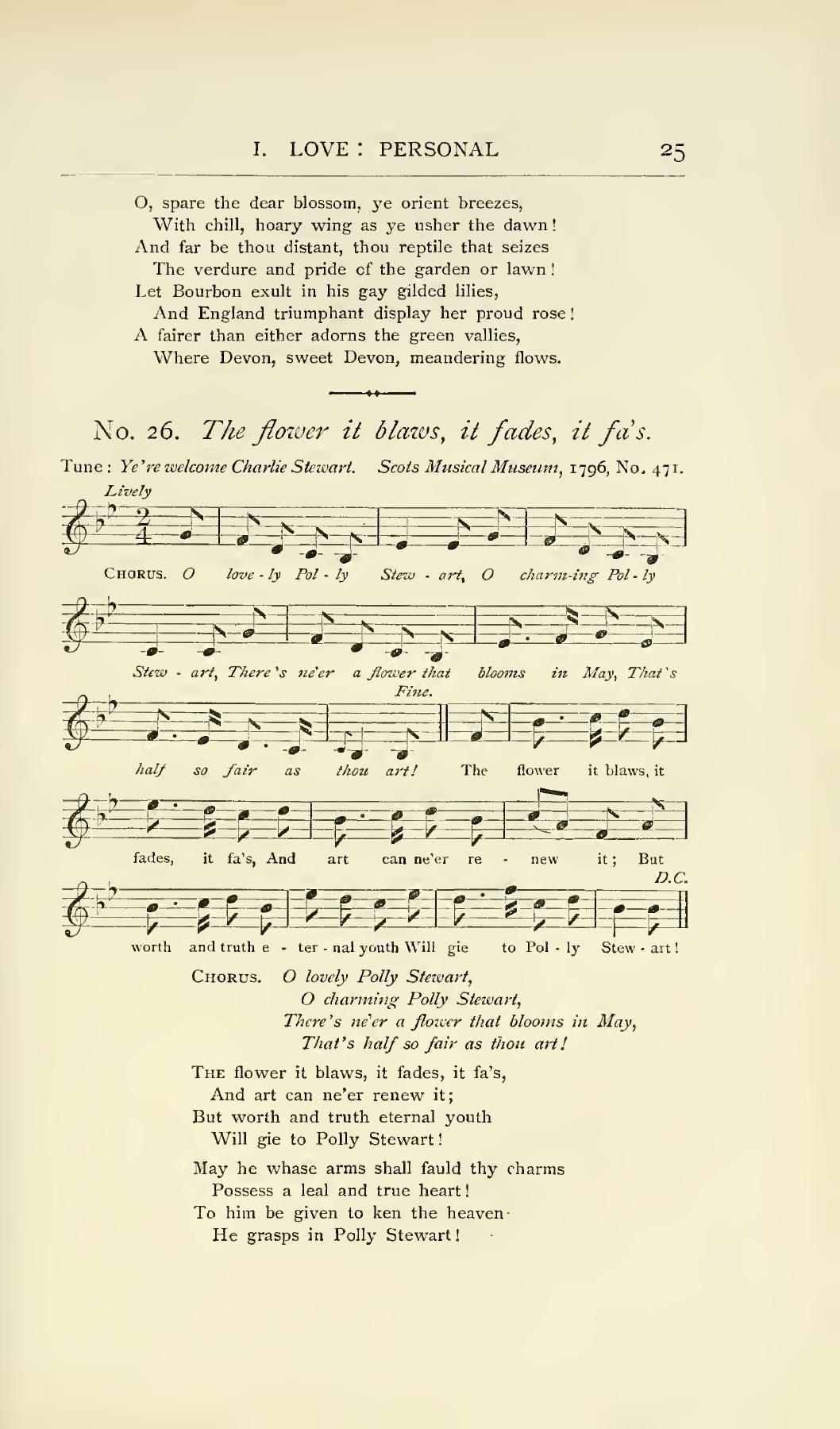 View score Dick’s Songs of Robert Burns (1903)
Lyrics
Dick (1903) · no. 26
CHORUS
O lovely Polly Stewart,
O charming Polly Stewart,
There's ne'er a flower that blooms in May,
That's half so fair as thou art!

The flower it blaws, it fades, it fa's,
And art can ne'er renew it;
But worth and truth eternal youth
Will gie to Polly Stewart!

May he whase arms shall fauld thy charms
Possess a leal and true heart!
To him be given to ken the heaven-
He grasps in Polly Stewart!
View the source edition · Dick1903 no. 26; p. 25
About this edition
Syllables separated by the musical notation are joined into words in this reading.
Music
View historical scores
Dick’s Songs of Robert Burns (1903)
Dick1903 no. 26; p. 25