How pleasant the banks of the clear winding Devon
Behind the song
Charlotte Hamilton was born beside the Ayr and was living at Harvieston in Clackmannanshire when Burns wrote these verses, according to a recollection printed by Dick. The singer carries her from one river to the other as a flower in bud, asking sun, rain and morning breezes to be gentle with her. By the end he sets her above the Bourbon lilies and England’s rose. [1][2][3]
Read the fuller story
Dick reproduces a recollection attributed to Burns in the Reliques of 1808. It identifies Charlotte Hamilton, sister of Gavin Hamilton of Mauchline, as the subject, says she was born beside the Ayr, and places her at Harvieston in Clackmannanshire when the verses were written. Dick inserts October 1787 into that account. Cunningham also identifies Charlotte in his introduction. [2][3]
The same transmitted recollection gives the melody a journey of its own. Burns says he first heard it from a woman in Inverness and had the notes taken down for the Scots Musical Museum. Dick prints Bhannerach dhon na chrie above his score, marked Slow; Cunningham’s heading has the closely related spelling Bhannerach dhon na chri. The melody and the lyric’s two rivers thus preserve different geographical threads in the song’s recorded history. [2][1][3]
Story references
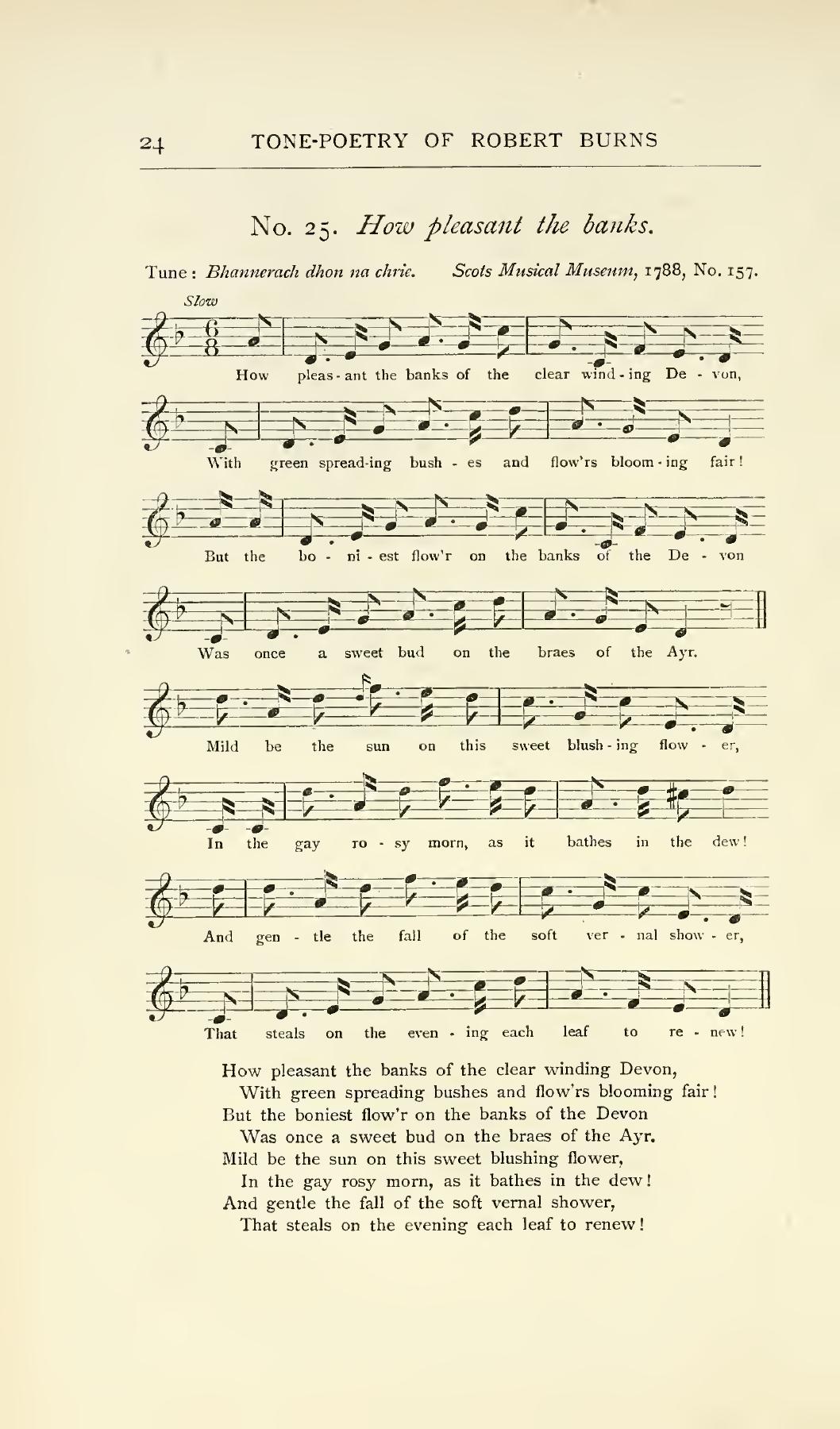 View score Dick’s Songs of Robert Burns (1903)
Lyrics
Choose an edition
Version notes
Dick gives “garden or lawn” and “vallies”. The Cunningham transcription has “garden and lawn” and “valleys”. Dick (1903) · no. 25 · Cunningham · 1855
| Dick (1903) · no. 25 | Cunningham · 1855Ebook transcription |
|---|---|
| garden or lawn | garden and lawn |
| vallies | valleys |
| flow’rs / flow’r | flowers / flower |
| bushes and | bushes, and |
More differences between these editions
| Dick (1903) · no. 25 | Cunningham · 1855Ebook transcription |
|---|---|
| Bhannerach dhon na chrie | Bhannerach dhon na chri |
Dick (1903) · no. 25
How pleasant the banks of the clear winding Devon,
With green spreading bushes and flow'rs blooming fair!
But the boniest flow'r on the banks of the Devon
Was once a sweet bud on the braes of the Ayr.
Mild be the sun on this sweet blushing flower,
In the gay rosy morn, as it bathes in the dew!
And gentle the fall of the soft vernal shower,
That steals on the evening each leaf to renew!

O, spare the dear blossom, ye orient breezes,
With chill, hoary wing as ye usher the dawn!
And far be thou distant, thou reptile that seizes
The verdure and pride of the garden or lawn!
Let Bourbon exult in his gay gilded lilies,
And England triumphant display her proud rose!
A fairer than either adorns the green vallies,
Where Devon, sweet Devon, meandering flows.
These are the words printed below the score.
View the source edition · no. 25; pp. 24–25
About this edition
Both readings contain two eight-line stanzas. Dick has “garden or lawn” and “vallies”; Cunningham has “garden and lawn” and “valleys”. Dick’s first stanza uses “flow’rs”/“flow’r” where Cunningham prints “flowers”/“flower”. Cunningham inserts a comma after bushes. Dick’s note distinguishes a different rudimentary melody of the same title in McDonald’s Highland Airs, no.105.
Cunningham (1855)
How pleasant the banks of the clear winding Devon,
  With green spreading bushes, and flowers blooming fair!
But the bonniest flower on the banks of the Devon
  Was once a sweet bud on the braes of the Ayr.
Mild be the sun on this sweet blushing flower,
  In the gay rosy morn, as it bathes in the dew;
And gentle the fall of the soft vernal shower,
  That steals on the evening each leaf to renew.

O spare the dear blossom, ye orient breezes,
  With chill hoary wing, as ye usher the dawn;
And far be thou distant, thou reptile that seizes
  The verdure and pride of the garden and lawn!
Let Bourbon exult in his gay gilded Lilies,
  And England, triumphant, display her proud Rose:
A fairer than either adorns the green valleys,
  Where Devon, sweet Devon, meandering flows.
Digital text from Project Gutenberg.
View the source edition · p. 226
About this edition
Both readings contain two eight-line stanzas. Dick has “garden or lawn” and “vallies”; Cunningham has “garden and lawn” and “valleys”. Dick’s first stanza uses “flow’rs”/“flow’r” where Cunningham prints “flowers”/“flower”. Cunningham inserts a comma after bushes. Dick’s note distinguishes a different rudimentary melody of the same title in McDonald’s Highland Airs, no.105.
Scots Musical Museum, vol. II (1788) · no. 157
View the source edition · Volume 2, no. 157; p. 165
Music
View historical scores
Dick’s Songs of Robert Burns (1903)
no. 25; pp. 24–25