Twas even—the dewy fields were green
Behind the song
In November 1786 Burns sent Wilhelmina Alexander the verses he had written after seeing her at Ballochmyle and asked if he could publish them. The song imagines her as a country maid and the singer as her lover, happy to share a cottage, flocks and ground to work. [1][2]
Read the fuller story
The opening lingers over a landscape alive with scent and sound. Dew shines on the grass, wind carries the bean flowers’ fragrance and thrushes sing through the glens. The walker’s happiness prepares for the appearance of the young woman in a secluded place. Her look and manner seem to gather the morning and spring into one figure.[1]
The third stanza develops that praise, placing the woman above the natural scenes already admired. The last two stanzas then move into a wish. If she were a country maid and he her country lover, the poorest shelter and hardest winter work would be welcome because they could share a home.[1]
The ending assigns dangerous ambition and the search for gold to others. A cottage, flocks and cultivated ground would provide the life the speaker desires. Cunningham’s headnote supplies the personal association and comments on the song’s reception; the lyric’s proposed life remains an imagined answer to the encounter. He prints “Miss Forbes’s Farewell to Banff” as the tune.[1]
Story references
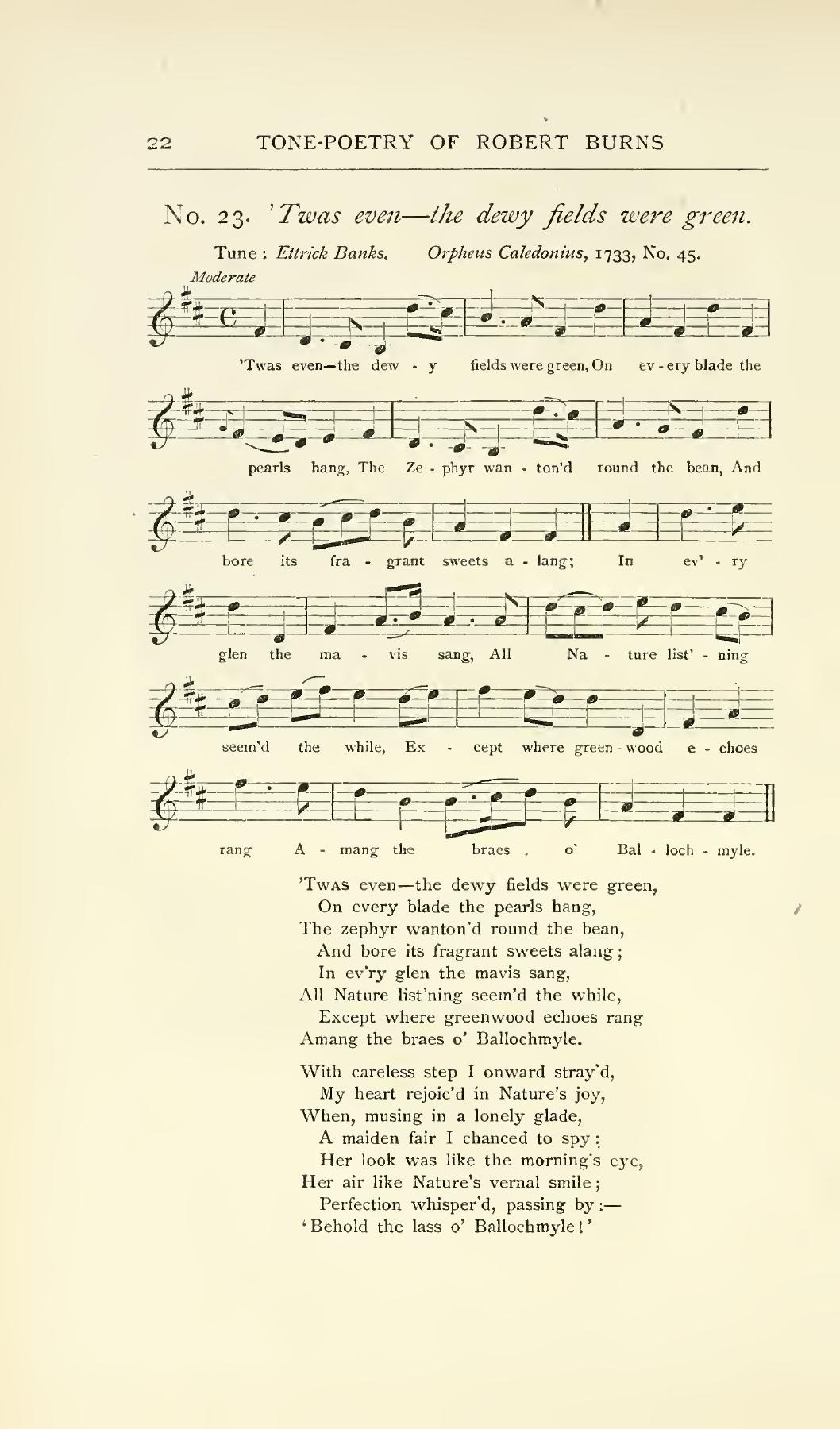 View score Dick’s Songs of Robert Burns (1903)
Lyrics
Choose an edition
Cunningham (1855)
’Twas even—the dewy fields were green,
  On every blade the pearls hang,
The zephyr wanton’d round the bean,
  And bore its fragrant sweets alang:
In ev’ry glen the mavis sang,
  All nature listening seem’d the while,
Except where greenwood echoes rang
  Amang the braes o’ Ballochmyle!

With careless step I onward stray’d,
  My heart rejoic’d in nature’s joy,
When musing in a lonely glade,
  A maiden fair I chanc’d to spy;
Her look was like the morning’s eye,
  Her air like nature’s vernal smile,
Perfection whisper’d passing by,
  Behold the lass o’ Ballochmyle!

Fair is the morn in flow’ry May,
  And sweet is night in autumn mild
When roving thro’ the garden gay,
  Or wand’ring in the lonely wild;
But woman, nature’s darling child!
  There all her charms she does compile;
Even there her other works are foil’d
  By the bonnie lass o’ Ballochmyle.

O, had she been a country maid,
  And I the happy country swain,
Tho’ shelter’d in the lowest shed
  That ever rose on Scotland’s plain,
Thro’ weary winter’s wind and rain,
  With joy, with rapture, I would toil;
And nightly to my bosom strain
  The bonnie lass of Ballochmyle.

Then pride might climb the slippery steep,
  Where fame and honours lofty shine:
And thirst of gold might tempt the deep
  Or downward seek the Indian mine;
Give me the cot below the pine,
  To tend the flocks, or till the soil,
And ev’ry day have joys divine
  With the bonnie lass o’ Ballochmyle.
Digital text from Project Gutenberg.
View the source edition · p. 220
About this edition
Cunningham’s preface discusses several poems he left out of the collection.
Dick (1903) · no. 23
The words are on the score page.
View the source edition · no. 23; pp. 22–23
Music
View historical scores
Dick’s Songs of Robert Burns (1903)
no. 23; pp. 22–23