Yon Wild Mossy Mountains
Behind the song
The young Clyde, heather full of grouse and a shepherd with his flock make up the country the singer would choose over the fertile valley of Gowrie or the sunny shores of the Forth. A woman lives beside one of its quiet streams. As the water hurries down the valley, she and her lover can let the hours go by unheeded. [1]
Read the fuller story
Cunningham associates the woman with a supposed Nannie near the Lugar. Dick says the origin is unknown and reports a different conjecture, connecting the song with Burns’s first Edinburgh journey and the country around Tinto. Both editors transmit Burns’s comment that the song touched private history he wished to keep private. Those traditions leave the beloved’s identity uncertain. [2][3]
Dick prints six quatrains and marks the closing two lines of each for repetition. Cunningham writes those repeated lines out, giving each stanza six printed lines. Dick’s Phoebe setting and his account of a later proposed air show how the same long verse could be fitted to different musical phrases; the repeated endings give particular weight to the stream, the shared walk and the woman’s answering love. [1][2][3]
Story references
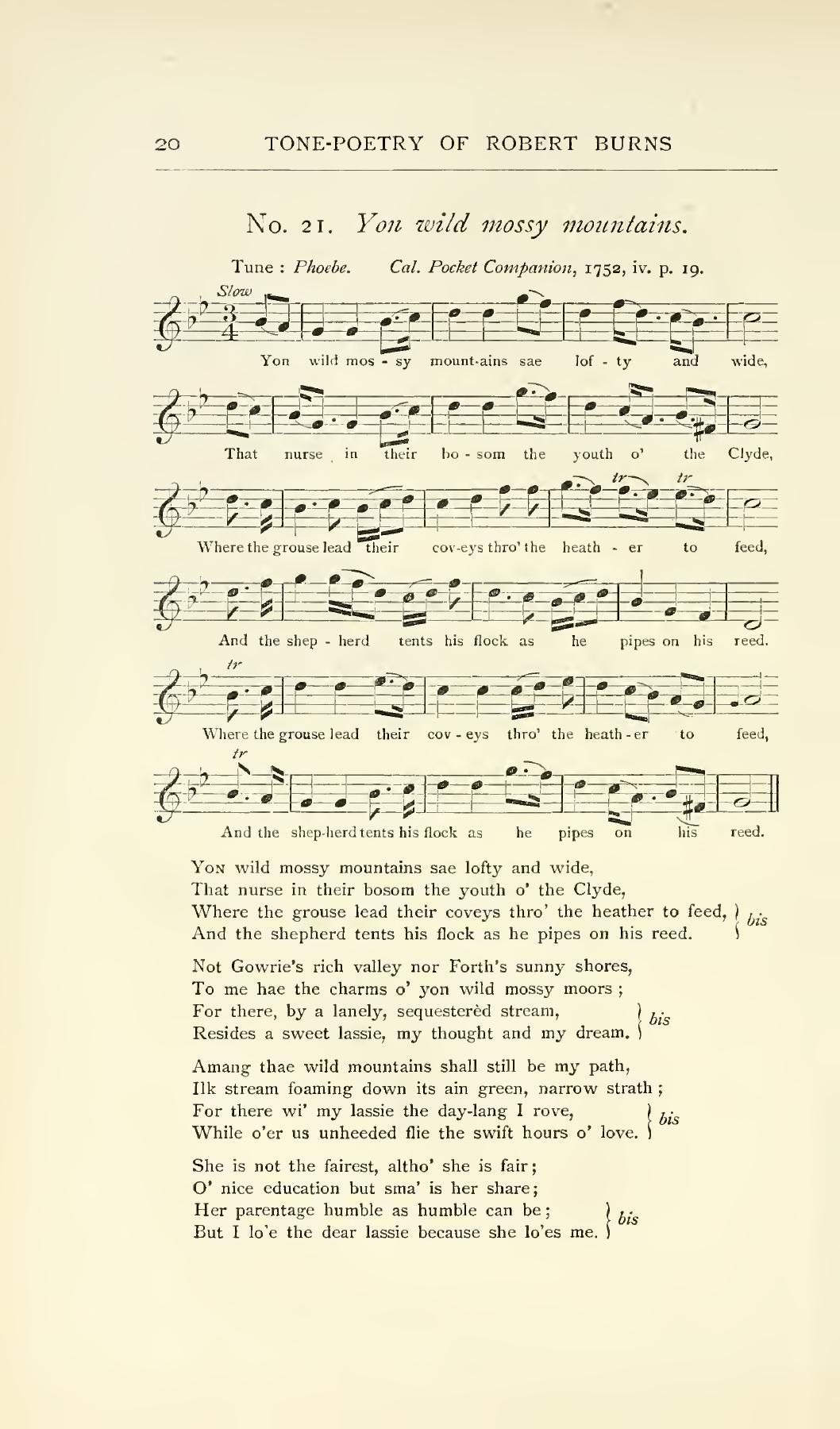 View score Dick’s Songs of Robert Burns (1903)
Lyrics
Choose an edition
Version notes
| Dick (1903) · no. 21 | Cunningham · 1855Ebook transcription |
|---|---|
| by a lanely, sequester’d stream | by a lanely and sequester’d stream |
| Gowrie’s rich valley | Gowrie’s rich valleys |
| bis on each final couplet | final couplets written twice |
| flie | flee |
More differences between these editions
| Dick (1903) · no. 21 | Cunningham · 1855Ebook transcription |
|---|---|
| the heart-beating love | the heart beating love |
Dick (1903) · no. 21
Yon wild mossy mountains sae lofty and wide,
That nurse in their bosom the youth o' the Clyde,
Where the grouse lead their coveys thro' the heather to feed,
And the shepherd tents his flock as he pipes on his reed. [bis: last two lines]

Not Gowrie's rich valley nor Forth's sunny shores,
To me hae the charms o' yon wild mossy moors;
For there, by a lanely, sequester'd stream,
Resides a sweet lassie, my thought and my dream. [bis: last two lines]

Amang thae wild mountains shall still be my path,
Ilk stream foaming down its ain green, narrow strath;
For there, wi' my lassie the day-lang I rove,
While o'er us unheeded flie the swift hours o' love. [bis: last two lines]

She is not the fairest, altho' she is fair;
O' nice education but sma' is her share;
Her parentage humble as humble can be;
But I lo'e the dear lassie because she lo'es me. [bis: last two lines]

To Beauty what man but maun yield him a prize,
In her armour of glances, and blushes, and sighs?
And when wit and refinement hae polish'd her darts,
They dazzle our een, as they flie to our hearts. [bis: last two lines]

But kindness, sweet kindness, in the fond sparkling e'e,
Has lustre outshining the diamond to me;
And the heart-beating love as I'm clasp'd in her arms,
O, these are my lassie's all-conquering charms! [bis: last two lines]
View the source edition · no. 21; pp. 20–21
About this edition
Six stanzas in both readings. Cunningham writes each final couplet twice; Dick uses bis. Dick has rich valley, flie and heart-beating love; Cunningham has rich valleys, flee and the heart beating love. Cunningham prints a lanely and sequester’d stream; Dick omits and.
Cunningham (1855)
Yon wild mossy mountains sae lofty and wide,
That nurse in their bosom the youth o’ the Clyde,
Where the grouse lead their coveys thro’ the heather to feed,
And the shepherd tents his flock as he pipes on his reed.
  Where the grouse lead their coveys thro’ the heather to feed,
  And the shepherd tents his flock as he pipes on his reed.

Not Gowrie’s rich valleys, nor Forth’s sunny shores,
To me hae the charms o’ yon wild, mossy moors;
For there, by a lanely and sequester’d stream,
Resides a sweet lassie, my thought and my dream.
  For there, by a lanely and sequester’d stream,
  Resides a sweet lassie, my thought and my dream.

Amang thae wild mountains shall still be my path,
Ilk stream foaming down its ain green, narrow strath;
For there, wi’ my lassie, the day lang I rove,
While o’er us unheeded flee the swift hours o’ love.
  For there wi’ my lassie, the day lang I rove,
  While o’er us unheeded flee the swift hours o’ love.

She is not the fairest, altho’ she is fair;
O’ nice education but sma’ is her share;
Her parentage humble as humble can be;
But I lo’e the dear lassie because she lo’es me.
  Her parentage humble as humble can be;
  But I lo’e the dear lassie because she lo’es me.

To beauty what man but maun yield him a prize,
In her armour of glances, and blushes, and sighs?
And when wit and refinement hae polish’d her darts,
They dazzle our een as they flee to our hearts.
  And when wit and refinement hae polish’d her darts,
  They dazzle our een, as they flee to our hearts.

But kindness, sweet kindness, in the fond sparkling e’e,
Has lustre outshining the diamond to me:
And the heart beating love as I’m clasp’d in her arms,
O, these are my lassie’s all-conquering charms!
  And the heart beating love as I’m clasp’d in her arms,
  O, these are my lassie’s all-conquering charms!
Digital text from Project Gutenberg.
View the source edition · p. 246
About this edition
Six stanzas in both readings. Cunningham writes each final couplet twice; Dick uses bis. Dick has rich valley, flie and heart-beating love; Cunningham has rich valleys, flee and the heart beating love. Cunningham prints a lanely and sequester’d stream; Dick omits and.
Scots Musical Museum, vol. IV (1792) · no. 331
View the source edition · Volume 4, no. 331; pp. 340–341
Music
View historical scores
Dick’s Songs of Robert Burns (1903)
no. 21; pp. 20–21