How long and dreary is the night
Behind the song
The hours once “glinted” when the lovers were together. Now the singer watches them drag from evening to morning and thinks of all the land between them. Dick marks the final two lines of each stanza to be sung twice, prolonging the darkness and the memory. [1]
Read the fuller story
Dick distinguishes this Museum song from a later recasting made for George Thomson to the air Cauld Kail. He quotes Burns explaining that he had altered and enlarged words found in a collection, then arranged them again to suit Thomson’s preferred air. Dick also prints a stanza from the Herd manuscript in a different metre, beginning with daybreak and turning to weeping for a dear one. [2]
The selected setting carries the heading A Gaelic air, the direction Slow and a reference to the Scots Musical Museum of 1788. Cunningham writes out the repeated lines, including two different orders of the words “but be” and “be but” in the middle stanza. That insistent return suits a song in which the mind keeps crossing the distance between the remembered past and the present night. [1][3]
Story references
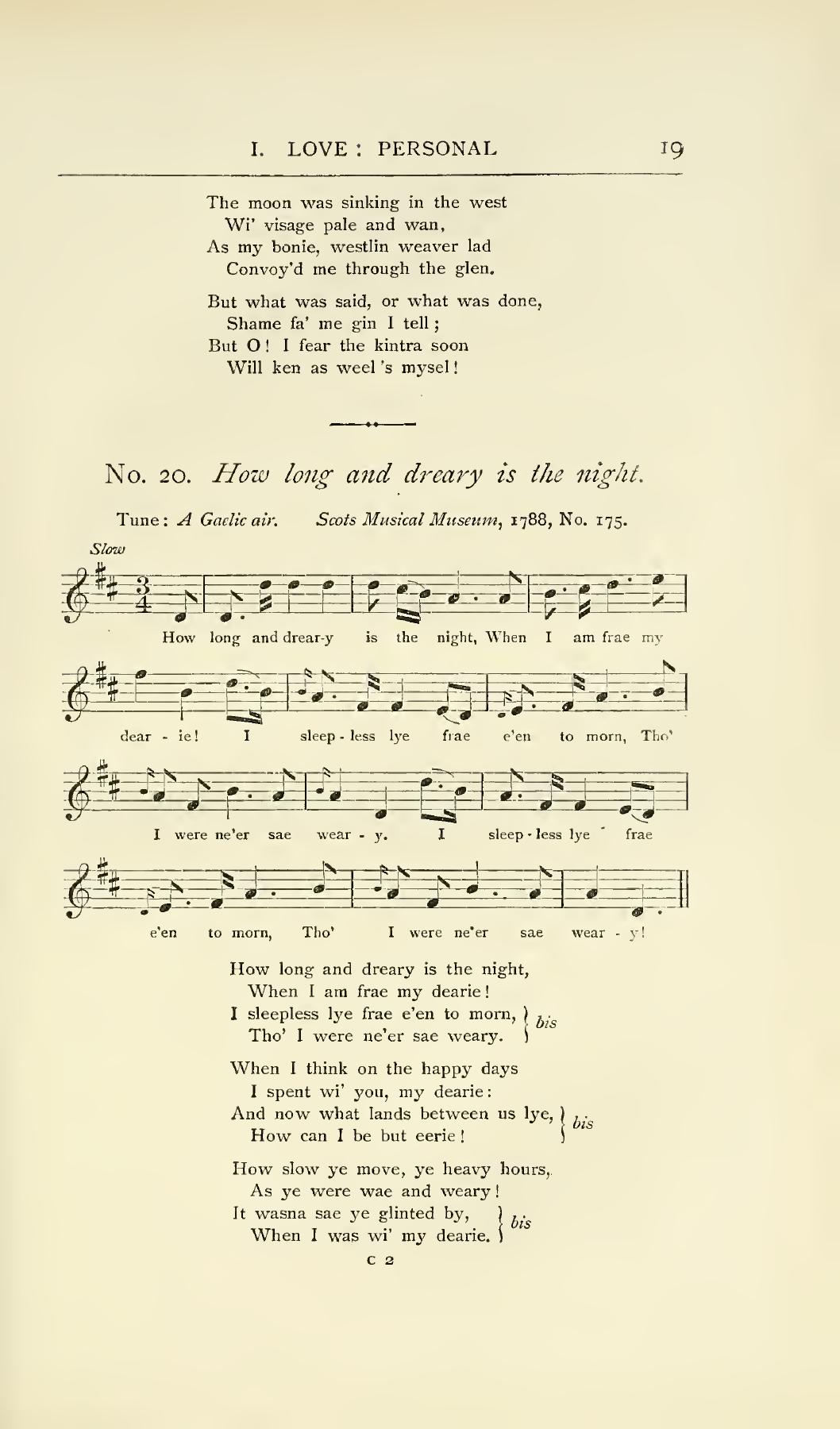 View score Dick’s Songs of Robert Burns (1903)
Lyrics
Choose an edition
Version notes
| Dick (1903) · no. 20 | Cunningham · 1855Ebook transcription |
|---|---|
| lye | lie |
| It wasna sae | It was na sae |
| bis braces after the last two lines of each stanza | repeated lines written out |
| How can I be but eerie! | How can I but be eerie! then How can I be but eerie! |
More differences between these editions
| Dick (1903) · no. 20 | Cunningham · 1855Ebook transcription |
|---|---|
| my dearie; | my dearie, |
Dick (1903) · no. 20
How long and dreary is the night,
When I am frae my dearie!
I sleepless lye frae e'en to morn,
Tho' I were ne'er sae weary.
[Repeat the last two lines.]

When I think on the happy days
I spent wi' you, my dearie;
And now what lands between us lye,
How can I be but eerie!
[Repeat the last two lines.]

How slow ye move, ye heavy hours,
As ye were wae and weary!
It wasna sae ye glinted by,
When I was wi' my dearie.
[Repeat the last two lines.]
View the source edition · no. 20; p. 19
About this edition
Dick prints three quatrains with bis directions for their last two lines; the checked text labels these directions in brackets. Cunningham writes out each repeated pair. Dick has lye and wasna; Cunningham lie and was na. Cunningham’s middle stanza first has How can I but be eerie!, then repeats it as How can I be but eerie! Dick’s single printed form uses the latter order.
Cunningham (1855)
How long and dreary is the night
  When I am frae my dearie!
I sleepless lie frae e’en to morn,
  Tho’ I were ne’er sae weary.
I sleepless lie frae e’en to morn,
  Tho’ I were ne’er sae weary.

When I think on the happy days
  I spent wi’ you, my dearie,
And now what lands between us lie,
  How can I but be eerie!
And now what lands between us lie,
  How can I be but eerie!

How slow ye move, ye heavy hours,
  As ye were wae and weary!
It was na sae ye glinted by,
  When I was wi’ my dearie.
It was na sae ye glinted by,
  When I was wi’ my dearie.
Digital text from Project Gutenberg.
View the source edition · p. 228
About this edition
Dick prints three quatrains with bis directions for their last two lines; the checked text labels these directions in brackets. Cunningham writes out each repeated pair. Dick has lye and wasna; Cunningham lie and was na. Cunningham’s middle stanza first has How can I but be eerie!, then repeats it as How can I be but eerie! Dick’s single printed form uses the latter order.
Scots Musical Museum, vol. II (1788) · no. 175
View the source edition · Volume 2, no. 175; p. 183
Music
View historical scores
Dick’s Songs of Robert Burns (1903)
no. 20; p. 19