My heart was ance as blythe and free
Behind the song
A mother sends her daughter to town to prepare a web of cloth. There a weaver at his loom captures her heart, and every movement of the work sends a pang through it. By the sinking moon he accompanies her through the glen; she fears that the countryside will soon know her secret.
Read the fuller story
Weaving gives the song its language of attachment. The heart is caught like something in a net, among knots and thrums; the warping-wheel and the loom’s repeated blows become part of the speaker’s distress. Her memory of being as free as a long summer day gives way to a warning addressed to other young women: take care about going to the weavers at night.
Cunningham quotes a note attributed to Burns: “The chorus of this song ... is old, the rest is mine.” That division makes the inherited warning the frame for the verses’ working detail and troubled recollection. The headnote also repeats an unidentified report that the weaver was Burns’s rival for a west-country landlady’s affection.[1]
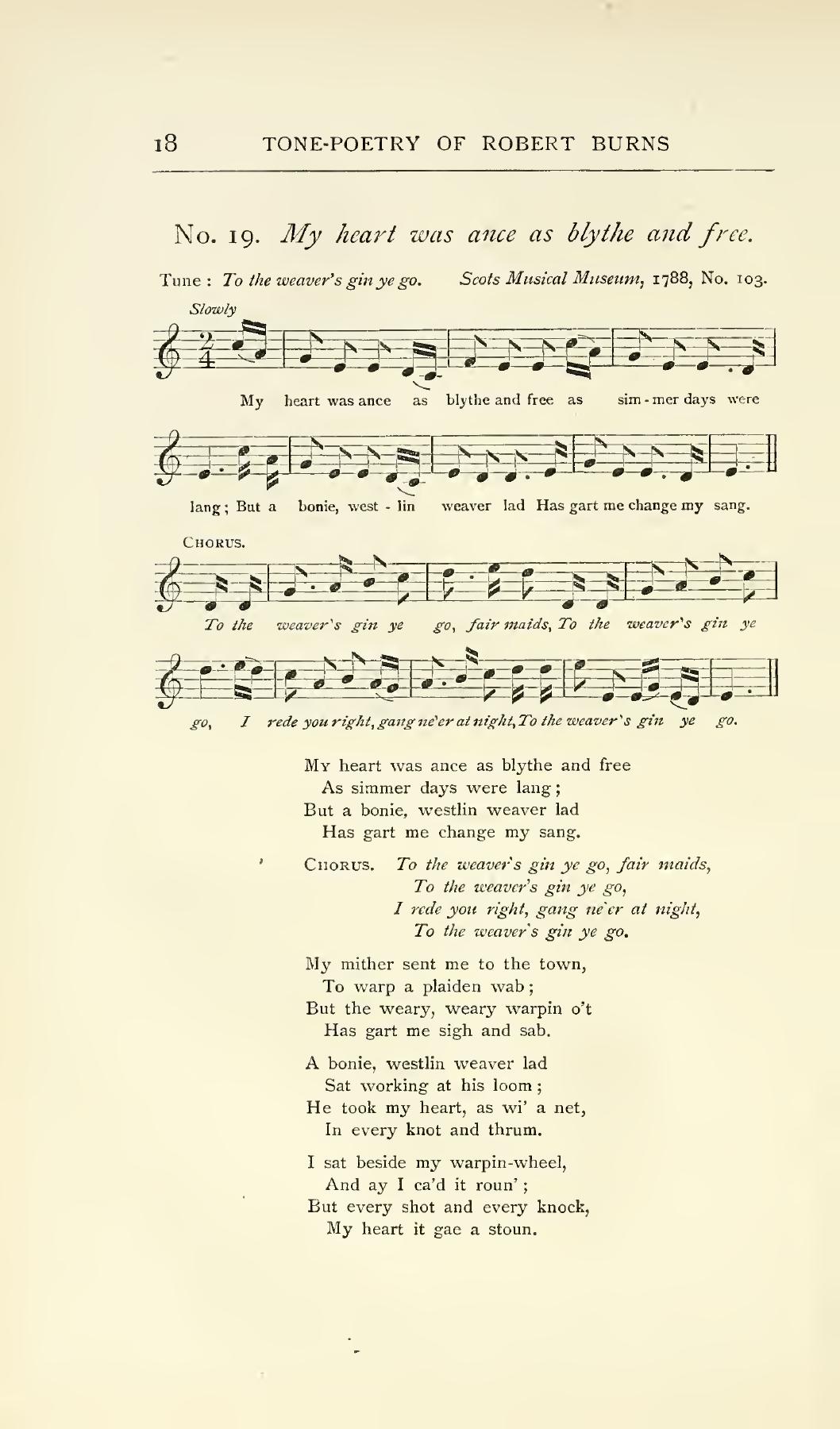 View score Dick’s Songs of Robert Burns (1903)
Lyrics
Choose an edition
Cunningham (1855)
My heart was ance as blythe and free
  As simmer days were lang,
But a bonnie, westlin weaver lad
  Has gart me change my sang.
    To the weavers gin ye go, fair maids,
      To the weavers gin ye go;
    I rede you right gang ne’er at night,
      To the weavers gin ye go.

My mither sent me to the town,
  To warp a plaiden wab;
But the weary, weary warpin o’t
  Has gart me sigh and sab.

A bonnie westlin weaver lad,
  Sat working at his loom;
He took my heart as wi’ a net,
  In every knot and thrum.

I sat beside my warpin-wheel,
  And ay I ca’d it roun’;
But every shot and every knock,
  My heart it gae a stoun.

The moon was sinking in the west
  Wi’ visage pale and wan,
As my bonnie westlin weaver lad
  Convoy’d me thro’ the glen.

But what was said, or what was done,
  Shame fa’ me gin I tell;
But, oh! I fear the kintra soon
  Will ken as weel’s mysel.
    To the weavers gin ye go, fair maids,
      To the weavers gin ye go;
    I rede you right gang ne’er at night,
      To the weavers gin ye go.
Digital text from Project Gutenberg.
View the source edition · p. 213
About this edition
Cunningham’s preface discusses several poems he left out of the collection.
Dick (1903) · no. 19
The words are on the score page.
View the source edition · no. 19; pp. 18–19
Scots Musical Museum, vol. II (1788) · no. 103
View the source edition · Volume 2, no. 103; p. 106
Music
View historical scores
Dick’s Songs of Robert Burns (1903)
no. 19; pp. 18–19
Burns’s verses with an older chorus — qualified attribution
Cunningham quotes Burns crediting himself with the verses and describing the chorus as old.
Words Robert Burns (verses); earlier song tradition (chorus)
Burns’s role Burns’s verses with an older chorus — qualified attribution