Stay, my charmer, can you leave me
Behind the song
“Cruel” comes four times in the opening stanza. The singer asks how the person he loves could leave him in such pain, repeating the question word for word. In the second stanza the appeal becomes an entreaty, with three lines beginning “By” and the doubled plea “Do not, do not leave me so!” [1]
Read the fuller story
Cunningham says that Burns picked up the air during a northern tour and connects the song with his Highland excursions. Dick treats the connection more cautiously: he calls the song most likely a souvenir of the Highland tour while describing its origin as unknown. He also reports a Burns manuscript in the British Museum. [2][3]
Dick prints An gille dubh ciar dhubh with the direction Slow and identifies the setting with the Scots Musical Museum of 1788. His note gives the English title The black-haired lad and points to McDonald’s Highland Vocal Airs of 1784. The lyric leaves its circumstances spare: its force comes from a direct address, a broken promise and the repeated effort to hold the departing person. [1][3]
Story references
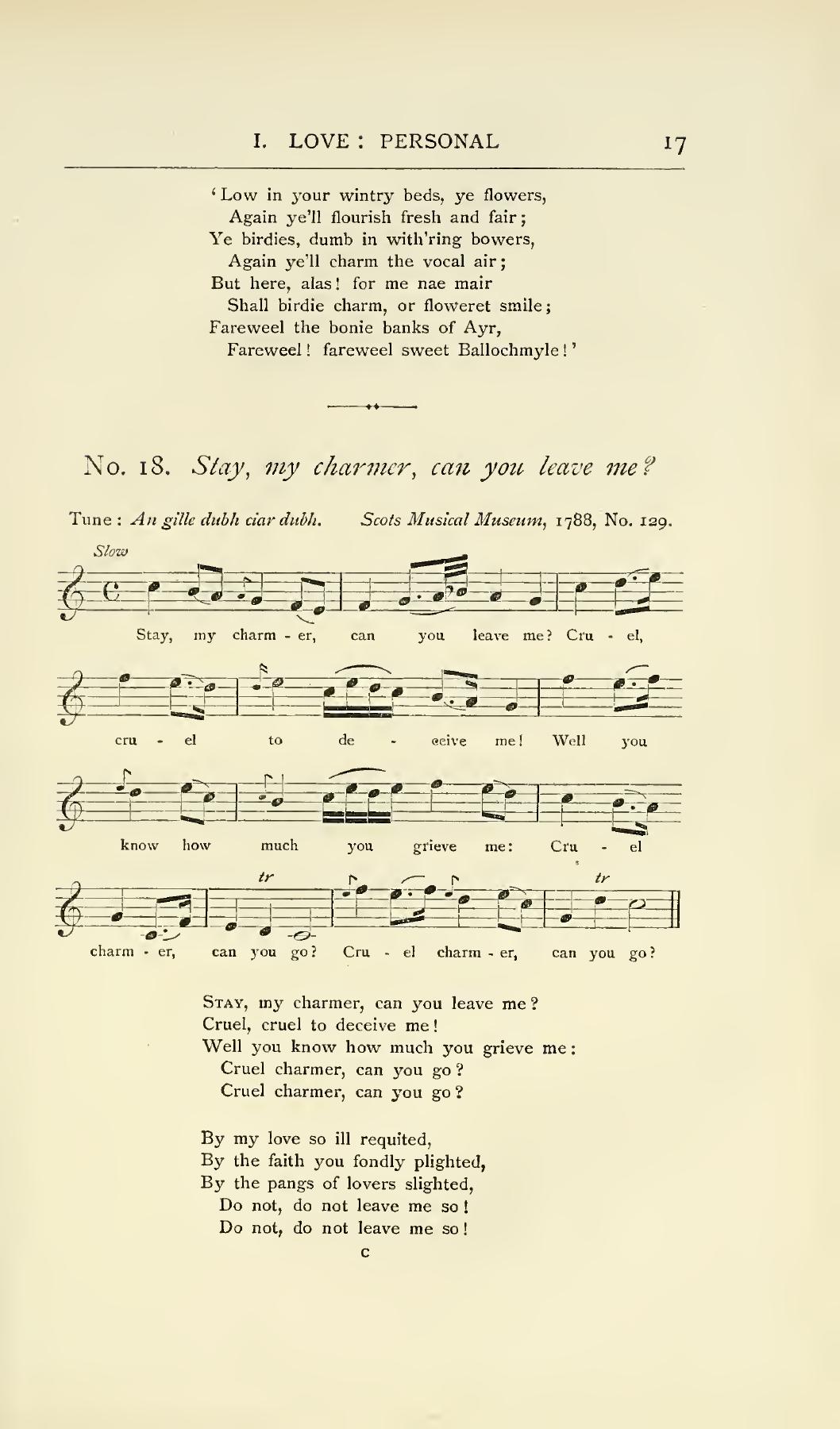 View score Dick’s Songs of Robert Burns (1903)
Lyrics
Choose an edition
Version notes
| Dick (1903) · no. 18 | Cunningham · 1855Ebook transcription |
|---|---|
| Cruel, cruel to deceive me! | Cruel, cruel, to deceive me! |
| grieve me: / requited, / plighted, / slighted, | grieve me; / requited; / plighted; / slighted; |
| two unnumbered five-line stanzas | two numbered five-line stanzas |
Dick (1903) · no. 18
Stay, my charmer, can you leave me?
Cruel, cruel to deceive me!
Well you know how much you grieve me:
Cruel charmer, can you go?
Cruel charmer, can you go?

By my love so ill requited,
By the faith you fondly plighted,
By the pangs of lovers slighted,
Do not, do not leave me so!
Do not, do not leave me so!
View the source edition · no. 18; p. 17
About this edition
Both editions print two five-line stanzas, with each final line repeated. Cunningham numbers the stanzas and adds a comma after the second cruel. Dick has a colon after grieve me and commas at the opening three line endings of stanza2; Cunningham uses semicolons.
Cunningham (1855)
Stay, my charmer, can you leave me?
Cruel, cruel, to deceive me!
Well you know how much you grieve me;
  Cruel charmer, can you go?
  Cruel charmer, can you go?

By my love so ill requited;
By the faith you fondly plighted;
By the pangs of lovers slighted;
  Do not, do not leave me so!
  Do not, do not leave me so!
Digital text from Project Gutenberg.
View the source edition · p. 224
About this edition
Both editions print two five-line stanzas, with each final line repeated. Cunningham numbers the stanzas and adds a comma after the second cruel. Dick has a colon after grieve me and commas at the opening three line endings of stanza2; Cunningham uses semicolons.
Scots Musical Museum, vol. II (1788) · no. 129
View the source edition · Volume 2, no. 129; p. 135
Music
View historical scores
Dick’s Songs of Robert Burns (1903)
no. 18; p. 17