The Catrine woods were yellow seen
Behind the song
Mary Whitefoord’s family was leaving its inheritance when, in Cunningham’s account, Burns gave her this farewell to Ballochmyle. In the song she is Maria. She tells the flowers and birds that they will return with the spring, knowing she expects to be gone. [1]
Read the fuller story
The two eight-line stanzas give the departure a seasonal shape. Maria’s own beauty remains in bloom among the faded woods; then her voice addresses flowers and birds that will return with the year. Their renewal makes her anticipated separation feel final.[1]
Cunningham identifies Mary Whitefoord, Sir John Whitefoord’s eldest daughter, as the heroine and connects the song with the family’s departure from its inheritance. He also reports its place in the Museum with an air by Allan Masterton.[1]
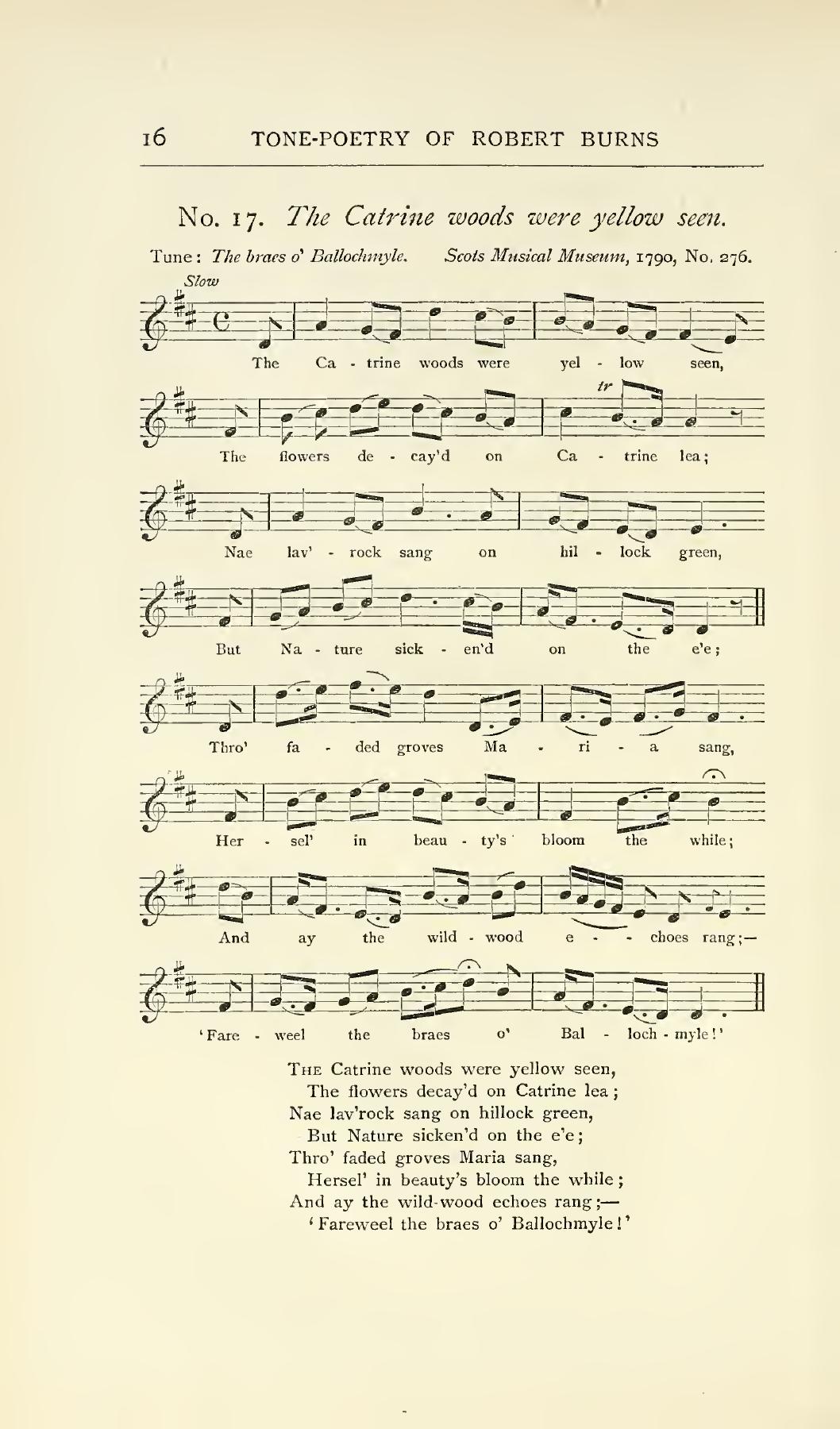 View score Dick’s Songs of Robert Burns (1903)
Lyrics
Choose an edition
Cunningham (1855)
The Catrine woods were yellow seen,
  The flowers decay’d on Catrine lea,
Nae lav’rock sang on hillock green,
  But nature sicken’d on the e’e.
Thro’ faded groves Maria sang,
  Hersel’ in beauty’s bloom the while,
And ay the wild-wood echoes rang,
  Fareweel the Braes o’ Ballochmyle!

Low in your wintry beds, ye flowers,
  Again ye’ll nourish fresh and fair;
Ye birdies dumb, in withering bowers,
  Again ye’ll charm the vocal air.
But here, alas! for me nae mair
  Shall birdie charm, or floweret smile;
Fareweel the bonnie banks of Ayr,
  Fareweel, fareweel! sweet Ballochmyle!
Digital text from Project Gutenberg.
View the source edition · p. 239
About this edition
Cunningham’s preface discusses several poems he left out of the collection.
Dick (1903) · no. 17
The words are on the score page.
View the source edition · no. 17; pp. 16–17
Scots Musical Museum, vol. III (1790) · no. 276
View the source edition · Volume 3, no. 276; p. 285
Music
View historical scores
Dick’s Songs of Robert Burns (1903)
no. 17; pp. 16–17