Young Peggy blooms our boniest lass
Behind the song
“Young Peggy” begins in the brightness of morning and spring. Blush, eyes, lips and smile are pictured through dawn, rainlit streams, flowers and playful lambs. The praise moves towards a wish that honour, love and truth protect her future.
Read the fuller story
The first two stanzas gather the landscape around Peggy’s appearance. The third gives her beauty power over Fortune, detraction and envy, imagining hostile forces softened or defeated. In the last stanza, the speaker asks a blessing for the young man destined for her, their married love and the children hoped for in the image of “filial blossom”.
Cunningham says Burns was reported to have used these verses as a farewell after eight months of courtship, and calls the woman Montgomery’s Peggy. His “it is said” leaves that identification and occasion qualified. The final stanza’s blessing looks towards a future household.
The page titled “Young Peggy” presents this same Cunningham song. Here it is read alongside the existing edition choices; the shared text gives both pages a common account of Peggy’s praise and its reported occasion.
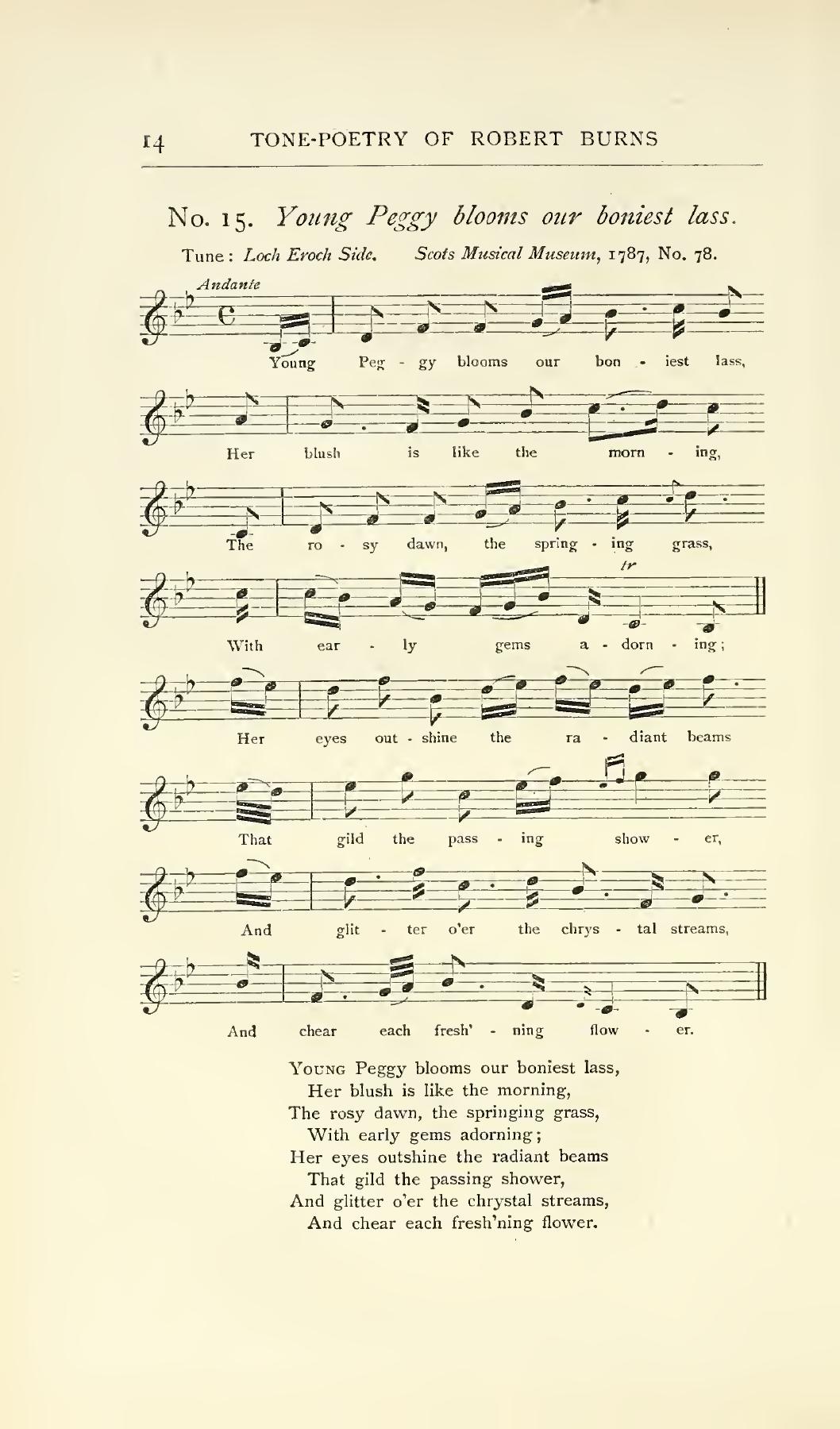 View score Dick’s Songs of Robert Burns (1903)
Music
View historical scores
Dick’s Songs of Robert Burns (1903)
no. 15; pp. 14–15
Choose an edition
Dick (1903) · no. 15
The words are on the score page.
View the source edition · no. 15; pp. 14–15
Scots Musical Museum, vol. I (1787) · no. 78
View the source edition · Volume 1, no. 78; pp. 78–79
About this edition
Young Peggy is printed as additional words to the foregoing Loch Eroch Side setting; both pages retained.
Words attributed to Burns
Words attributed to Burns through Cunningham’s qualified account.0258/0546 share exactTW658 Cunninghamtext; no additional unique composition, separate version or tune-composition claim.
Words Robert Burns
Burns’s role Wrote the words