Yestreen I met you on the moor
Behind the song
Tibbie has passed the singer on the moor without speaking. When he encountered her on the road the previous Sunday, she answered him with a toss of her head. He interprets both gestures as contempt for his poverty. His reply is a song that repeatedly declares how little he cares, while finding plenty to say about the insult. [1]
Read the fuller story
The refrain reminds Tibbie that she once behaved differently. He blames her present reserve on his lack of “gear”, the wealth that becomes the song’s recurring measure of social value. In the stanzas, money appears as cash, coin, “yellow dirt”, her father’s possessions and, finally, a thousand marks. The varied terms keep returning the listener to the same accusation: Tibbie judges a prospective lover by what he owns. [1]
The singer’s counterattack grows sharper. A clever lad without money will receive a cold answer, he says, whereas a wealthy man can command her attention even if he has little sense or learning. The image of her clinging to him like a brier turns courtship into a prickly kind of attachment. This is the aggrieved suitor’s account, sharpened to make his opponent look ridiculous. His repeated profession of indifference becomes part of the comedy of a voice so thoroughly occupied by being slighted. [1]
The last stanza supplies an alternative. Another lass lives beside the park, and he would rather have her in her shirt than Tibbie with her money. The comparison completes the argument on his own terms: affection can choose its object without accepting the wealthy woman’s valuation. It also gives him the final word after a series of encounters in which Tibbie controlled the exchange by refusing to speak. [1]
James C. Dick identifies Tibbie as Isabella Stein, a farmer’s daughter at Tarbolton, and assigns the song to Burns at seventeen. His 1903 note cites the Commonplace Book published in 1872 and says the Scots Musical Museum printed a shorter version in 1788, omitting the second and last stanzas. The complete reading he prints preserves both the second roadside slight and the concluding preference for the other lass. [2]
Dick names Invercauld’s Reel as the tune and marks the setting “Lively”. The score returns from the stanza to the chorus, letting the recurring dismissal of Tibbie punctuate each new charge. His note also distinguishes this setting, taken from Stewart’s collection, from the Museum version. The brisk musical direction suits the speaker’s quick alternation between wounded pride, insult and defiant self-assertion. [1][2]
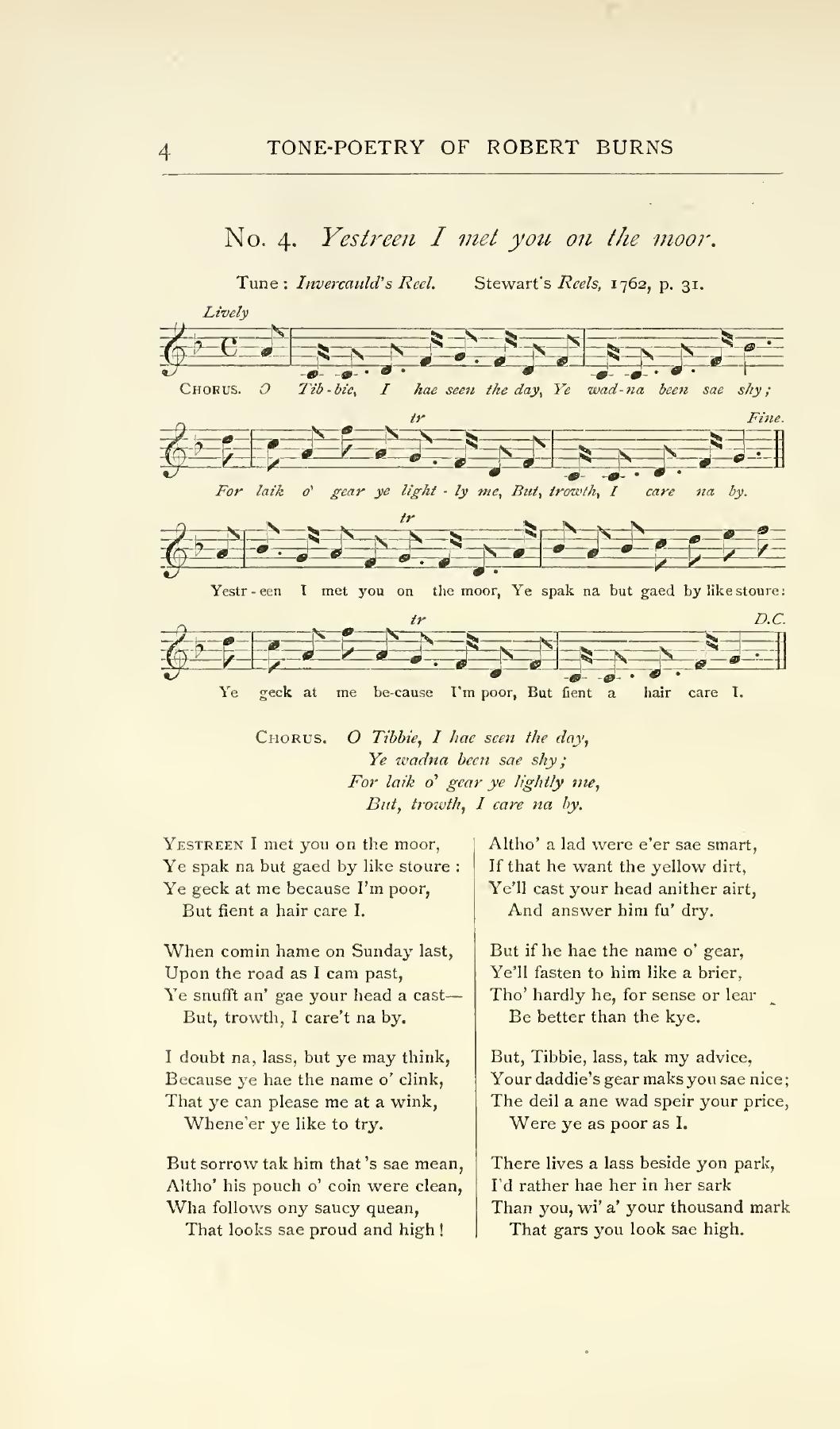 View score Dick’s Songs of Robert Burns (1903)
Lyrics
Dick (1903) · no. 4
CHORUS
O Tibbie, I hae seen the day,
Ye wadna been sae shy;
For laik o' gear ye lightly me,
But, trowth, I care na by.

Yestreen I met you on the moor,
Ye spak na but gaed by like stoure:
Ye geck at me because I'm poor,
But fient a hair care I.

When comin hame on Sunday last,
Upon the road as I cam past,
Ye snufft an' gae your head a cast—
But, trowth, I care't na by.

I doubt na, lass, but ye may think,
Because ye hae the name o' clink,
That ye can please me at a wink,
Whene'er ye like to try.

But sorrow tak him that's sae mean,
Altho' his pouch o' coin were clean,
Wha follows ony saucy quean,
That looks sae proud and high!

Altho' a lad were e'er sae smart,
If that he want the yellow dirt,
Ye'll cast your head anither airt,
And answer him fu' dry.

But if he hae the name o' gear,
Ye'll fasten to him like a brier,
Tho' hardly he, for sense or lear,
Be better than the kye.

But, Tibbie, lass, tak my advice,
Your daddie's gear maks you sae nice;
The deil a ane wad speir your price,
Were ye as poor as I.

There lives a lass beside yon park,
I'd rather hae her in her sark
Than you, wi' a' your thousand mark
That gars you look sae high.
View the source edition · Dick1903 no. 4; p. 4
About this edition
Syllables separated by the musical notation are joined into words in this reading.
Music
View historical scores
Dick’s Songs of Robert Burns (1903)
Dick1903 no. 4; p. 4