O That I Had Ne'er Been Married
Behind the song
Every time the singer complains about marriage, his family calls for crowdie, an oatmeal dish. By the last verse he seems to be holding the door against hunger itself. [1]
Read the fuller story
The opening can sound like a familiar grumble about the cost of family life. “Weans” means children, and the chorus counts their demands once, twice and three times a day. Its repeated word, crowdie, begins to consume the song just as the food consumes the meal supply. The singer complains that another demand will use it all up. Repetition makes the pressure audible. [1]
The final quatrain changes the scale of that anxiety. Want and hunger are imagined as figures glaring from the edge of the home. He fights them at the door, yet remains frightened that they will come inside. “Fley” means frighten, “fecht” means fight and “eerie” here means fearful. The person who began by blaming marriage is now trying to protect the household against deprivation. That turn gives the short song its emotional weight. [1]
Dick brackets the first stanza and chorus together. His note places those inherited lines in Herd’s manuscript and assigns only the final stanza to Burns. The division is significant for the reading: the older complaint about marriage and food is followed by the vivid picture of a threatened household which Dick identifies as Burns’s addition. [1][2]
Dick also quotes a letter to Mrs Dunlop dated 15 December 1793. In the passage he prints, Burns describes the prolonged illness of his youngest child and his fears about what would happen to his children if he died. The letter turns from those anxieties to the old song and quotes its opening stanza. This is a close connection between the song and family care, preserved here through Dick’s quotation of the correspondence. It helps explain why a comic complaint could carry a more serious burden. [2]
The setting is headed “Crowdie” and marked “Slowly”. Dick reports that the Museum gave the music a livelier direction, which he considered at odds with the song’s feeling. His own printed pace allows the last stanza’s fear to linger. Across just two stanzas and a chorus, the repeated demands for food become part of a struggle to keep hunger from crossing the threshold. [1][2]
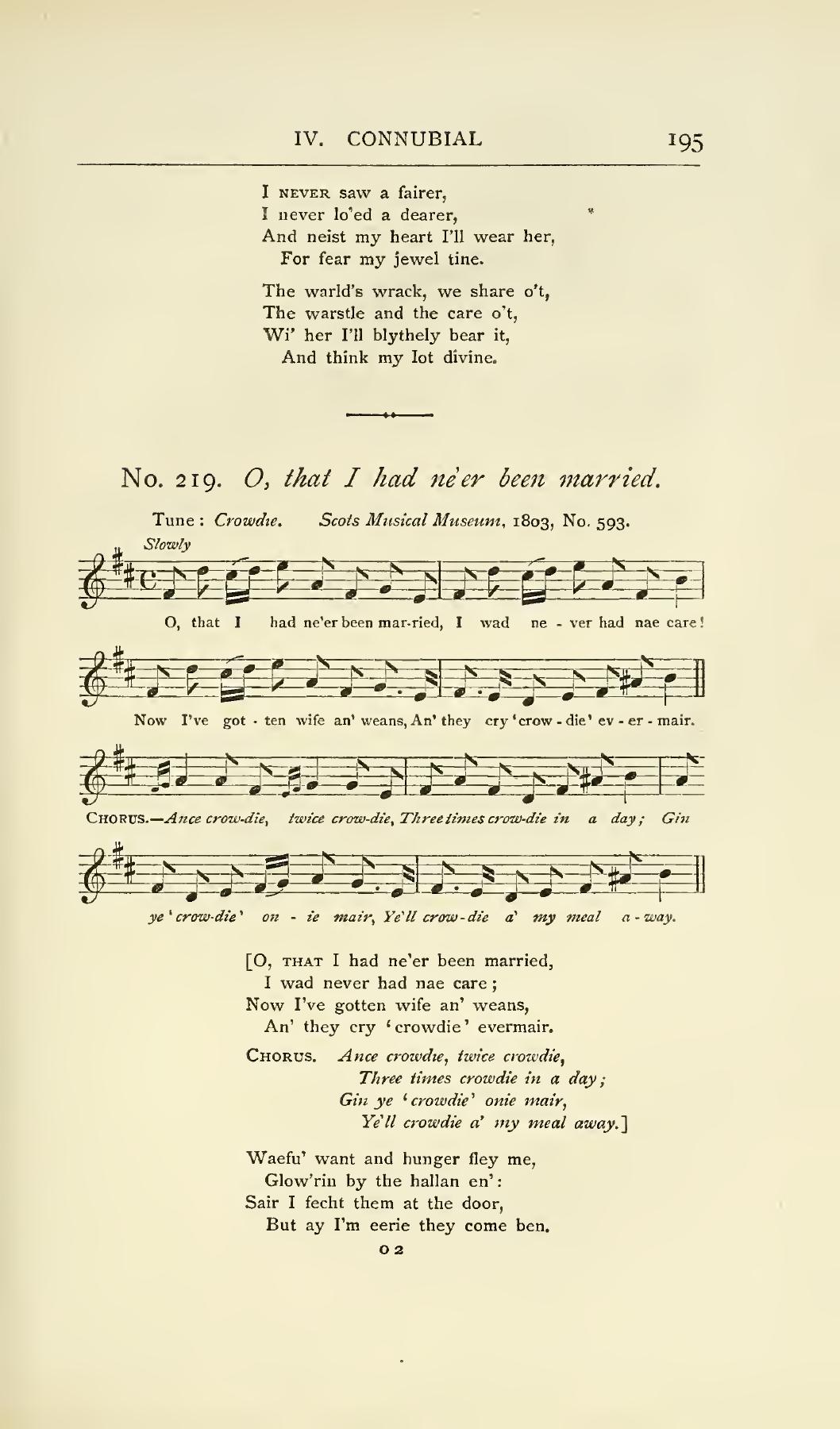 View score Dick’s Songs of Robert Burns (1903)
Lyrics
Choose an edition
Dick (1903) · no. 219
[O, that I had ne'er been married,
I wad never had nae care;
Now I've gotten wife an' weans,
An' they cry 'crowdie' evermair.
CHORUS
Ance crowdie, twice crowdie,
Three times crowdie in a day;
Gin ye 'crowdie' onie mair,
Ye'll crowdie a' my meal away.]

Waefu' want and hunger fley me,
Glow'rin by the hallan en':
Sair I fecht them at the door,
But ay I'm eerie they come ben.
View the source edition · Dick1903 no. 219; p. 195
About this edition
Syllables separated by the musical notation are joined into words in this reading.
Scots Musical Museum, vol. VI (1839) · no. 593
View the source edition · p. 613
About this edition
Museum no. 593.
Music
View historical scores
Dick’s Songs of Robert Burns (1903)
Dick1903 no. 219; p. 195
Reworked or extended by Burns
The printed score credits Burns with revising the words.
Words Earlier words revised by Burns
Burns’s role Correction credited in the edition