There Was a Bonie Lass
Behind the song
Roaring cannon hold no fear for the soldier, but thoughts of the lass he has left behind can still overcome him. The song follows both lovers across a separation made by war. [1]
Read the fuller story
The opening lingers over the lass’s beauty, repeating “bonie” before saying how dearly she loves her lad. War then enters as a violent interruption, tearing him from her arms with sighs and tears. The movement is swift: private affection gives way to the noise and reach of conflict. “Frae” means from, and “monie” means many. The familiar Scots lets that loss remain personal even as the scene moves towards distant places. [1]
The second half follows him over sea and shore. Its expansive geography is answered by a very small emotional centre: the lass he loves. The cannon cannot frighten him, yet love can reach the breast that battle leaves unshaken. The last line returns to the opening figure, so that the whole eight-line fragment comes round to her again. The lyric leaves the lovers apart, with the strength of their attachment providing its close. [1]
The Museum prints “By R. Burns” above the song. Dick repeats that attribution but says that he found no further historical evidence for this fragment beyond the Museum’s marking. The earlier Museum commentary also assigns it to Burns. These printed attributions explain its place among his songs, while the circumstances of its composition remain uncertain. [2][3]
The two settings offer a striking difference in pace. The Museum page is marked “Rather Slow”, and its commentary describes the air as a favourite slow march. Dick’s setting says “Briskly”. A slower performance can dwell on the separation and the sustained affection; a brisker one can bring forward the lad’s movement through danger. Both editions print the same eight-line shape despite these different musical directions. [1][3]
Dick calls the tune “A bonie lass” and compares its opening section with “Pinky house”, citing eighteenth-century collections. He considers the second part apparently original. That is his account of the melody’s relationship to earlier music. For a listener, the song’s clearest turn remains the final one: martial courage gives way to the force of remembered love. [2]
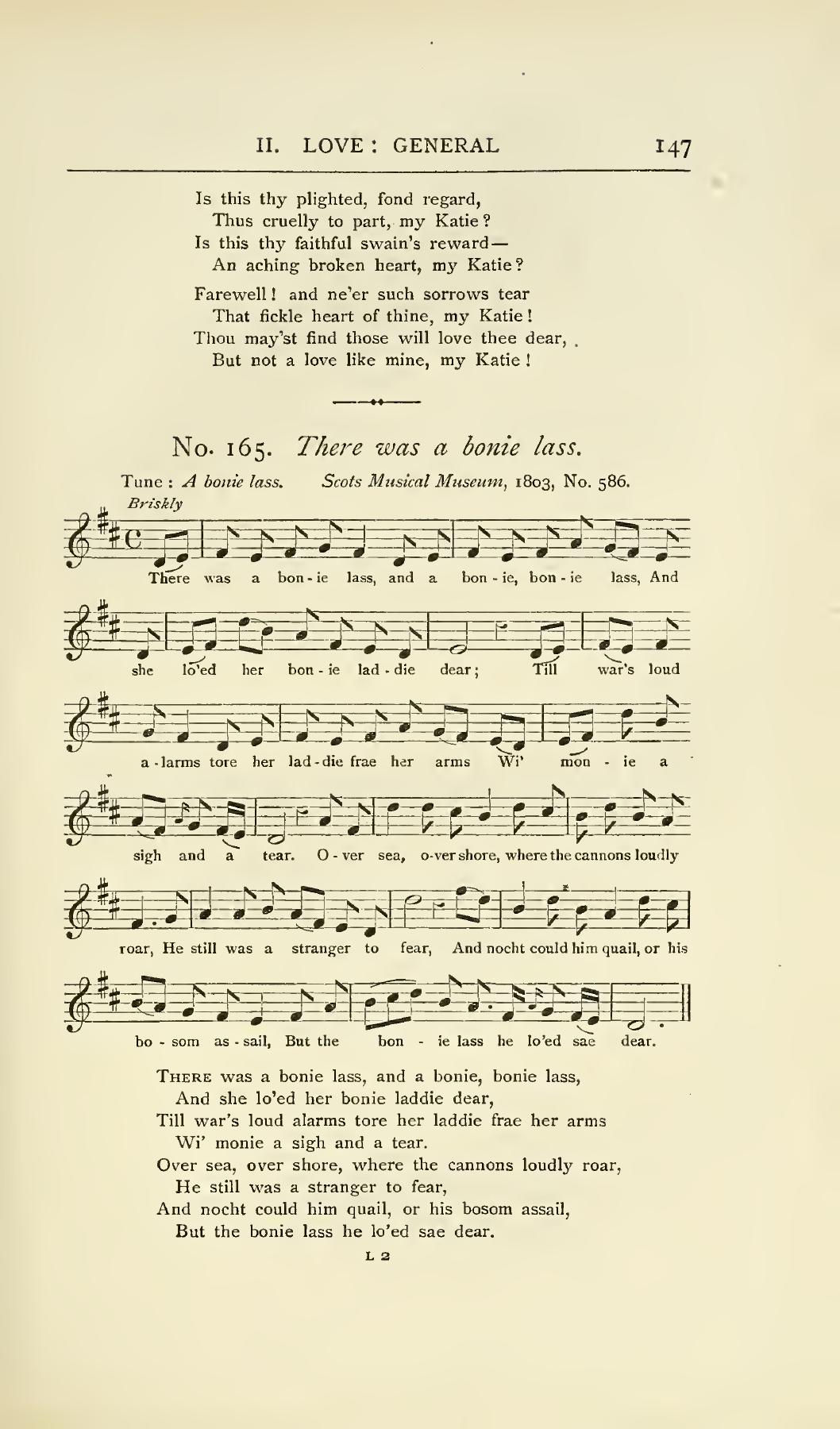 View score Dick’s Songs of Robert Burns (1903)
Lyrics
Choose an edition
Dick (1903) · no. 165
There was a bonie lass.
There was a bonie lass, and a bonie, bonie lass,
And she lo'ed her bonie laddie dear;
Till war’s loud alarms tore her laddie frae her arms,
Wi' monie a sigh and a tear.
Over sea, over shore, where the cannons loudly roar,
He still was a stranger to fear,
And nocht could him quail, or his bosom assail,
But the bonie lass he lo'ed sae dear.
Complete eight-line fragment as printed by Dick in 1903.
View the source edition · There was a bonie lass.; p. 147
About this edition
Complete eight-line fragment as printed by Dick in 1903.
Scots Musical Museum, vol. VI (1839) · no. 586
There was a bonie lass.
There was a bonie lass, and a bonie, bonie lass,
And she lo'ed her bonie laddie dear;
Till wars loud alarms tore her laddie frae her arms,
Wi' monie a sigh and a tear.
Over sea, over shore, where the cannons loudly roar;
He still was a stranger to fear:
And nocht could him quail, or his bosom assail,
But the bonie lass he lo'ed sae dear.
Complete eight-line fragment from the selected 1839 edition.
View the source edition · There was a bonie lass.; p. 606
About this edition
Complete eight-line fragment from the selected 1839 edition.
Music
View historical scores
Dick’s Songs of Robert Burns (1903)
There was a bonie lass.; p. 147
Credited to Burns in print
The printed score names Burns. How much he wrote or revised is uncertain.
Words Burns credited by the printed edition
Burns’s role Credited in print. The extent of his contribution is uncertain.