Scots, wha hae
Behind the song
Scots, wha hae gives Robert Bruce a voice on the edge of battle. He addresses men who have fought with Wallace, sets Edward’s advancing army before them and asks who will stand for Scotland. The short fourth line brings each verse to a decision: victory, flight, freedom or death. The song’s pressure comes from that repeated demand to choose. [1]
Burns framed the address around Bannockburn and the air Hey, tutti taitie. Dick prints a letter to George Thomson, assigned to September 1793, in which Burns describes an evening walk and a tradition that the tune had been Bruce’s march. The tradition helped him imagine the scene; Dick treats the supposed medieval use of the air as unproved. [2]
Read the fuller story
Dick also preserves John Syme’s different account, placing the song’s composition during a wet journey through Galloway in July 1793. The two accounts give the song a vivid later history of origin. The letter, as printed by Dick, makes liberty and independence the subjects that stirred Burns and refers to more recent struggles as well. Dick reads a connection with the French Revolution into that passage. [2]
The music became a point of contention. Dick recounts Thomson’s preference for Lewie Gordon and the lengthening of the fourth lines to fit it. His examples include “Or to glorious victory” and “Let him bravely follow me”. Those extra syllables change the clipped force of the address. Dick dates Thomson’s printing with Lewie Gordon to 1799 and his return to Hey, tutti taitie to 1801. [2]
The reading here follows Dick’s six quatrains and his score for Hey, tutti taitie. Cunningham’s “First Version” keeps the same sequence, with such differences as “our sons” where Dick has “your sons”. The speaker’s appeal moves from the assembled army to the freedom of the next generation. [1][3]
Story references
- James C. Dick, The Songs of Robert Burns (1903), no. 255: lyric and musical heading; printed pp. 231–231; PDF pp. 287–287.
- Dick (1903), historical note 255, printed 448, 449, 450, 451.
- Allan Cunningham, The Complete Works of Robert Burns (1855), printed 285; HTML #CCVI. Project Gutenberg transcription.
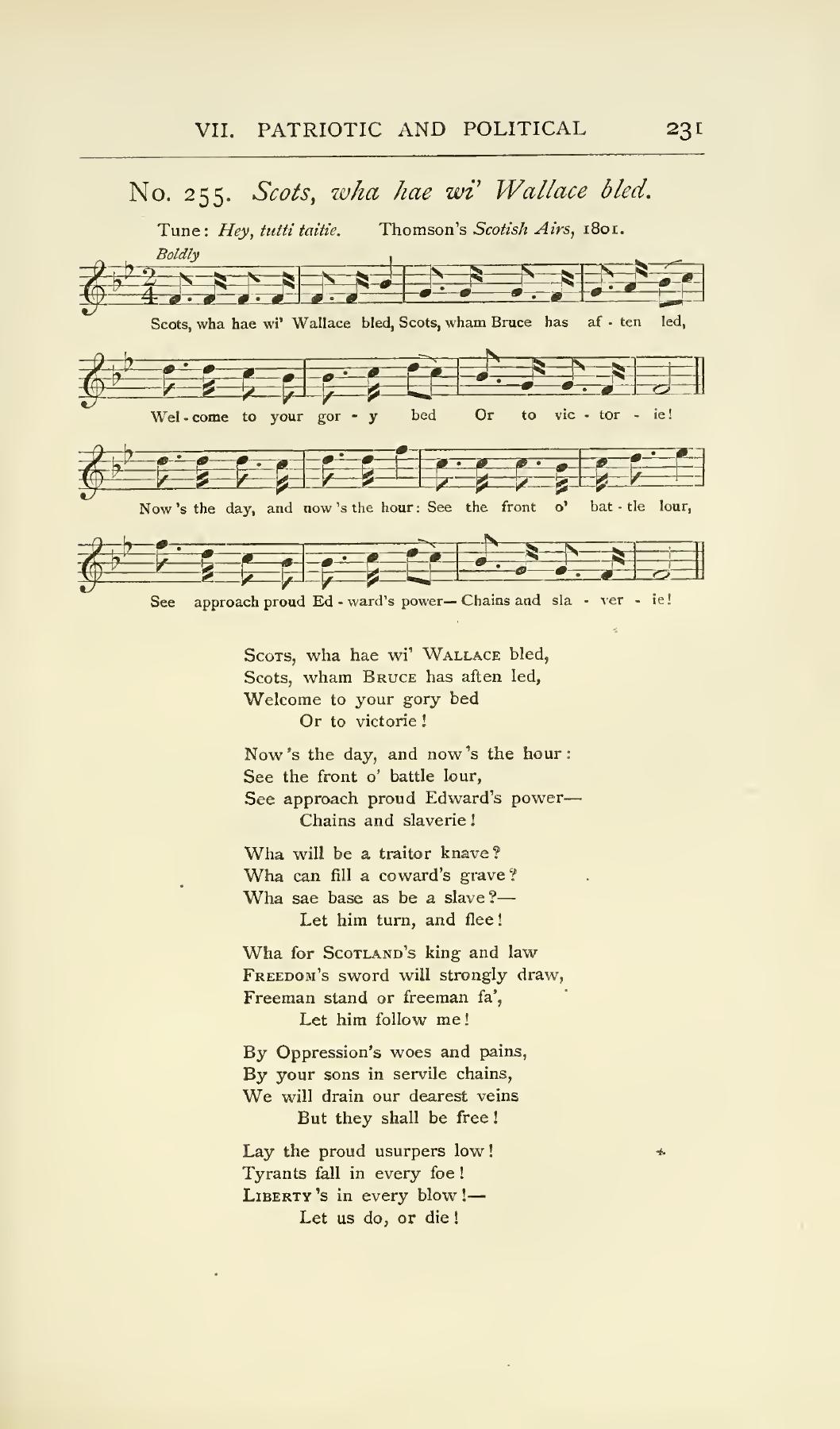 View score Dick’s Songs of Robert Burns (1903)
Lyrics
Choose an edition
Version notes
| Dick (1903) · no. 255 | Cunningham · 1855Ebook transcription |
|---|---|
| Wha will be a traitor knave? | Wha will be a traitor-knave? |
| Let us do, or die! | Let us do or die! |
Dick (1903) · no. 255
Scots, wha hae wi’ Wallace bled,
Scots, wham Bruce has aften led,
Welcome to your gory bed
    Or to victorie!

Now’s the day, and now’s the hour:
See the front o’ battle lour,
See approach proud Edward’s power—
    Chains and slaverie!

Wha will be a traitor knave?
Wha can fill a coward’s grave?
Wha sae base as be a slave?—
    Let him turn, and flee!

Wha for Scotland’s king and law
Freedom’s sword will strongly draw,
Freeman stand, or freeman fa’,
    Let him follow me!

By Oppression’s woes and pains,
By your sons in servile chains,
We will drain our dearest veins
    But they shall be free!

Lay the proud usurpers low!
Tyrants fall in every foe!
Liberty’s in every blow!—
    Let us do, or die!
View the source edition · no. 255; p. 231
About this edition
Cunningham labels this “First Version” and names Hey, tuttie taitie. His fifth stanza has “our sons”; Dick prints “your sons”. His final line has “Let us do or die!”; Dick inserts a comma. The separately catalogued Museum 1839 witness remains available with its inherited screening status.
Scots Musical Museum, vol. VI (1839) · no. 577
View the source edition · p. 596
About this edition
Museum no. 577.
Cunningham (1855)
Scots, wha hae wi’ Wallace bled,
Scots, wham Bruce has aften led;
Welcome to your gory bed,
  Or to victorie!

Now’s the day, and now’s the hour;
See the front o’ battle lour:
See approach proud Edward’s pow’r—
  Chains and slaverie!

Wha will be a traitor-knave?
Wha can fill a coward’s grave?
Wha sae base as be a slave!
  Let him turn and flee!

Wha for Scotland’s king and law
Freedom’s sword will strongly draw,
Freeman stand, or freeman fa’,
  Let him follow me!

By oppression’s woes and pains!
By our sons in servile chains!
We will drain our dearest veins,
  But they shall be free!

Lay the proud usurpers low!
Tyrants fall in every foe!
Liberty’s in every blow!—
  Let us do or die!
Digital text from Project Gutenberg.
View the source edition · p. 285
About this edition
Cunningham labels this “First Version” and names Hey, tuttie taitie. His fifth stanza has “our sons”; Dick prints “your sons”. His final line has “Let us do or die!”; Dick inserts a comma. The separately catalogued Museum 1839 witness remains available with its inherited screening status.
Music
View historical scores
Dick’s Songs of Robert Burns (1903)
no. 255; p. 231
Credited to Burns in print
The printed score names Burns. How much he wrote or revised is uncertain.
Words Burns credited by the printed edition
Burns’s role Credited in print. The extent of his contribution is uncertain.