My Lady's Gown There's Gairs upon't
Behind the song
The lady wears gold flowers on her gown and brought land to the marriage. The song says it was her land that caught her husband’s eye. Now he goes hunting towards Colin’s cottage, knowing what he hopes to find there if Jenny is home. [1]
Read the fuller story
The lady has beauty and kinship with Cassillis, yet the lyric says her dowry lands were the charms her husband loved. Jenny receives a different kind of portrait: a lily beyond the moor and moss, with graceful movement and laughing blue eyes. The last verse praises the lass a man loves best before returning to the opening comparison of the two women’s clothes.
Cunningham credits Burns with most of the song, describing his correction of improprieties and his additions to an older strain before its publication in the Museum. That account combines substantial new writing with revision of inherited material.[1]
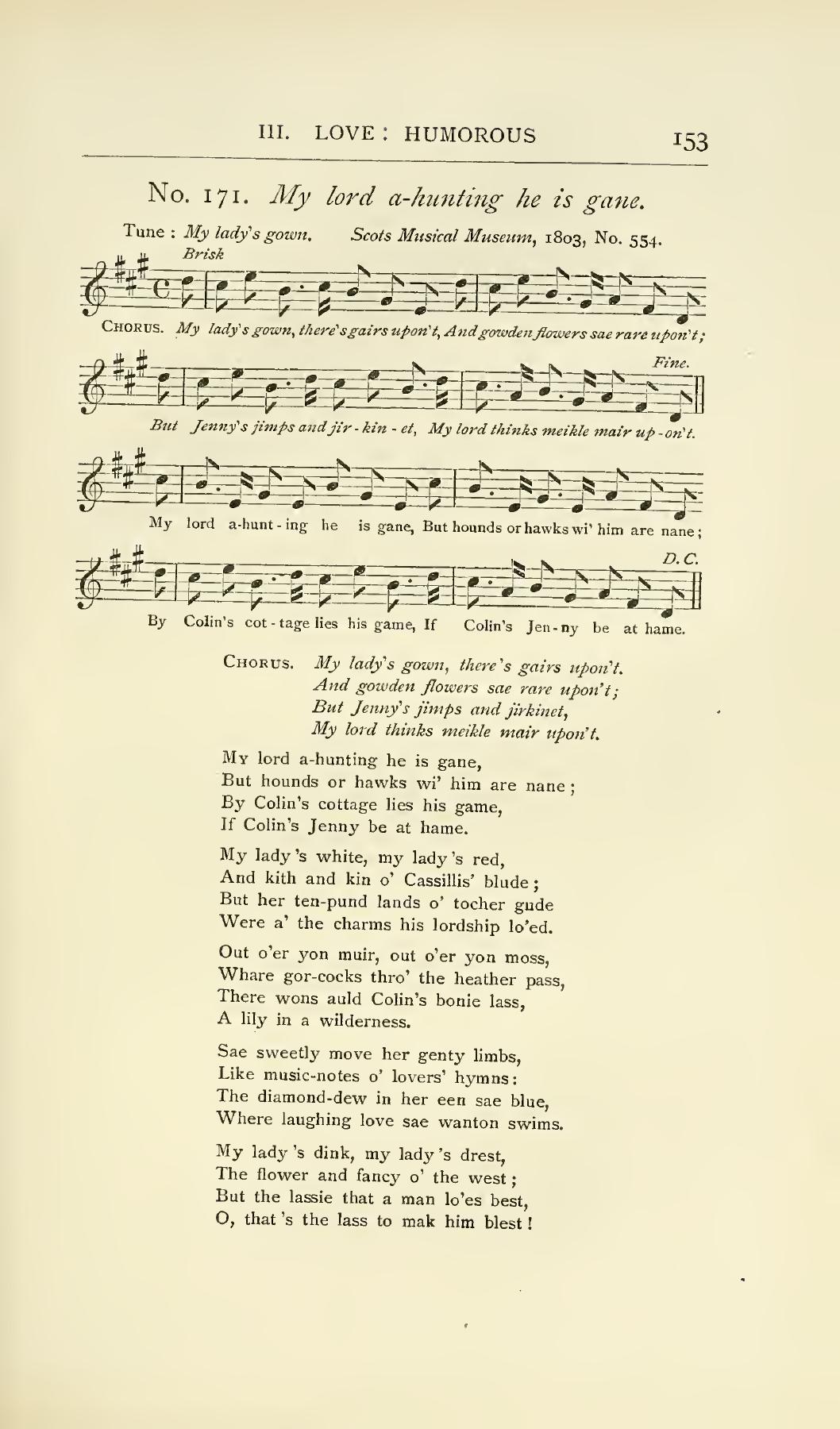 View score Dick’s Songs of Robert Burns (1903)
Lyrics
Choose an edition
Cunningham (1855)
My lady’s gown, there’s gairs upon’t,
And gowden flowers sae rare upon’t;
But Jenny’s jimps and jirkinet,
My lord thinks meikle mair upon’t.
My lord a-hunting he is gane,
But hounds or hawks wi’ him are nane;
By Colin’s cottage lies his game,
If Colin’s Jenny be at hame.

My lady’s white, my lady’s red,
And kith and kin o’ Cassillis’ blude;
But her ten-pund lands o’ tocher guid
Were a’ the charms his lordship lo’ed.

Out o’er yon muir, out o’er yon moss,
Whare gor-cocks thro’ the heather pass,
There wons auld Colin’s bonnie lass,
A lily in a wilderness.

Sae sweetly move her genty limbs,
Like music notes o’ lovers’ hymns:
The diamond dew is her een sae blue,
Where laughing love sae wanton swims.

My lady’s dink, my lady’s drest,
The flower and fancy o’ the west;
But the lassie that a man lo’es best,
O that’s the lass to make him blest.
My lady’s gown, there’s gairs upon’t,
And gowden flowers sae rare upon’t;
But Jenny’s jimps and jirkinet,
My lord thinks meikle mair upon’t.
Digital text from Project Gutenberg.
View the source edition · p. 272
About this edition
Cunningham’s preface discusses several poems he left out of the collection.
Dick (1903) · no. 171
The words are on the score page.
View the source edition · no. 171; p. 153
Scots Musical Museum, vol. VI (1839) · no. 554
View the source edition · p. 573
About this edition
Museum no. 554.
Music
View historical scores
Dick’s Songs of Robert Burns (1903)
no. 171; p. 153
Reworking attributed to Burns
Cunningham credits Burns with most of the words while describing revision and additions to an older strain.
Words Robert Burns and the earlier song tradition
Burns’s role Reworking attributed to Burns